


More news on this day
Europe’s new biometric border regime is colliding with the peak holiday season, as European Union institutions hold firm on the Entry/Exit System even while acknowledging widespread congestion and growing traveler frustration.
Get the latest news straight to your inbox!
EU Digs In On Biometric Border Controls
The Entry/Exit System, a long-planned biometric database for most non-EU visitors to the Schengen area, became fully operational in April 2026 after a phased rollout. The system replaces manual passport stamping with digital records of each border crossing, including fingerprints and facial images for many travelers. Publicly available information shows that officials in Brussels view EES as central to tightening migration control, combating document fraud, and tracking overstays.
In recent days, reports indicate that the European Commission has rejected calls from airlines and airports to suspend EES for the core summer months. Coverage in European media describes messages to industry representatives that a full suspension is “not needed” and “not possible,” even as the Commission concedes that there are multiple “difficult spots” where queues and processing times remain problematic.
The decision keeps the political priority firmly on border security and data accuracy, even when it clashes with short-term operational realities at busy hubs. For travelers, this means the new system is here to stay for the 2026 season, with only limited local flexibility when lines become unmanageable.
The stance also reflects years of investment and repeated delays to the launch. Official documents and prior statements have framed EES as a cornerstone of a broader digital overhaul of Schengen borders, and abandoning or pausing it at the first sign of stress could undermine that wider agenda.
Summer Disruption Spreads Across Key Gateways
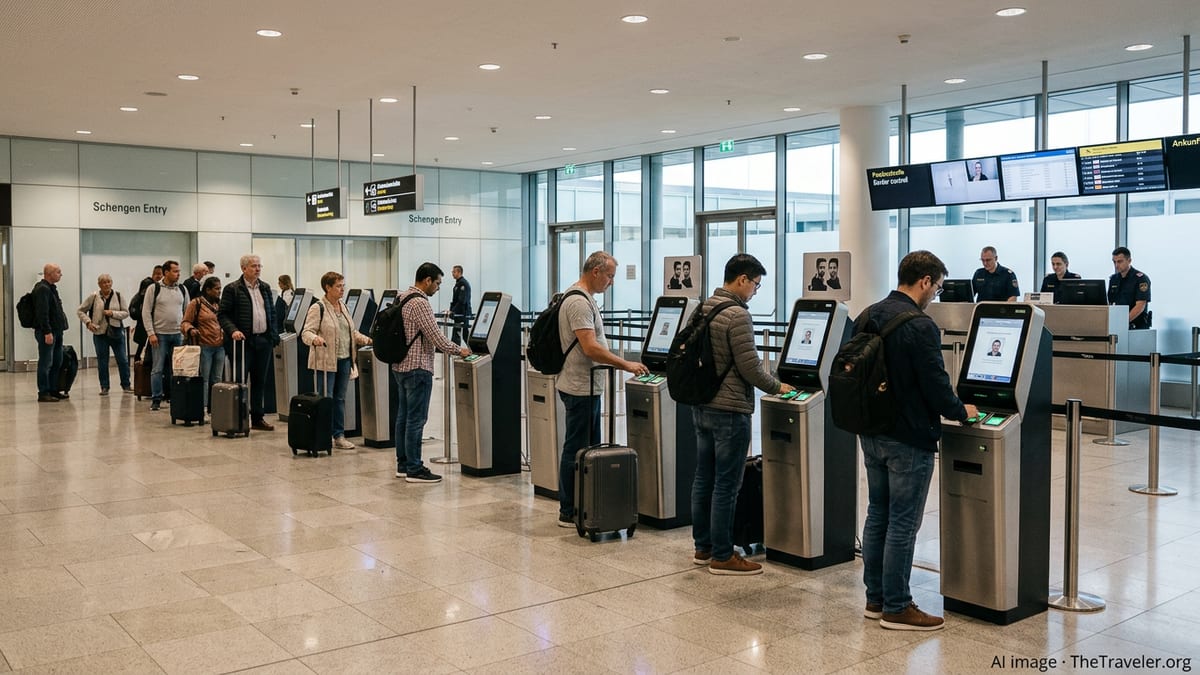
As schools break up and leisure traffic surges, EES-related disruption is surfacing from major hubs and tourist gateways around the continent. Coverage from Euronews and other outlets highlights reports of waits approaching or exceeding two hours at peak times, particularly where infrastructure and staffing have not kept pace with the new requirements.
Industry groups say the most severe issues are arising in terminals that lack enough automated kiosks, trained border guards, or space to channel large numbers of novice users through fingerprinting and photo capture. Smaller airports serving popular beach and city destinations appear especially vulnerable, as they handle intense seasonal spikes with more limited resources.
In Italy, recent reporting on Rome’s airports describes warnings of a potential summer “disaster,” with operators arguing they may need to bypass the new digital checks at times to keep passenger flows moving. Similar concerns are being voiced for Spanish, Portuguese, and Greek gateways that welcome large numbers of UK and other non-EU tourists who now fall under the regime.
For travelers, the practical impact is most evident at first entry into the Schengen area this year, when full biometric enrolment is required. Subsequent trips should be faster, but for many holidaymakers arriving for the first time in 2026, that initial registration is colliding directly with peak travel demand.
Airlines And Airports Push For A Summer Pause
Europe’s aviation sector has mounted an unusually united campaign for relief. Joint letters and public statements from Airlines for Europe, Airports Council International Europe, and the International Air Transport Association warn that EES is already causing missed flights, connection failures, and knock-on disruption across schedules.
Their core demand has been for broad permission to fully suspend EES checks whenever queues pass a defined threshold, not only at a handful of designated bottlenecks. According to published coverage, industry groups argue that partial or piecemeal suspension will not be sufficient to prevent extensive delays during July and August, when traffic typically reaches its annual peak.
Individual carriers have gone further. Ryanair, for example, has issued multiple public appeals for governments to postpone or pause EES until September to avoid what it describes as “queue chaos” for families at passport control. Airport operators at some major hubs have similarly warned of reputational damage if travelers associate European holidays with hours of border hold-ups.
Despite that pressure, the EU line has not shifted. Public comments from Brussels emphasize that while technical issues and staffing gaps are real, they should be addressed through extra resources, better procedures, and targeted flexibilities rather than by shelving the system altogether for the summer.
Limited Flexibility Leaves Travelers In The Middle
While rejecting a blanket suspension, the EU has allowed some room for maneuver. A regulation adopted in 2025 set out a “progressive” start of operations for EES and permits member states, for a limited period, to partially or even fully suspend the system at particular border points if waiting times become excessive. Recent communications indicate that this discretion can still be used for up to several months after full rollout.
In practice, this has led to a patchwork of approaches. Some countries have quietly relaxed biometric checks at the busiest times or shifted certain passenger flows back to traditional stamping to clear backlogs. Others, including popular holiday destinations, have publicly signaled that they do not intend to suspend the new system and will instead try to manage through with additional staff and infrastructure.
The result is that travelers face an uneven experience across Europe. Two airports serving similar volumes may handle the same EES rules very differently, depending on staffing levels, layout, and national policy choices. Frequent flyers report breezing through certain hubs with minimal delay while encountering gridlock at others only days later.
Consumer advocates note that this uncertainty complicates trip planning, particularly for tight connections or same-day onward travel by rail or ferry. With no continent-wide suspension on the horizon, passengers are being advised in media reports to allow extra time at border control, especially when entering the Schengen area for the first time since EES became fully active.
What Travelers Should Expect For The Rest Of 2026
Looking ahead to the remainder of the year, publicly available information suggests that EES will remain a fixture at Europe’s external borders, with only targeted relief where conditions are judged unmanageable. The current flexibility for partial suspension is time-limited, and several reports indicate that this window is scheduled to close after the main summer and early autumn period.
EU agencies involved in border management argue that teething troubles will diminish as both technology and user familiarity improve. Officials have pointed to a learning curve for first-time users and for border guards, predicting that registration will speed up as more travelers have their biometric profiles stored and can be verified instead of enrolled.
For now, though, the burden of adjustment is falling on passengers. Travel coverage across Europe is advising non-EU visitors to check in earlier, avoid overly tight connections, and be prepared for the possibility of long lines at the first Schengen border crossing on any itinerary. Those routing via smaller tourist airports may wish to pay particular attention to local reports on recent wait times.
The broader message is that Europe is prioritizing long-term border digitization over short-term comfort, at least for this summer. For millions of holidaymakers heading to beaches and cities across the continent, that choice is likely to be felt most acutely at the passport queue.