

More news on this day
Non EU visitors arriving in Europe this year are encountering a radically different border experience, as a new biometric Entry/Exit System pairs with a dedicated mobile travel app to cut queues and move passport checks onto smartphones before take off.
Get the latest news straight to your inbox!
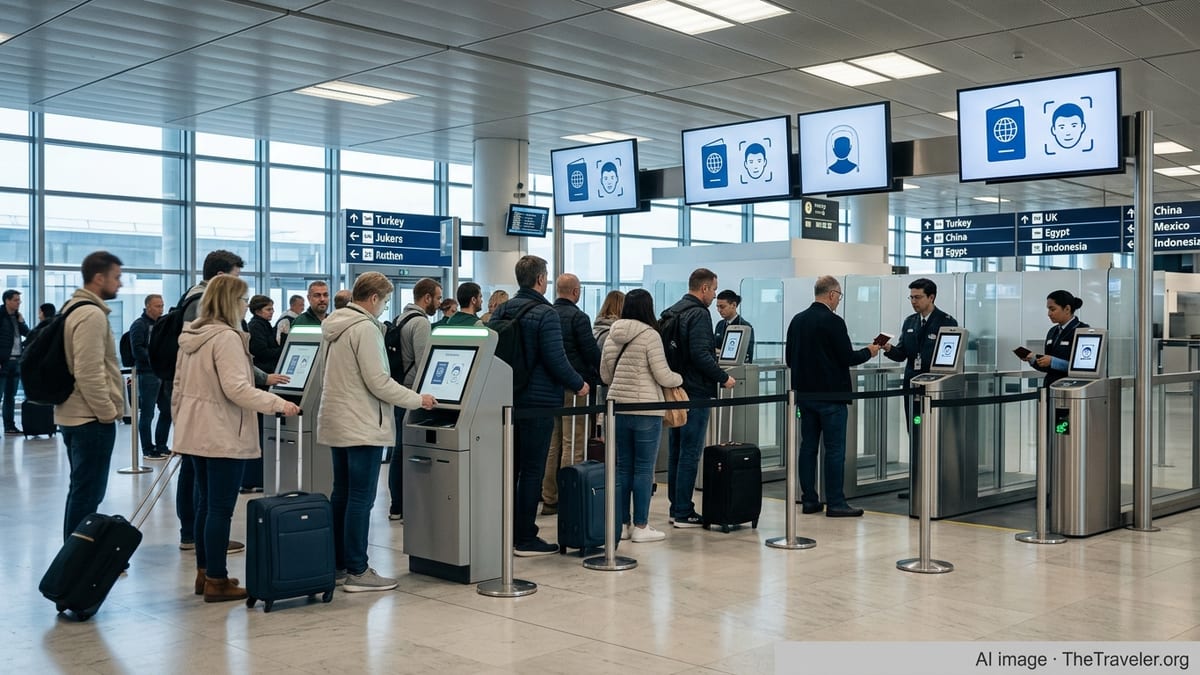
Digital Border Controls Go Live Across Europe
The European Union’s long planned Entry/Exit System is now fully operational at external Schengen borders, replacing routine passport stamping for most non EU short stay visitors with biometric registration. Publicly available information from the European Commission describes the system as recording each traveller’s identity data, the time and place of crossing, and a combination of facial and fingerprint biometrics in a shared database managed at EU level.
The roll out, completed on 10 April 2026 after a phased introduction at select airports in late 2025, represents the most significant overhaul of Europe’s border checks in decades. For travellers, the change is most visible at automated e gates, where cameras now capture a live facial image and compare it with the biometric passport and the new database record, rather than relying solely on visual inspection and ink stamps.
Member states and travel industry reports have highlighted that the switch to biometrics initially generated longer queues at some busy hubs as equipment and staff routines bedded in. In response, attention has quickly focused on digital tools that shift part of the process away from the border booth and into travellers’ hands before they arrive.
‘Travel to Europe’ App Brings Pre Registration to Tourists’ Phones
At the centre of this shift is the new Travel to Europe mobile app, developed under the coordination of Frontex and the European Commission for non EU nationals subject to Entry/Exit System checks. Official guidance describes the app as a way for travellers to pre register their passport details, travel plans and facial image within a limited window before reaching the border, generating a digital token to be scanned at dedicated lanes.
According to information published on the EU’s own travel portal, the app does not replace border controls or guarantee entry. Instead, it is designed to reduce the time spent at kiosks by front loading data entry and certain questionnaire steps to a secure smartphone interface. Travellers who complete the process receive a QR style code or confirmation screen that can be presented alongside their passport when they reach the terminal.
The tool is currently aimed at visitors from visa exempt and visa required third countries alike, provided they carry a biometric passport and are required to register in the Entry/Exit System. National authorities stress that those who do not wish to use the app can still complete all steps at the airport or land crossing, although they may face longer waits at peak times.
Early Results: Queues Shrink at Pilot Airports
Initial results from early adopting airports suggest the combination of pre registration and biometric fast track lanes can materially reduce waiting times. Travel industry coverage from Portugal indicates that Lisbon’s Humberto Delgado Airport, one of the first to deploy the Travel to Europe app for arriving non EU passengers, has recorded border processing times dropping from more than ten minutes on average to under five for travellers who completed the app steps in advance.
Reports from airlines and local travel media describe a two lane experience in practice. Passengers who have pre registered use app designated gates or counters, where border staff or automated kiosks scan a QR code and capture or verify biometrics, while other visitors continue to queue in traditional non EU lines. For mixed nationality groups, families are often able to stay together by opting into the same digital channel.
Other participating airports in Sweden and several Mediterranean destinations are reported to be following similar models, with some framing the app registration as an additional, optional step in online check in flows. Industry observers suggest that as adoption grows and travellers become familiar with the process, the time saving gap between app users and non users is likely to widen further.
Fast Track Promise Tempered by Patchy Coverage
Despite the headline of a Europe wide travel app, coverage remains uneven. Public information from the Commission and several member states shows that Ireland and Cyprus are not part of the Entry/Exit System and continue to apply manual border checks, meaning the app offers no benefit for trips that only involve those countries. In addition, some smaller airports and land crossings are still phasing in equipment and procedures.
Local news outlets in Central Europe also note that, in certain cities, the Travel to Europe app is technically available but not yet integrated with airport infrastructure, leaving travellers confused when they arrive with a QR code but find no separate lane. Border authorities in these locations continue to use the underlying Entry/Exit System through staffed booths and standard kiosks, sometimes resulting in the very queues the app is intended to ease.
The fragmented picture reflects how border management remains a shared responsibility between EU bodies and national governments. While the common system and app exist at EU level, each state must connect its own installations, train personnel and decide how prominently to promote pre registration tools to incoming visitors.
What Tourists Need to Know Before Summer
For travellers planning European trips in 2026, publicly available guidance generally recommends checking whether the Travel to Europe app is supported at the first point of entry into the Schengen area and completing registration within the permitted window before travel if possible. Those arriving at large hubs where the app is fully integrated are likely to see the greatest benefit, especially during school holidays and major events when non EU lines historically stretch for an hour or more.
Prospective visitors should also be aware that biometric registration under the Entry/Exit System is compulsory for most non EU nationals on short stays, regardless of whether they use the app. The first trip after the system’s introduction typically takes the longest, as both facial and fingerprint data need to be captured and stored, but subsequent visits should be quicker because only verification is required.
Looking ahead, the travel technology landscape around Europe’s borders is set to evolve further. The forthcoming European Travel Information and Authorisation System, an online pre clearance requirement for visa exempt travellers now scheduled for late 2026, is expected to sit alongside the Entry/Exit System and the mobile app. Together, these tools point toward a future in which much of the paperwork and data collection traditionally handled at border booths occurs well before passengers reach the airport, with biometric fast track processing turning the promise of shorter queues into a routine reality.