

More news on this day
The Federal Aviation Administration has issued new safety alerts highlighting a series of surface “hot spots” at San Francisco International Airport and Los Angeles International Airport, drawing fresh attention to collision risks at two of the nation’s busiest hubs.
Get the latest news straight to your inbox!
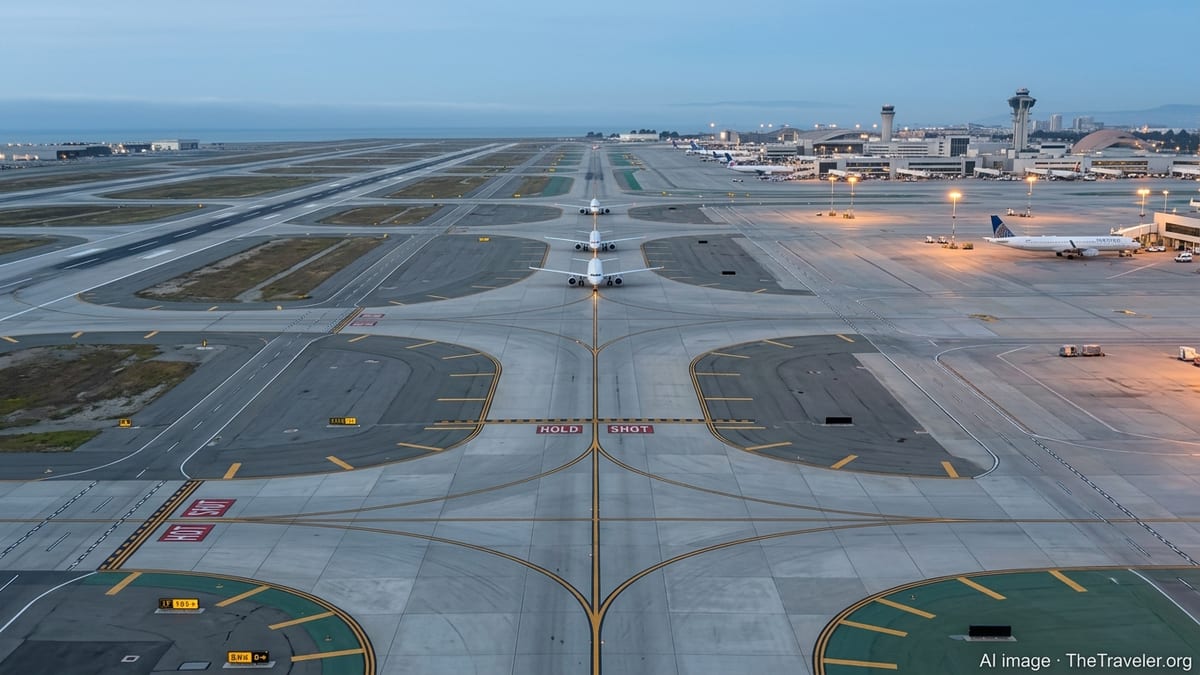
Renewed Focus on Ground Collision Risk at Major California Hubs
Publicly available FAA safety material describes an airport hot spot as a location on a movement area with a history or potential risk of collision or runway incursion where pilots and vehicle operators must exercise heightened attention. These areas often involve complex or confusing intersections between taxiways and runways that have previously contributed to close calls.
Recent FAA charts and runway safety publications show that both San Francisco International Airport and Los Angeles International Airport feature multiple designated hot spots, reflecting their dense traffic, intersecting layouts, and frequent configuration changes tied to construction and weather. The latest alert packages direct pilots and ground operators to review updated airport diagrams and hot spot symbology before operating at either airport.
Safety briefings emphasize that hot spots remain charted until the underlying risk has been reduced or eliminated. In practice, that means several locations at SFO and LAX have been flagged over multiple chart cycles, signaling persistent complexity in how aircraft taxi, line up, and cross active runways.
The FAA’s runway safety materials note that misaligned takeoffs, incorrect runway entries, and taxiway landings have all been traced back to poor awareness of hot spots. The new alerts urge operators to integrate hot spot reviews into preflight planning, arrival briefings, and taxi checklists rather than treating them as optional background information.
San Francisco’s Parallel Runways and History of Near Misses
San Francisco International is known for its closely spaced parallel runways and high volume of arrivals, particularly during good visual weather when simultaneous approaches are common. According to published coverage of past incidents, the airport has experienced several high profile near collisions, including events linked to wrong-surface alignment and runway incursion hazards.
Current FAA diagram notes highlight hot spots around key runway crossings and taxiway intersections that feed the 28 and 10 runway complexes. These are areas where pilots must navigate tight turns, short hold lines, and frequent crossing clearances, often while monitoring multiple frequencies and managing congested ground traffic.
Runway safety bulletins indicate that the combination of complex geometry and heavy schedules can increase the risk that a crew lines up on an incorrect surface or crosses a runway without full situational awareness. At SFO, low clouds and shifting winds can compound that risk by forcing rapid configuration changes as controllers move arrivals and departures between runway pairs.
Recent safety outreach directed at operators into San Francisco has urged more detailed briefings on taxi routes, explicit discussion of hot spot locations, and a willingness to stop and ask for clarification if signage or markings appear confusing. Training guidance also encourages crews to use airport moving-map displays when available to confirm positions near charted hot spots.
Complex Taxi Network at LAX Under Scrutiny
Los Angeles International features four parallel runways and an extensive network of high speed taxiways supporting a global hub operation. FAA hot spot designations at LAX focus on areas where closely spaced taxiways intersect or where aircraft must cross multiple runways in sequence to reach terminals on the opposite side of the airfield.
Runway safety documents point to the western and northern portions of the field as especially demanding, with multiple hold-short lines, offset intersections, and frequent changes in taxi instructions as traffic builds. In these areas, the potential for an aircraft to stop at the wrong line, enter a runway without clearance, or follow an adjacent taxiway by mistake is elevated.
Public guidance to pilots stresses the need for precise readbacks of taxi and crossing clearances at LAX, with particular attention to runway numbers and hold points near hot spots. The FAA’s standardized hot spot symbology initiative seeks to make charted warnings more intuitive, so that a quick glance at the airport diagram highlights the most critical conflict points before a flight begins to taxi.
Industry commentary notes that as LAX continues to undergo terminal redevelopment and airfield construction, temporary changes in taxi patterns can themselves become new hot spots until crews gain familiarity. The latest alerts urge operators to pay close attention to notices about closed taxiways and shifting routes that may push more traffic through already sensitive areas.
Standardized Hot Spot Symbology and Pilot Training Efforts
The FAA has been working to standardize how hot spots are displayed on airport diagrams nationwide, moving toward clear circular or elliptical markings labeled with identifiers such as HS 1 or HS 2. Recent safety analysis documents explain that the goal is to give pilots a consistent, quickly recognizable cue that a particular intersection has an elevated collision or incursion risk.
According to published FAA safety newsletters, the agency is also encouraging operators to incorporate hot spot reviews into recurrent training, scenario based simulator sessions, and line oriented briefings. At airports like SFO and LAX, this can include practicing complex taxi routes, handling last minute runway changes, and recognizing when it is safer to stop and verify instructions than to rush through a confusing intersection.
Runway safety materials highlight the role of cockpit technology, including airport moving maps and electronic flight bags, in helping crews visualize their position relative to hot spots in real time. However, the FAA emphasizes that technology is a supplement to, not a substitute for, disciplined taxi procedures, careful sign and marking interpretation, and full attention to ground frequency communications.
Airlines and pilot groups have responded by issuing their own guidance that mirrors the FAA’s messages, encouraging standardized taxi briefings at high risk airports. For SFO and LAX, those briefings typically call out specific hot spot identifiers, expected taxi flows at peak times, and any construction that might alter familiar patterns.
Broader Safety Context After Recent U.S. Incidents
The renewed emphasis on hot spots at San Francisco and Los Angeles comes as the United States aviation system confronts a wider pattern of serious close calls and, more recently, a deadly midair collision near Washington, D.C. Public reports from safety investigators describe systemic challenges around controller staffing, traffic growth, and the limits of traditional “see and avoid” practices in congested airspace.
In this environment, runway and taxiway risks at major hubs are receiving heightened scrutiny. National runway safety campaigns underscore that ground incursions remain a significant contributor to high risk events, even as airborne collision avoidance systems and radar provide additional layers of protection once aircraft are off the surface.
For SFO and LAX, the latest FAA alerts fit into a broader push to tighten defenses long before a potential collision scenario develops. By signaling exactly where history and data show elevated risk, the agency aims to prompt both airlines and individual pilots to treat hot spots as critical briefing items rather than routine chart annotations.
Observers note that the practical impact of the new alerts will depend on how consistently air carriers, cargo operators, and general aviation users integrate them into daily operations. For travelers passing through the two California gateways, the changes are largely invisible, but they represent an effort to reduce underlying collision risk on the airfield as traffic volumes continue to climb.