

More news on this day
Finnair has temporarily suspended all flights to Doha and Dubai as fresh security concerns and widespread airspace closures across the Middle East disrupt global aviation, leaving travelers scrambling to adjust plans just as spring travel demand builds.
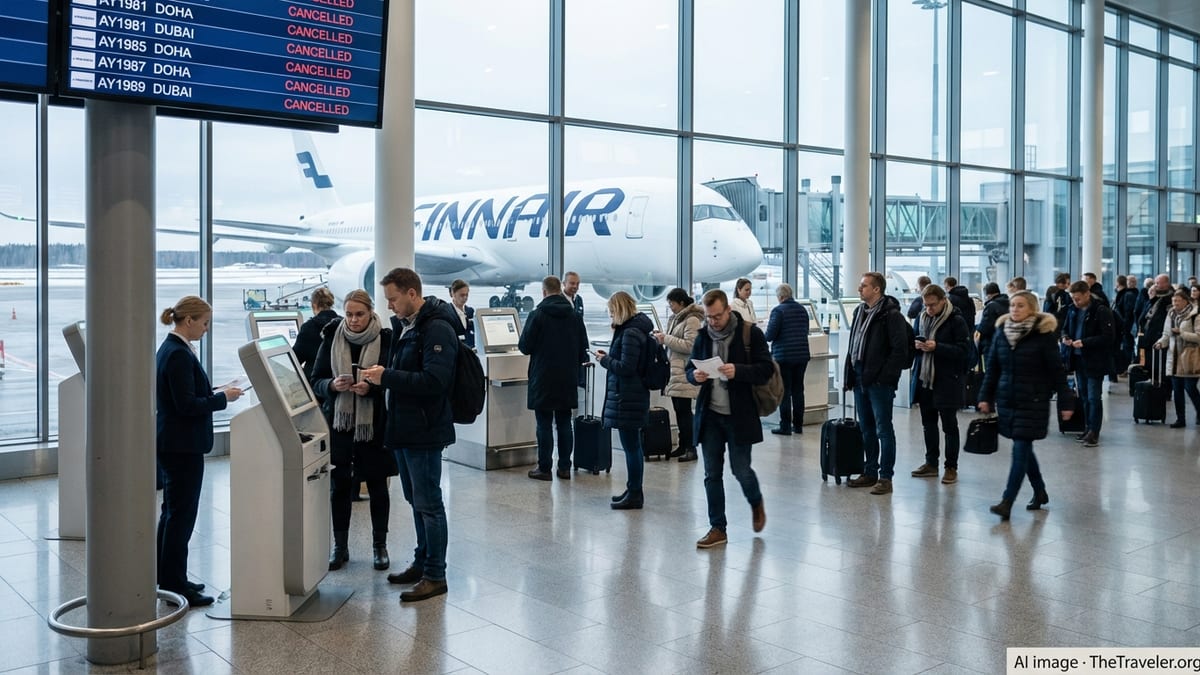
Finnair Extends Middle East Suspension as Airspace Risks Escalate
Finnair confirmed that all flights to and from Doha and Dubai are suspended between 28 February and 6 March 2026, citing the rapidly deteriorating security environment and evolving airspace restrictions across the region. The decision expands on earlier short-term cancellations and aligns the Finnish flag carrier with a growing list of European and Asian airlines temporarily withdrawing services to key Gulf hubs.
The move follows coordinated military strikes in the region and subsequent airspace closures by several Gulf states, which have prompted aviation safety regulators to warn of significantly elevated risks to civil aircraft operating over parts of the Middle East. Finnair said its network planning and safety teams have been continuously assessing routings and the availability of secure flight corridors, but concluded that operations to Doha and Dubai are not currently viable.
Finnair’s Middle East flights, which typically connect Helsinki with Qatar and the United Arab Emirates and feed long haul and partner networks, have been an important bridge for passengers traveling between Northern Europe, Asia and Africa. The temporary suspension therefore has knock-on effects across the carrier’s connecting traffic, increasing pressure on already constrained alternative routings that avoid conflict-affected airspace.
The airline has indicated that the current suspension window to 6 March will be reviewed as authorities issue updated safety guidance and as regional states reassess airspace closures. While Finnair has not ruled out an earlier restart if conditions improve, it has also warned that the disruption may extend further if risk levels remain high.
Safety First as European and Regional Airlines Reroute or Halt Services
Finnair’s decision comes against the backdrop of broad turbulence in Middle East aviation, with regional carriers and European airlines simultaneously suspending or heavily rerouting flights involving Gulf airspace. Aviation safety bulletins have highlighted a high risk to civil operations in certain conflict-adjacent flight information regions, prompting airlines to divert traffic or avoid the area entirely.
Data from industry analytics firms over the weekend indicate that hundreds of flights into and out of the wider Middle East were cancelled in a matter of hours as airspace restrictions took hold. Services to Qatar and the United Arab Emirates, including Doha, Dubai and other major hubs, have been among the hardest hit, with cancellations rippling through airline schedules on both sides of the region.
For Finnair, which already faces longer routings on some Asia services due to ongoing limitations on Russian airspace, the new Middle East constraints remove another critical transit corridor. Analysts note that the cumulative effect is higher fuel burn, reduced aircraft utilization and tighter scheduling margins, all of which make it harder to maintain reliable long haul operations while preserving safety buffers.
Aviation experts say that while most carriers have robust contingency plans, the layering of multiple conflict zones along traditional east–west routes is creating unprecedented complexity. In that context, Finnair’s conservative approach to Doha and Dubai services is widely seen as an extension of its safety-first posture, prioritizing risk mitigation over near-term commercial considerations.
Cancellations, Refunds and Rebooking: What Finnair Travelers Can Expect
Finnair has outlined a suite of options for passengers holding tickets to or from Doha and Dubai on affected dates, starting with automatic cancellation of the disrupted flights and the offer of either rebooking or a refund. Customers booked to travel during the suspension window can typically move their journey to a later date on the same route, subject to availability, without additional change fees.
For travelers whose itineraries relied on Doha or Dubai as connecting points, Finnair is working to reroute journeys via alternative hubs where safe and operationally feasible. In some cases this may involve rebooking onto other Finnair services that avoid the affected airspace, while in others it could mean travel on partner airlines under existing cooperation agreements, provided those carriers are still operating suitable routes.
Passengers who prefer not to travel in light of the security situation can request a refund for the unused portion of their ticket. Finnair has encouraged customers to initiate changes through its digital channels where possible, including managing bookings online and using self-service tools, in order to ease pressure on call centers facing high volumes of inquiries.
The airline is also reminding travelers whose journeys begin with flights to or from Doha and Dubai to avoid heading to the airport before confirming their updated arrangements. With airport queues in many hubs lengthening as stranded passengers seek assistance, obtaining clear confirmation of rebooking, vouchers or refunds in advance is emerging as an important step in reducing additional disruption.
Operational Support and Guidance for Stranded and Transit Passengers
Finnair says it is deploying additional customer support resources to assist travelers affected by the suspension, including extended contact center hours and extra staff at key airports. For passengers already en route or stranded in transit when the cancellations took effect, the airline is coordinating with ground handlers and partner carriers to secure hotel accommodation, meal vouchers and onward travel where entitled under local regulations and the airline’s own policies.
Information updates are being pushed out via multiple channels, including booking notifications, SMS and email alerts, and the carrier’s own information pages, which detail the specific flights and dates affected. Travelers are being urged to ensure their contact details are correctly registered in their booking so that they can receive real-time updates on any further changes or new travel options.
Finnair is also directing passengers to its general disruption guidance for broader advice on what to do when flights are cancelled, including documentation to keep, receipts for reasonable expenses, and how to file claims once travel is complete. While the airline is emphasizing that the security situation is beyond its control, it has signaled a willingness to handle disruption-related claims in line with applicable consumer protection rules and its own service commitments.
Travel insurance providers, meanwhile, are updating their own guidance, with many policies treating official airline cancellations differently from voluntary changes of plan. Passengers are being advised to review the fine print of their coverage, particularly clauses related to war, terrorism and government-imposed airspace closures, to understand which costs may be recoverable.
What Travelers Should Watch for in the Coming Days
For travelers with upcoming itineraries involving Doha, Dubai or other Middle Eastern hubs, the evolving security picture means conditions can change quickly. Finnair has warned that even once the formal suspension period ends, schedules may take time to normalize as aircraft and crew return to regular rotations and as air traffic control authorities gradually reopen busy corridors.
Industry observers say that short-notice cancellations, rolling delays and last-minute rerouting are all possible scenarios while regional tensions remain elevated. Passengers are being encouraged to monitor their booking status frequently, allow extra time at airports, and keep contingency plans in mind, especially for trips involving tight connections or critical time-sensitive commitments.
Finnair’s experience underscores how closely global air travel is tied to geopolitical developments, with safety-driven decisions in one part of the network reverberating across continents. For now, the airline’s focus remains on shepherding affected customers through cancellations and alternative arrangements, even as it prepares to adjust schedules again if conditions in the Middle East either improve or deteriorate further.
With spring and summer booking seasons approaching, the carrier and its passengers alike are hoping for a stabilisation that will allow Doha and Dubai services to resume safely. Until then, travelers are being advised to stay informed, remain flexible, and lean on airline and travel agency support channels to navigate one of the most complex, fast-moving disruption events to hit Middle Eastern aviation in recent years.