

More news on this day
Chicago O’Hare International Airport is facing a fresh wave of disruption today, with nine flight cancellations and more than 200 delays affecting services operated by United Airlines, Qatar Airways, Etihad Airways, SkyWest and Emirates, throwing travel plans into disarray on key routes to Johnstown, London, Toronto, Brussels, Denver and beyond.
Ripple Effects From Gulf Airspace Crisis Reach Chicago
The latest turbulence at O’Hare comes as a cascading consequence of severe airspace restrictions across the Middle East, where conflict-driven closures have forced major Gulf carriers to ground or reroute thousands of flights in recent days. Emirates, Etihad Airways and Qatar Airways, which normally funnel global traffic through their hubs in Dubai, Abu Dhabi and Doha, have been operating on sharply reduced schedules or temporary suspensions, leaving long-haul networks under strain and exposing weak points as far away as Chicago.
Industry data over the past week shows that the three Gulf giants have collectively canceled or delayed thousands of services as they navigate shuttered corridors over Iran, Iraq, Israel, Qatar, Bahrain and parts of the United Arab Emirates. Those cancellations are now filtering into North American gateways, including O’Hare, where transatlantic and transpacific itineraries that normally rely on smooth long-haul connections are seeing knock-on delays, aircraft swaps and last-minute schedule changes.
For Chicago travelers, that means flights to and from major international hubs such as London, Brussels and Toronto are more vulnerable to disruption, particularly when an inbound aircraft is arriving late after lengthy diversions around restricted airspace. Even passengers on shorter domestic hops to cities like Johnstown and Denver are feeling the impact when crews and aircraft are out of position.
While weather at O’Hare has been largely benign, airline planners are grappling with a different kind of storm: global congestion that compresses capacity, lengthens flight times and reduces the margin for recovery when things go wrong. The nine cancellations logged today, alongside more than 200 delayed departures and arrivals, are a snapshot of a network running hot with little slack.
United and Partners Struggle to Keep Schedules Intact
United Airlines, O’Hare’s dominant carrier, is at the heart of the disruption. The airline and its regional affiliate SkyWest, which flies many United Express routes, have together accounted for the bulk of today’s delays as they work to reposition aircraft and crews that have been knocked off their normal patterns. Even a small number of outright cancellations can send shockwaves through a schedule when load factors are high and backup options are scarce.
United’s international operation is particularly exposed because of its reliance on long-haul connections that touch the Middle East and South Asia, markets heavily served by partner and interline carriers such as Emirates, Etihad and Qatar Airways. With Gulf networks curtailed or rerouted, United’s planners are facing a complex daily puzzle of accommodating misaligned inbound passengers, adjusting connection windows and finding spare widebody aircraft for routes that suddenly require extra flying time.
SkyWest’s regional services, including links from Chicago to smaller cities like Johnstown, Pennsylvania, have also been affected. When one or two morning departures are delayed or canceled, the same aircraft may be scheduled to operate multiple subsequent legs. That can quickly cascade into afternoon and evening disruptions across the Midwest, pushing some flights to the edge of crew duty limits and forcing last-minute cancellations.
Gulf carriers serving Chicago are not immune. Emirates and Etihad have been selectively canceling or delaying their O’Hare departures as they integrate polar and African routings that add hours to flights once destined to pass through now-contested skies. Qatar Airways, juggling a more constrained set of alternatives, has been operating with heightened uncertainty, leading to late schedule changes that ripple into Chicago-bound services.
Key International and Domestic Routes Hit
Among the most visible impacts for travelers at O’Hare are on high-demand routes to London, Brussels and Toronto, which act as vital gateways between the United States and Europe. Delays on these sectors, often tied to late-arriving aircraft from disrupted regions, can trigger missed onward connections and longer-than-expected layovers for passengers trying to reach destinations across the continent.
Flights between Chicago and London are particularly sensitive, given their role in feeding transatlantic banks of connections on both sides of the ocean. A late evening departure from O’Hare can jeopardize early-morning arrivals into Heathrow or Gatwick, cutting into the buffer time needed for passengers to clear immigration and recheck for onward services. Airlines are responding by proactively trimming some frequencies and padding schedules where possible, yet this can only partially offset the knock-on effects from global airspace constraints.
Closer to home, O’Hare’s role as a hub for domestic connectivity means that even minor disruptions on routes to Denver, Johnstown and other regional cities can snowball into a broader operational challenge. A delayed rotation on a Chicago–Denver flight can strand crews at outstations, impede aircraft maintenance checks and compress turnaround times for subsequent legs, all of which make the network more fragile when confronted with sudden international schedule changes.
For Canadian-bound travelers, delays on Chicago–Toronto services add another layer of complexity, given the cross-border security and customs requirements that lengthen minimum connection times. As airlines juggle aircraft assignments to keep these core routes running, less-trafficked services may be the first to be canceled to free up capacity.
Passengers Face Crowded Gates and Tight Rebooking Options
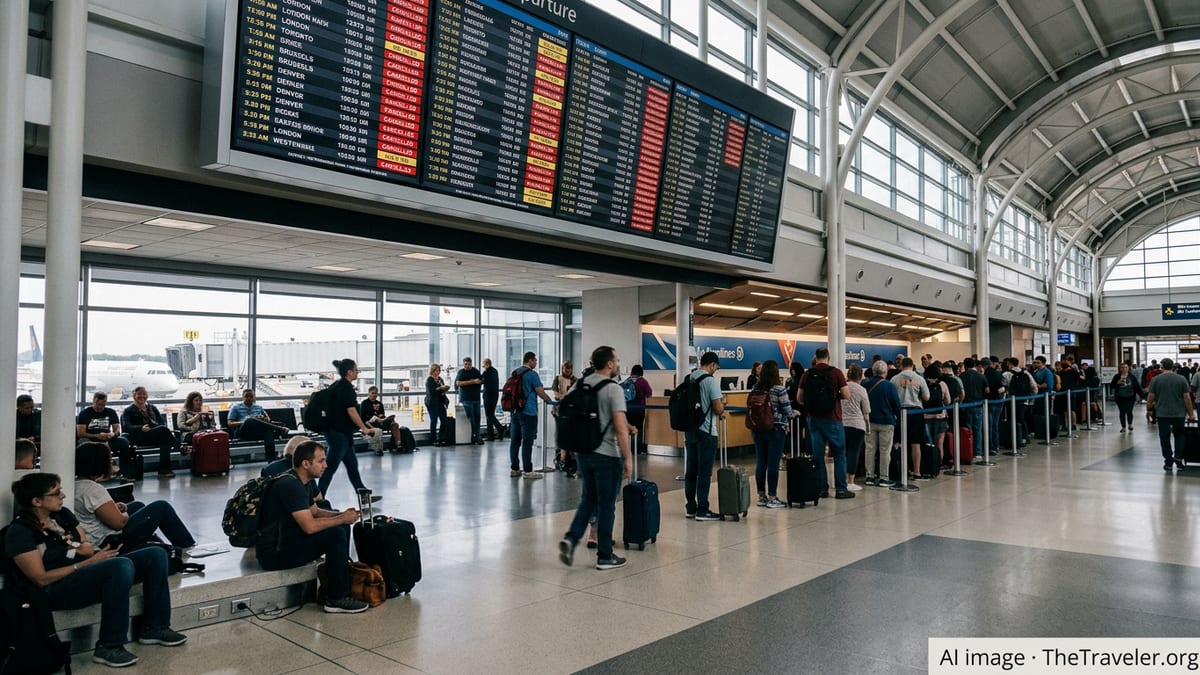
On the concourses at O’Hare, the operational complexity translates into a familiar but unwelcome picture for passengers: crowded departure areas, long customer-service lines and departure boards awash in amber and red. With average load factors remaining high across many routes, rebooking options are limited, making it harder to accommodate travelers from canceled flights on the same day.
Airline agents are encouraging affected passengers to accept alternative routings, sometimes involving additional stops or overnight stays, as they try to spread demand across whatever seats remain open. For some, that has meant rebookings via secondary hubs rather than direct Chicago departures, while others have opted to postpone nonessential travel altogether in the hope of more stability later in the week.
Travelers with tight connections, particularly those linking a domestic United or SkyWest leg with an onward Emirates, Etihad or Qatar Airways flight, are being advised to build in more buffer time or seek earlier departures. Priority is often being given to travelers with onward long-haul segments and limited alternatives, which can leave short-hop passengers facing longer waits.
At the same time, airport officials are stressing that passengers should not assume their flights are canceled simply because of the broader disruption. Many flights are still operating, albeit behind schedule, and authorities urge travelers to monitor airline apps closely and arrive at the airport in line with official guidance rather than abandoning their itineraries in advance.
What Travelers Through O’Hare Should Do Now
With the situation in key Middle Eastern air corridors still fluid, operational experts are warning that Chicago O’Hare could see rolling disruptions over the coming days, even if the headline number of cancellations fluctuates. Airlines are attempting to rebuild more resilient schedules, but until airspace restrictions ease, long-haul networks will remain vulnerable to late-breaking changes.
For travelers with imminent departures from O’Hare, the clearest advice is to stay informed and flexible. Checking flight status repeatedly on the day of travel, confirming terminal and gate assignments, and allowing extra time for security and connections can all help reduce the stress of last-minute disruptions. Those who booked through third-party agencies may find that working directly with the airline speeds up rebooking when flights are canceled or heavily delayed.
Passengers holding tickets on United, Qatar Airways, Etihad, Emirates and SkyWest are also being urged to review any waivers or flexible travel policies that may allow free date changes or rerouting in light of the extraordinary circumstances. While compensation rules differ by jurisdiction and ticket type, many carriers are offering additional flexibility as they work to smooth out snarled operations.
As O’Hare navigates this latest test of its resilience, today’s nine cancellations and more than 200 delays serve as a reminder of how tightly interconnected the global air transport system has become. A crisis thousands of miles away can, within days, reshape departure boards in Chicago, turning routine journeys into logistical puzzles for airlines and passengers alike.