

More news on this day
Air travel across South Korea and wider Northeast Asia faced fresh disruption this week as Korean Air and China Airlines cancelled three newly launched flights, affecting high-demand routes linking Hong Kong, Cheongju and other key regional destinations.
New Cancellations Add Strain to Asia’s Busiest Corridors
The latest wave of cancellations comes at a time when carriers in the region are still recalibrating capacity after a volatile two years marked by surging demand, airport congestion and a tightening regulatory environment. Industry officials said the withdrawn flights, which included services touching Hong Kong and the central South Korean city of Cheongju, were removed from schedules with limited advance notice, forcing many passengers into same-day rebooking scrambles at already crowded terminals.
Operational data from airport authorities and schedule trackers show that the scrapped services touched both trunk and secondary routes, amplifying the impact well beyond the three individual flights. Hong Kong’s role as a connecting hub for Southeast Asia and mainland China, together with Cheongju’s growing position as an alternative entry point to Seoul and nearby industrial cities, meant that disruptions quickly rippled across multiple itineraries.
While the airlines did not immediately provide detailed public explanations for each cancellation, aviation analysts pointed to a mix of factors, including aircraft rotation issues, crew scheduling constraints and knock-on effects from earlier delays. They noted that the pattern mirrors a broader regional trend in which relatively small schedule adjustments can trigger wider disruption, particularly on days when load factors are already high.
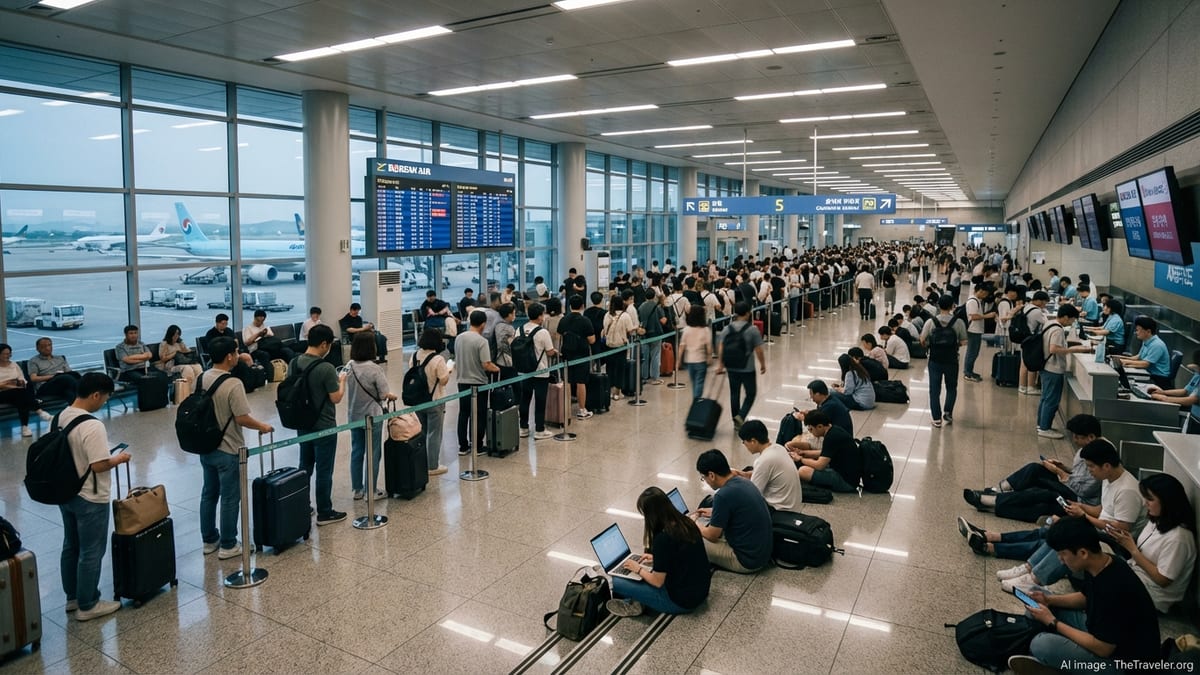
Passengers arriving at check-in counters in Seoul, Hong Kong and other affected airports reported long queues at airline service desks as they sought rerouting options. Some travelers heading to business meetings in southern China and central Korea said they were offered multi-stop alternatives adding five hours or more to their journeys, while others accepted refunds and postponed trips altogether.
Impact on Hong Kong and Cheongju Connectivity
For Hong Kong, the cancellations represent a setback to its ongoing efforts to rebuild its position as a premier Asian transfer hub. The city has been steadily restoring flight frequencies to key markets, and even a modest reduction in services can reduce choice and raise fares on peak days. Travel agents in the city said that seats on remaining departures to South Korea, particularly late-evening and early-morning rotations, sold out quickly after the schedule changes filtered through booking systems.
Cheongju, traditionally overshadowed by Seoul’s Incheon and Gimpo airports, has been courting carriers with discounted fees and marketing support to attract more international routes. The loss of a newly launched link involving the city is therefore seen as more than an operational hiccup. Local tourism and business groups in North Chungcheong Province voiced concern that inconsistent schedules could undermine campaigns promoting Cheongju as a convenient gateway for both leisure travelers and corporate visitors.
Domestic travelers who rely on Cheongju for access to regional hubs now face the prospect of longer surface journeys or additional connections through Seoul. For small and medium-sized enterprises in surrounding industrial parks, the reduced air connectivity could complicate last-minute travel to supplier meetings and trade events across East Asia.
Airport officials in both Hong Kong and Cheongju said they were working with airlines to minimize further disruption and to secure substitute capacity where possible. However, they acknowledged that short-term solutions are limited when carriers across the region are already operating near the edge of their available fleet and crew resources.
Passengers Confront Delays, Rebookings and Rising Costs
For travelers caught in the cancellations, the immediate fallout has been a familiar mix of long delays, missed connections and unexpected expenses. At South Korea’s main gateway, Incheon International Airport, travelers described scenes of crowded departure halls as passengers from the affected flights joined queues for customer service alongside those dealing with routine delays.
Some passengers reported being rebooked onto flights departing the following day, prompting a scramble for last-minute hotel rooms near the airport. Others opted for complex rerouting via alternative hubs such as Taipei, Shanghai or Tokyo to salvage their travel plans. With many of these replacement tickets sold at higher last-minute fares, travelers said they faced additional out-of-pocket costs that were only partially offset by airline vouchers or refunds.
Consumer advocates noted that inconsistent policies on compensation and meal or lodging support continue to frustrate passengers in the region. Unlike in some long-haul markets, where clear regulatory frameworks define traveler rights during disruptions, compensation rules in much of Asia can vary widely by carrier and ticket type, leaving passengers to negotiate on a case-by-case basis.
Travel agencies and corporate travel managers said the episode underscored the importance of building more flexibility into itineraries involving regional connections. Several recommended that clients avoid tight transfer windows in current conditions and consider purchasing changeable fares or travel insurance that explicitly covers airline-initiated cancellations.
Signals of Wider Operational Pressure on Asian Carriers
The cancellations at Korean Air and China Airlines arrive against a backdrop of persistent operational pressure on carriers across the Asia Pacific. South Korean airlines in particular have grappled with elevated delay rates in recent months, as increased international traffic has tested airport capacity and airspace management. Aviation experts warn that the margin for error on tightly packed schedules remains slim, especially during peak travel seasons and weather disruptions.
Regional network carriers such as Korean Air and China Airlines also face complex balancing acts as they deploy widebody and narrowbody aircraft across a mix of long-haul, regional and domestic routes. Fleet maintenance checks, crew duty limits and shifting demand patterns can all force last-minute schedule revisions, with thinner secondary routes often bearing the brunt of capacity cuts.
Industry analysts say that although the removal of three flights may appear modest in isolation, such cancellations can be an early warning sign of deeper constraints, particularly if they cluster around specific days or destinations. They noted that secondary hubs like Cheongju, which rely on a smaller number of daily departures, are especially vulnerable to service volatility compared with mega-hubs that can absorb disruptions across multiple frequencies.
Both Korean Air and China Airlines have signaled plans to continue expanding in key markets this year, but they are expected to proceed more cautiously where operational resilience is a concern. That may mean slower growth on experimental or recently launched routes until reliability metrics improve.
What Travelers Should Expect in the Coming Weeks
Travel planners say passengers flying between South Korea and neighboring Asian destinations should brace for intermittent schedule changes over the coming weeks, even if no further large-scale cancellations are announced. Airlines are likely to keep adjusting departure times and aircraft types as they seek to stabilize operations while still capitalizing on strong demand.
Experts recommend that travelers monitor their bookings closely in the days leading up to departure and again on the morning of travel, using both airline apps and airport information boards. They also suggest factoring in generous layover times for itineraries that rely on tight regional connections, especially through busy hubs such as Incheon and Hong Kong.
Corporate travel departments, which often book complex multi-city trips across Asia, are advising employees to maintain backup plans, including alternative flight options or the possibility of virtual participation in meetings if journeys are severely disrupted. Some companies are temporarily favoring routes with multiple daily frequencies, even when they are slightly more expensive, in order to retain flexibility if one flight is canceled.
For now, the cancellations by Korean Air and China Airlines serve as a reminder that Asia’s aviation recovery, while robust in terms of passenger numbers, remains fragile beneath the surface. Travelers on routes touching Hong Kong, Cheongju and other secondary gateways may experience a bumpier ride as airlines continue to fine-tune their networks in real time.