

More news on this day
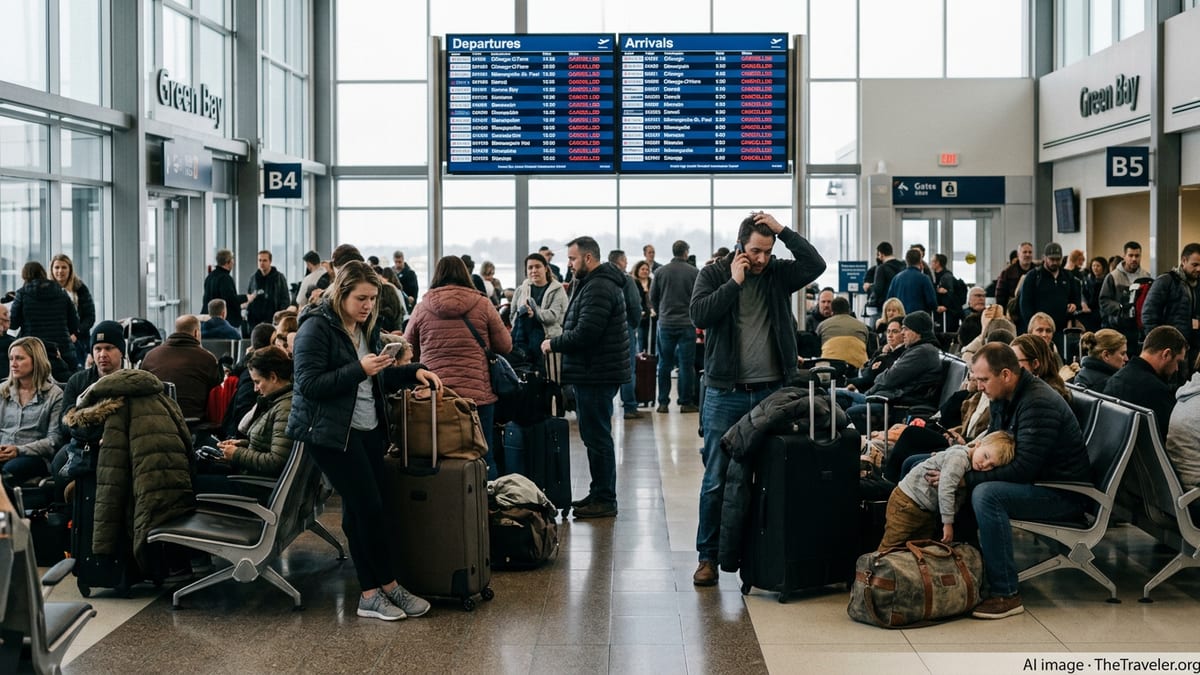
Travelers moving through Green Bay’s Austin Straubel International Airport on March 15 faced widespread disruption as 37 regional flights operated for SkyWest, Delta and Envoy Air were canceled, rippling across key hubs in Chicago, Minneapolis, Detroit and other U.S. cities.
Get the latest news straight to your inbox!
Regional Cancellations Ripple Through Major Midwest Hubs
Publicly available flight-tracking data on Saturday showed a sharp concentration of cancellations among regional services linking Green Bay with larger connecting airports. The affected flights were primarily operated under the banners of SkyWest, Delta Connection and Envoy Air, which handle a significant share of short-haul traffic between Green Bay and hubs in Chicago, Minneapolis and Detroit.
The 37 canceled departures and arrivals effectively thinned out the day’s schedule between Green Bay and these key cities, limiting options for passengers who rely on early-morning and late-evening connections. Many of the scrubbed flights were marketed by major carriers but flown by regional partners, a structure that often amplifies disruption when a single operator is affected.
Operational summaries for recent weeks show that SkyWest and Envoy typically run multiple daily frequencies from Green Bay to Chicago O’Hare, while SkyWest-operated Delta Connection flights link the airport to Minneapolis and Detroit. Saturday’s elevated cancellation count therefore translated into lost connectivity across several banks of departures, complicating onward travel plans for passengers heading to destinations across the United States and beyond.
Reports from national aviation coverage in recent months have highlighted how concentrated disruptions at regional operators such as SkyWest and Envoy can quickly cascade through the wider domestic network. A reduced schedule at a smaller airport like Green Bay can, in turn, affect aircraft positioning and crew availability in busier hubs later in the day.
Weather and Network Strain Underscore Fragility of Regional Links
While specific causes for each individual cancellation were not immediately detailed in public feeds, recent patterns in U.S. aviation suggest that a combination of weather-related constraints and network strain likely played a role. Earlier seasonal storms and low-visibility conditions across the Upper Midwest have already led to mass cancellations at Green Bay and neighboring airports, illustrating how quickly local operations can grind to a halt.
Historic announcements from the airport and regional media have documented episodes where airlines proactively canceled all remaining flights in anticipation of major winter storms, rather than risk diversions and extended delays. Those decisions are often influenced by safety considerations, de-icing capacity and limitations on crew duty hours, all of which can make it difficult to recover schedules once a disruption begins.
Industry analysis over the past year has also pointed to how regional carriers face particular vulnerability when weather or operational issues arise. Because they operate smaller fleets and serve many short-haul routes, a cluster of cancellations in one location can quickly absorb available spare aircraft and crews, leaving fewer options for recovery flights or last-minute substitutions.
In practice, this means that when several Green Bay flights to Chicago, Minneapolis or Detroit are canceled on the same day, it can be challenging for airlines to reinsert those rotations into the timetable. The knock-on effect may show up hours later in the form of additional delays or cancellations out of the major hubs where those aircraft and crews were expected to continue flying.
Stranded Passengers Face Missed Connections and Rebooking Challenges
For travelers, the immediate impact of Saturday’s disruption was felt in missed connections and extended layovers. Passengers scheduled to connect in Chicago, Minneapolis or Detroit to flights onward to the East and West Coasts, as well as select international destinations, suddenly had fewer options to reach their next leg on time.
Publicly available consumer guidance from airline and government resources notes that when a flight is canceled, travelers who choose not to fly are generally entitled to a refund of the unused portion of their ticket, even on nonrefundable fares. However, many stranded passengers often opt to accept rebooking in hopes of salvaging at least part of their itinerary, particularly when attending time-sensitive events or returning from vacations.
According to travel industry reporting, rebooking during large-scale disruptions has become increasingly complex as airlines run fuller schedules with less slack capacity. On busy days, finding open seats on later departures from Green Bay or on alternative routings via other Midwest airports can be difficult, especially for families or groups seeking to stay together on the same flight.
Social media mentions and anecdotal accounts from previous mass cancellation events suggest that travelers in situations like Saturday’s often resort to renting cars to reach larger hubs, splitting itineraries across different airlines, or extending hotel stays near the airport. Such workarounds can add considerable out-of-pocket expense, even when a portion of the airfare is ultimately refunded.
Operational Focus on Recovery as Airlines Adjust Schedules
Recent coverage of similar disruption episodes across the United States indicates that airlines typically shift quickly from canceling flights to executing a recovery plan that restores the network to normal operations. This often involves consolidating lightly booked flights, repositioning aircraft from less-affected cities and reassigning crews to ensure that the following day’s early-morning departures can run more reliably.
Regional partners such as SkyWest and Envoy play a central role in that process because of their dense web of short-haul connections between smaller communities and major hubs. When widespread cancellations occur, they must balance the need to resume service to outlying airports like Green Bay with contractual obligations to maintain adequate frequencies on core hub routes.
Public statistical reports from airport authorities and federal regulators show that, over time, many carriers aim to improve their completion factor by canceling flights early when necessary, rather than allowing cascading delays to build up throughout the day. While that strategy can minimize uncontrolled disruptions, it also means that days like Saturday may feature high cancellation counts in specific markets even when conditions are gradually improving.
For travelers in northeastern Wisconsin, the focus now shifts to how quickly airlines can restore the full schedule between Green Bay and major hubs, and whether additional adjustments will follow as carriers analyze the operational and financial impact of the 37 canceled flights.
What Travelers Can Do When Regional Flights Are Grounded
Travel experts often recommend several practical steps for passengers caught in sudden waves of cancellations at smaller airports. One of the most frequently cited pieces of advice is to use airline apps and websites to monitor flight status in real time, which can provide earlier notice of schedule changes than departure boards in the terminal.
Consumer advocacy resources also suggest researching alternative routings as soon as disruption becomes likely, including departures from nearby airports reachable by car. In the Green Bay region, this can sometimes mean looking at flights from Appleton or Milwaukee when Austin Straubel’s schedule is heavily affected.
In addition, publicly available guidance from aviation regulators and traveler rights organizations encourages passengers to keep documentation of expenses such as meals and lodging incurred during extended disruptions. While reimbursement policies vary by airline and by cause of cancellation, having clear records can help when seeking goodwill compensation or asserting refund rights.
As airlines and airports continue to contend with volatile weather patterns and tight operational margins, incidents like the cancellation of 37 flights linked to Green Bay’s Austin Straubel airport underscore the importance of preparation for travelers. Understanding how regional networks function, and how quickly local disruptions can spread to major hubs, can help passengers make faster, more informed decisions when their plans are suddenly upended.