

More news on this day
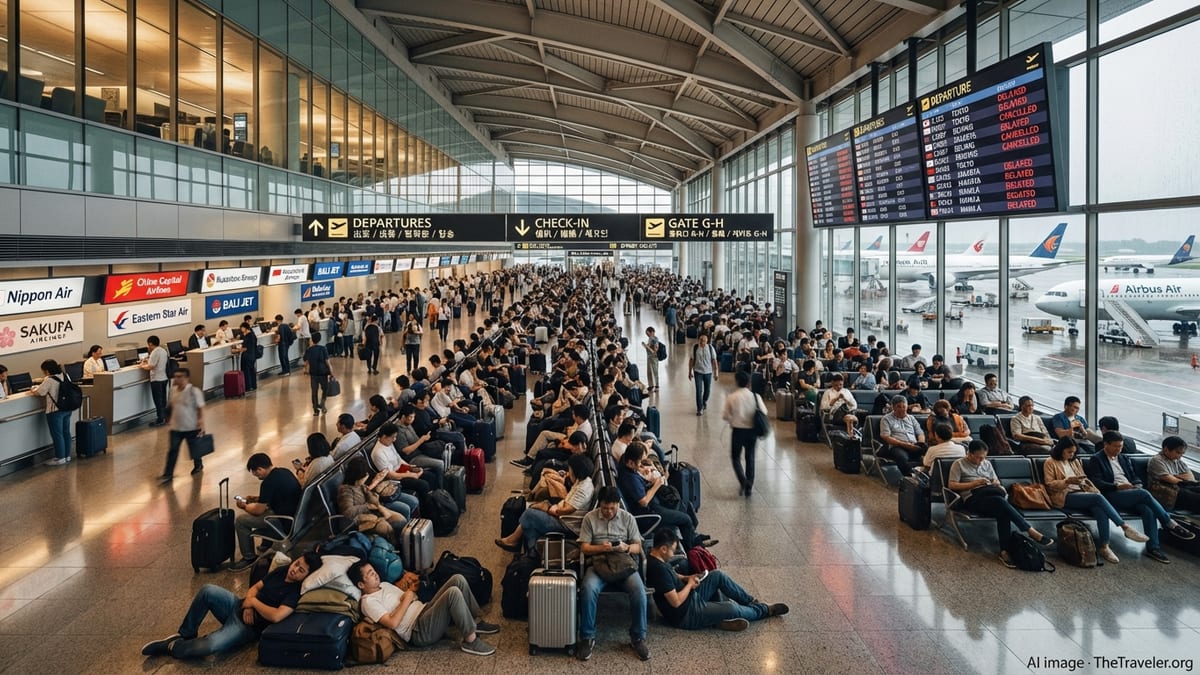
Hundreds of passengers were stranded across Asia on April 12, 2026, as at least 46 international flights were canceled and around 600 delayed at major hubs including Jakarta, Bali, Shanghai, Bangkok, Narita, Yancheng, Mumbai, and other airports, causing fresh disruption for regional and long-haul travelers.
Get the latest news straight to your inbox!
Major Asian Gateways See Cascading Flight Disruptions
Published aviation data and regional travel coverage indicate that airports in Indonesia, China, Japan, Thailand, and India are among the most heavily affected, with operational bottlenecks rippling through both domestic and international networks. Jakarta Soekarno Hatta, Bali’s Ngurah Rai, Shanghai Pudong, Bangkok Suvarnabhumi, Tokyo Narita, and Mumbai’s Chhatrapati Shivaji Maharaj International have all reported clusters of cancellations and lengthy delays on key routes.
In Indonesia, Jakarta and Bali have seen a spike in late-running departures and missed connections, particularly on regional services linking Southeast Asia with China and the Middle East. Reports show double-digit cancellation figures alongside well over a hundred delayed movements in Jakarta alone, with Bali handling a spillover of disrupted holiday and transit traffic bound for Australia and regional island destinations.
China’s busy coastal corridor, anchored by Shanghai’s dual-airport system, has recorded some of the highest disruption levels. Shanghai Pudong and Shanghai Hongqiao have faced a mix of cancellations and hours-long delays affecting trunk routes to Southeast Asia, Japan, and Europe, while second-tier Chinese cities feeding into these hubs have also experienced knock-on schedule slippages.
In Japan and Thailand, Tokyo Narita and Bangkok Suvarnabhumi have emerged as additional chokepoints. Narita’s long-haul and regional departures have been affected by late-arriving aircraft and crew rotation issues, while Bangkok’s role as a transfer hub for travelers moving between South Asia, Southeast Asia, and the Middle East has meant that even modest schedule changes are quickly amplified across multiple airlines and alliance networks.
Yancheng, Secondary Chinese Airports, and Their Wider Impact
While attention often centers on the mega-hubs, smaller but fast-growing airports such as Yancheng in eastern China play a critical role in the current disruption picture. Publicly available route maps and airline schedules show that Yancheng is connected to major regional centers including Shanghai, Beijing, and several Southeast Asian gateways, which means local cancellations or delays can reverberate far beyond the immediate catchment area.
Recent Chinese aviation disruption tallies highlight that congestion and schedule pressures are not confined to a handful of tier-one cities. Cities such as Wuhan, Nanjing, Xiamen, and others have contributed to the overall count of delayed and canceled services in recent days, feeding additional stress into already crowded airport banks in Shanghai and Beijing. When weather or operational issues emerge at these secondary nodes, downstream services to hubs like Narita, Bangkok, and Jakarta can be pushed off-slot or scrubbed entirely.
This network effect is especially evident on cross-border routes, where aircraft cycle between multiple countries over a single operating day. A late departure from a smaller Chinese city to Shanghai or Yancheng can jeopardize a tightly timed onward leg to Southeast Asia, leaving passengers stranded at transit points and forcing airlines to re-accommodate travelers on later flights or alternative routings.
As demand across regional Asia continues to rebound, traffic through secondary airports has grown faster than infrastructure and staffing in some locations. Industry analyses have repeatedly pointed to limited buffer capacity in air traffic control, airport ground handling, and airline scheduling, creating conditions where relatively minor disturbances can translate into widespread operational instability.
Mumbai, Delhi and the South Asian Dimension
In South Asia, Mumbai has featured prominently in the latest wave of disruptions, with national and low-cost carriers adjusting timetables amid broader network constraints. Recent coverage of airline scheduling challenges in India shows how tighter crew duty rules, higher operating costs, and strong post-pandemic demand have left several carriers operating near the edge of their available capacity.
Flight data from India’s key airports, including Mumbai and Delhi, point to clusters of delays similar in scale to those seen at Jakarta and Bangkok, especially on services that interlink with East and Southeast Asian hubs. Late inbound aircraft from the Middle East and Europe have contributed to missed departure slots for onward flights to East Asia, compounding congestion during already busy morning and evening peaks.
The result is a web of disruptions in which a delayed departure from Mumbai bound for an intermediate hub can affect connectivity for passengers connecting onward to Shanghai, Narita, or Bali. With many routes operating near full load factors, finding spare seats for rebooked travelers has become increasingly challenging, extending the time passengers spend stranded in terminals or forced into overnight stays.
Indian carriers are simultaneously adding capacity on some long-haul routes to Europe and North America in response to other geopolitical pressures on airspace, which further complicates aircraft and crew rotations. This broader realignment of capacity leaves fewer margins for error in regional operations that connect South Asia with Southeast and East Asia.
Multiple Drivers: Weather, Costs, and Geopolitics
Recent weeks have seen several overlapping drivers behind Asia’s air travel disruption, according to industry-focused publications and airline statements. Periodic adverse weather in parts of China has triggered waves of delays and cancellations, particularly affecting carriers based in Guangzhou, Chengdu, and surrounding provinces. When storms or visibility issues force temporary ground stops or air traffic restrictions, recovering normal schedules can take many hours, if not days.
At the same time, airlines in the Asia Pacific region are contending with higher jet fuel prices, rising insurance premiums, and additional operational costs linked to detours around conflict zones. Trade and travel media outlets have documented how some carriers have curtailed or suspended services on certain long-haul routes, while shifting aircraft into alternative markets. These shifts alter aircraft and crew availability for intra-Asian flights, occasionally leaving short-haul networks exposed when irregular operations occur.
Geopolitical tensions and evolving airspace restrictions have further compressed available routings between Asia, the Middle East, and Europe. Rerouted flights can require longer block times and additional fuel, reducing operational flexibility when unexpected maintenance issues, crew shortages, or weather disruptions arise. The cumulative effect is that even routine technical delays can spill into multi-hour or multi-flight disruptions across an airline’s Asian network.
Together, these factors have created conditions in which the cancellation of a few dozen flights and the delay of hundreds more in a single day can feel particularly acute to travelers. With many carriers still rebuilding staffing and fleets to pre-pandemic levels, irregular operations expose structural vulnerabilities that have not yet been fully resolved.
Stranded Passengers Face Long Queues and Limited Options
For passengers caught up in the current wave of disruptions, the experience has been characterized by crowded terminals, long check-in and rebooking lines, and limited near-term alternatives. Observations from traveler forums and travel-industry reporting describe scenes of passengers camped out overnight in waiting areas at major hubs, particularly where same-day re-accommodation options have been exhausted.
Airlines are generally offering standard remedies such as rebooking on later flights, meal vouchers, or hotel accommodation in line with their published policies, though the exact entitlements vary widely between carriers and jurisdictions. In some cases, travelers have opted to purchase one-way tickets on competing airlines or reroute through secondary hubs in order to continue their journeys, adding to the overall cost and complexity of their trips.
Consumer advocates and travel analysts continue to underline the importance of passengers understanding their rights under applicable regulations and airline contracts of carriage, especially on itineraries that combine multiple carriers or involve code-share arrangements. When disruptions span several countries and regulatory regimes, the practical path to refunds or compensation can be opaque, and outcomes often depend on the specific ticket type and operating carrier.
With Asia’s peak summer travel season approaching, industry watchers note that the current pattern of rolling delays and targeted cancellations at hubs such as Jakarta, Bali, Shanghai, Bangkok, Narita, Yancheng, and Mumbai may be an early stress test of the region’s readiness for sustained high demand. Unless capacity, staffing, and contingency planning improve in tandem, similar episodes of large-scale disruption are likely to recur in the coming months.