

More news on this day
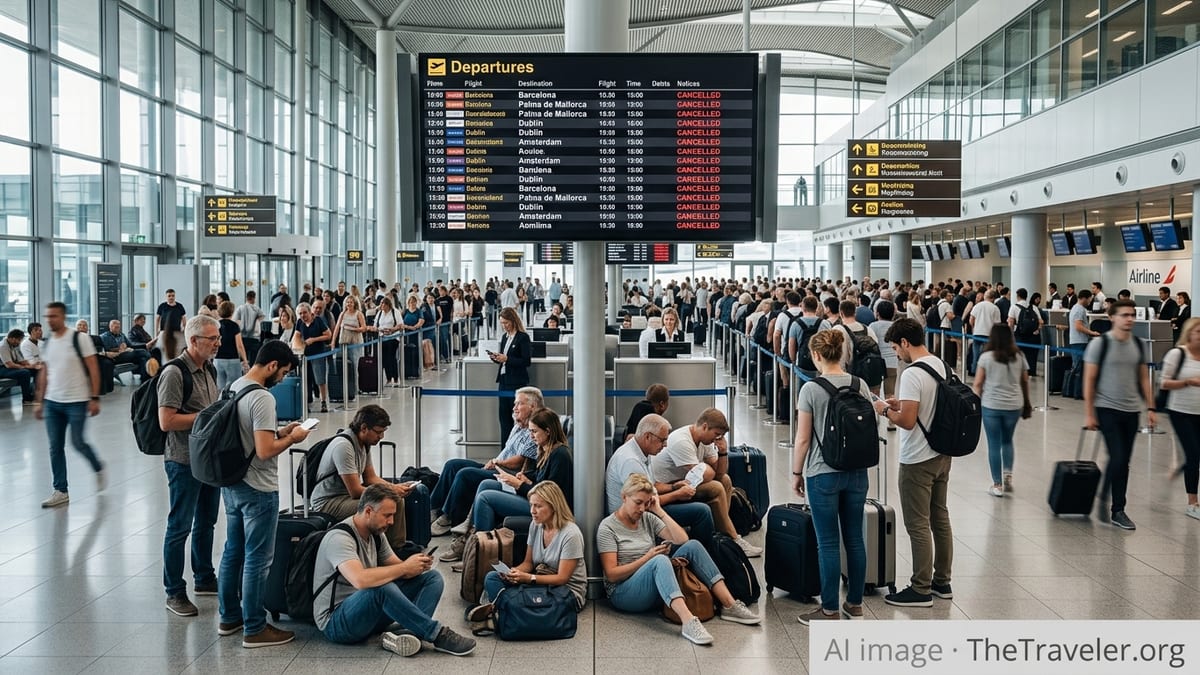
More than 70 flights were cancelled across several major European airports, including Barcelona, Palma de Mallorca, Dublin and Amsterdam Schiphol, disrupting busy spring travel periods and leaving passengers on carriers such as Ryanair, KLM, easyJet and Air France facing extensive delays, missed connections and overnight stays in terminals.
Get the latest news straight to your inbox!
Widespread Disruption Hits Key European Holiday Gateways
European flight tracking data and local media reports indicate that a wave of cancellations has swept through Barcelona El Prat, Palma de Mallorca, Dublin Airport and Amsterdam Schiphol, affecting more than 70 departures and arrivals in a single operating period. The disruption comes at a time when many travelers are moving through these hubs for short breaks and early Easter-season holidays, magnifying the impact on tourism flows.
At Barcelona and Palma de Mallorca, two of Spain’s busiest leisure gateways, cancellations and rolling delays have become more common during recent periods of industrial action and challenging weather, particularly strong winds and storms tracking across the western Mediterranean. Published aviation trend analyses highlight that Palma and Barcelona have ranked among the European airports most affected by air traffic management delays during recent strike waves, setting the stage for further instability when schedules are tight and aircraft are heavily utilized.
Amsterdam Schiphol and Dublin Airport, both critical links for transatlantic and intra‑European traffic, have also seen elevated disruption on peak days. Earlier in the winter season, Schiphol experienced mass cancellations related to snow and high winds, with several hundred flights grounded during the most severe conditions. That operational fragility continues to ripple through airline networks when new systems issues, staffing constraints or localized weather problems arise.
On the ground, the latest cancellations have translated into crowded terminals, long lines at airline service desks and passengers attempting to rebook trips via alternative hubs. Many travelers have turned to social media and online forums to document missed events, unused hotel reservations and the difficulty of obtaining timely information about revised itineraries.
Ryanair, KLM, easyJet and Air France Among Affected Carriers
Low cost and network carriers alike have been caught up in the most recent disruption. Ryanair, easyJet and other budget airlines operate dense point‑to‑point schedules from Barcelona, Palma, Dublin and Amsterdam, meaning that the cancellation of a single aircraft rotation can cascade quickly through subsequent flights. Publicly available scheduling data shows that many of these carriers are operating at or near peak utilization, which leaves little spare capacity to recover from unexpected events.
At the same time, full service airlines such as KLM and Air France, which rely heavily on Amsterdam Schiphol and other European hubs for connecting traffic, have faced particular challenges when cancellations occur on feeder routes from Spain and Ireland. When a short‑haul leg into a hub is cancelled, onward long‑haul passengers can become stranded far from their final destination, generating additional hotel, transfer and rebooking needs that must be managed under European consumer protection rules.
While airlines have generally cited a mix of adverse weather, knock‑on effects from earlier technical issues and air traffic control constraints in public explanations for recent waves of disruption, the precise reason for each individual cancellation often varies by route and time of day. Industry observers note that even where the root cause lies outside an airline’s direct control, limited spare aircraft, tight crew scheduling and strong seasonal demand increase the likelihood that disruptions will spread across multiple bases.
For the carriers involved, the financial consequences go beyond immediate revenue loss. Under European air passenger rights rules, airlines must typically provide care and assistance, including meals and accommodation, during extended disruptions, and in some circumstances may owe cash compensation. These obligations add cost pressure at a time when airlines are still working to rebuild balance sheets and invest in new fleets.
Passengers Report Long Queues and Confusing Rebooking Options
Across affected airports, passenger accounts posted online describe hours‑long queues at airline counters, difficulty reaching customer service by phone and confusion about whether travelers should accept complex rerouting proposals or wait for a direct flight on a later date. Some stranded passengers at Barcelona and Amsterdam have reported being rebooked multiple times in succession as fresh cancellations forced airlines to reshuffle limited seats on remaining services.
In several cases, travelers connecting between different carriers under the same booking reference, such as KLM in combination with partner airlines, have expressed uncertainty about which company bears responsibility for providing assistance when a first leg is cancelled. Public guidance from airlines often refers customers back to online self‑service tools and mobile apps, but these systems can become overloaded during major disruption events, leaving many to rely on airport staff who are managing high volumes of requests.
Travelers stranded overnight at hubs like Schiphol and Dublin have described spending the night in terminal seating, with blankets and water provided in some airport areas. Others have opted to purchase separate tickets on competing airlines or to travel over land by train or ferry when practical, in hopes of salvaging at least part of their trip. These ad hoc solutions can reduce delays but may complicate later efforts to secure reimbursement, since proof of necessity and documentation of the original cancellation are often required.
Consumer organizations monitoring Europe’s aviation sector note that the recurring scenes of crowded terminals and improvised sleeping areas highlight the continued vulnerability of the network to shocks, even several years after the sharp downturn seen during the pandemic. They argue that while carriers have restored much of their capacity, investment in resilience, staffing buffers and clear passenger communication has not always kept pace.
Regulatory Framework and Passenger Rights in Focus
The renewed wave of cancellations is again drawing attention to the European Union’s air passenger rights framework, commonly referred to as Regulation EC 261. Under this regulation, travelers whose flights are cancelled are generally entitled to a choice between rerouting at the earliest opportunity, rerouting at a later date that suits them, or a refund of the unused ticket portion. Additional rights to meals, refreshments and hotel accommodation may apply depending on the length of the delay and the distance of the flight.
Cash compensation can be owed where cancellations occur close to departure and are not caused by extraordinary circumstances such as severe weather or airspace closures. The amounts vary according to flight length, with higher payments for longer routes. However, disputes frequently arise over whether a specific disruption qualifies as extraordinary, and passengers often need to submit formal claims or pursue complaints through national enforcement bodies when airlines reject initial requests.
Recent policy discussions within European institutions have focused on updating and clarifying aspects of the regulation to better address the realities of modern airline operations, including more granular rules for long connecting journeys and clearer definitions of technical faults versus unavoidable external events. While no single change can eliminate disruption during storms or strikes, consumer advocates contend that stronger enforcement and transparency could reduce uncertainty for travelers during events like the current wave of cancellations.
For now, publicly available consumer advice emphasizes the importance of retaining boarding passes, booking confirmations and any written notices of cancellation, as well as receipts for hotels, meals or alternative transport purchased during the disruption. These documents can prove crucial when seeking reimbursement or compensation once travel is finally completed.
What Travelers Can Do if Their Flight Is Cancelled
In the immediate aftermath of a cancellation, passenger advocacy groups generally recommend that travelers first check their airline’s app or website for automatically proposed alternatives. Many carriers, including the major European operators affected in the latest disruption, allow customers to select new flights or request refunds digitally without waiting in airport queues, at least when inventory is available.
If suitable options do not appear online, heading directly to airline service desks within the terminal can still be effective, particularly at hub airports where carriers have more staff on hand. Travelers should arrive prepared with preferred alternative dates and routes, including nearby airports and partner airlines, to increase the chances of finding an acceptable rerouting solution before remaining seats are taken by others in the same situation.
Where passengers decide to make their own arrangements, such as booking a seat on another airline or arranging rail travel from cities like Barcelona or Amsterdam, it is advisable to document the unavailability or inadequacy of the options offered by the original carrier. Screenshots of proposed itineraries, written explanations provided at the airport and time‑stamped photos of departure boards can all help substantiate later claims.
With schedules across Europe expected to remain busy through the coming months, the latest cluster of more than 70 cancellations across Barcelona, Palma de Mallorca, Dublin and Amsterdam serves as a reminder to travelers to build in buffer time for connections, travel with flexible plans when possible and stay informed about developing weather patterns and industrial actions that can quickly impact flights.