

More news on this day
Hundreds of travelers were left stranded at Queen Alia International Airport on Monday after 102 flights were cancelled and nine delayed, as carriers including Royal Jordanian, Ryanair, Saudia and Emirates scrambled to respond to sudden airspace restrictions linked to escalating tensions across the Middle East.
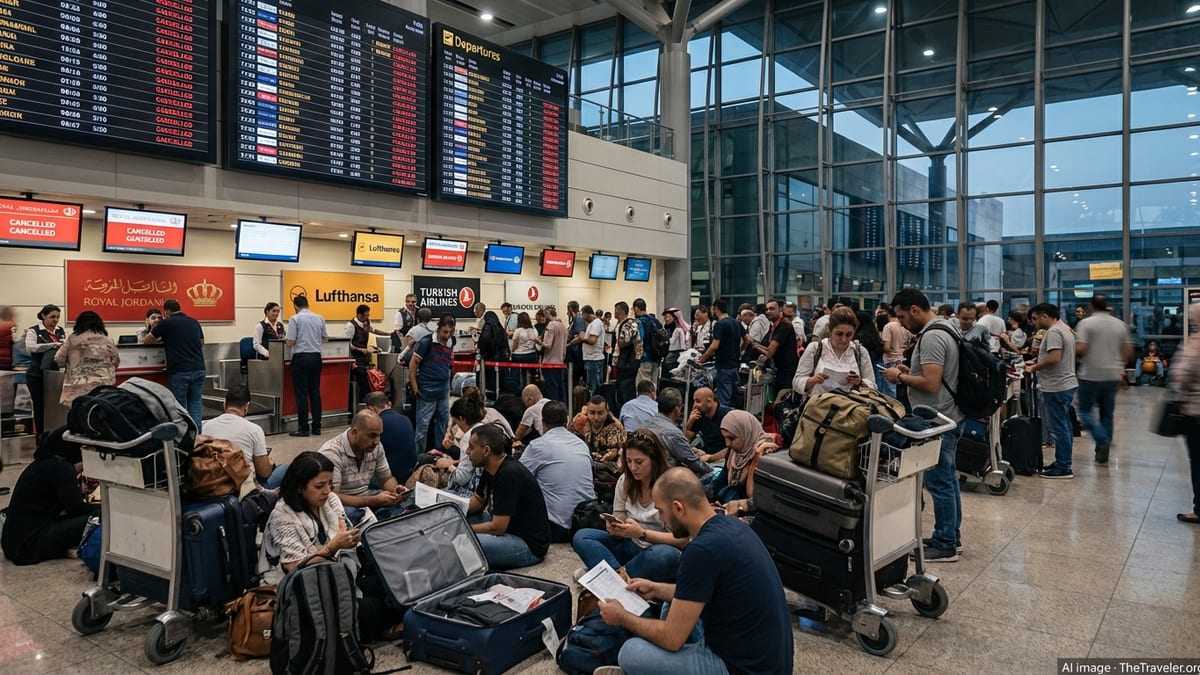
Severe Disruptions Hit Queen Alia International Airport
The disruption at Amman’s main gateway unfolded through the early hours of March 2 as airlines halted or rerouted services passing through contested skies over parts of the region. Airport operations data showed 102 flights cancelled and nine delayed in and out of Queen Alia International Airport, affecting a mix of regional and long-haul routes and creating long queues at airline service desks.
Royal Jordanian, the national flag carrier, bore the brunt of the upheaval, grounding multiple rotations to key regional hubs and European cities. Low-cost operator Ryanair and Gulf and Saudi carriers, including Saudia and Emirates, also cancelled departures and arrivals, particularly those using air corridors now subject to temporary closures or severe restrictions.
The wave of cancellations was part of a much wider aviation shock rippling across the Middle East and beyond, as countries from Iran and Iraq to Jordan and the Gulf states imposed at least partial closures of their skies. Airlines were forced into a patchwork of diversions, extended routings and outright cancellations, with Amman emerging as one of several airports struggling to absorb the knock-on effects.
Airport officials said safety considerations had priority over schedule reliability. Ground staff were instructed to keep passengers inside terminal areas and away from airside zones unless a departure was confirmed as operating, adding to the sense of uncertainty for those waiting on word from their carriers.
Key Routes to Amman, Cairo, Dubai and London Affected
The cancellations and delays at Queen Alia cut across some of the region’s most important corridors, including services linking Amman with Cairo, Dubai and London. Flights into and out of the Egyptian capital were among the first to be scrubbed or retimed, leaving business travelers and migrant workers in limbo as connections onward to North Africa and the Gulf evaporated.
Links to Dubai, one of the busiest hubs for Jordanian travelers and transit passengers, were particularly strained. With Dubai International Airport itself running on sharply reduced schedules and many carriers suspending operations or flying only limited “special” services, several Amman–Dubai frequencies disappeared from departure boards. Travelers faced the prospect of extended hotel stays in Amman or improvised overland journeys to alternative gateways.
London-bound traffic also suffered. Royal Jordanian’s flagship Amman–London Heathrow route and services by European low-cost carriers using Amman as a spoke were disrupted as airlines sought longer, more circuitous routings to avoid closed airspace. The added flying time, fuel burn and crew duty constraints meant that several rotations were simply cancelled, with rebooking options pushed days into the future for some passengers.
Regional routes to Gulf cities and secondary destinations in Saudi Arabia saw rolling adjustments throughout the day. Saudia trimmed frequencies and delayed departures while monitoring the evolving airspace picture, while other Gulf carriers continued to evaluate whether narrow operational windows justified limited flights or full suspensions.
Stranded Passengers Face Long Waits, Limited Options
Inside Queen Alia’s terminals, travelers confronted snaking lines at check-in counters and ticket offices as they sought answers and alternatives. Families returning from school holidays, medical travelers heading for specialist treatment abroad and tourists on tight itineraries all reported uncertainty over when they might be able to leave Amman.
Airline staff offered meal vouchers, hotel accommodation in some cases, and free rebooking or refunds, but capacity on remaining flights quickly evaporated. With neighboring hubs such as Dubai and Doha coping with their own waves of cancellations and diversions, rerouting passengers through alternative cities proved challenging, especially for those traveling to onward long-haul destinations in Europe, Asia and North America.
Budget-conscious travelers were among the hardest hit, particularly those booked on low-cost carriers with fewer interline agreements. Some passengers reported being advised to seek self-funded alternatives, including booking new tickets on carriers still operating or arranging surface transport to airports in neighboring countries, in hopes of finding a way out once they arrived there.
Local hotels near Queen Alia and in central Amman saw a spike in last-minute bookings as stranded passengers looked for rooms at short notice. Travel agents in the city center extended working hours to manage a surge of calls from concerned families and corporate clients trying to track colleagues stuck overseas or on the ground at Amman.
Airlines Scramble to Adapt Amid Regional Airspace Closures
The cancellations in Amman formed one part of a complex operational puzzle confronting airlines across the Middle East. Carriers that normally rely on direct routings over Iran, Iraq, Jordan and Gulf states were instead threading aircraft through narrower corridors, lengthening flight times and complicating crew scheduling. Analysts noted that, under such constraints, some airlines preferred to cancel entire rotations rather than risk cascading delays throughout their networks.
Royal Jordanian, which uses Amman as its primary hub for connections between Europe, the Levant and the Gulf, faced the difficult task of protecting its most critical routes while complying with all airspace restrictions. Operational teams worked through the night to re-plan rotations, prioritize essential services and position aircraft and crews for when restrictions are eased and demand for seats surges again.
Gulf heavyweights such as Emirates balanced their limited capacity across strategic markets, operating selected flights when safe routings and airport slots could be secured. For passengers in Amman, this meant that even when some Emirates services ran, they often did so at unusual times or with heavily constrained availability, limiting their usefulness for stranded travelers hoping to reach Dubai or connect onward to global destinations.
Industry observers warned that restoring full schedules will take time even after airspace fully reopens. Aircraft and crews are currently out of position across multiple continents, and airlines will need several days, if not weeks, to realign networks, rebuild confidence in timetables and clear the backlog of passengers waiting for seats.
Authorities Urge Passengers to Check With Airlines Before Traveling
Airport and aviation authorities in Jordan urged travelers to avoid unnecessary trips to Queen Alia International Airport until they had confirmed flight details directly with their airline. With departure boards changing by the hour and some cancellations announced only shortly before scheduled departure times, officials emphasized that real-time airline communication was now the most reliable source of information.
Passengers with flexible travel plans were encouraged to postpone non-essential journeys, thereby freeing scarce seats for those needing to travel urgently for medical, family or work reasons. Airlines also advised customers to keep contact details up to date in booking records so they could receive text messages or calls with last-minute schedule changes.
Travel industry experts said the current disruption underscores how dependent global aviation has become on a handful of critical air corridors through the Middle East. With those routes constrained, even cities far from the immediate flashpoints, such as Amman, Cairo, Dubai and London, quickly feel the impact through cancellations, missed connections and longer journey times.
For now, travelers through Queen Alia International Airport are being told to brace for further uncertainty. While airlines and authorities work to stabilize operations, many stranded passengers face the prospect of an unplanned and extended stay in Amman before they can resume their journeys.