

More news on this day
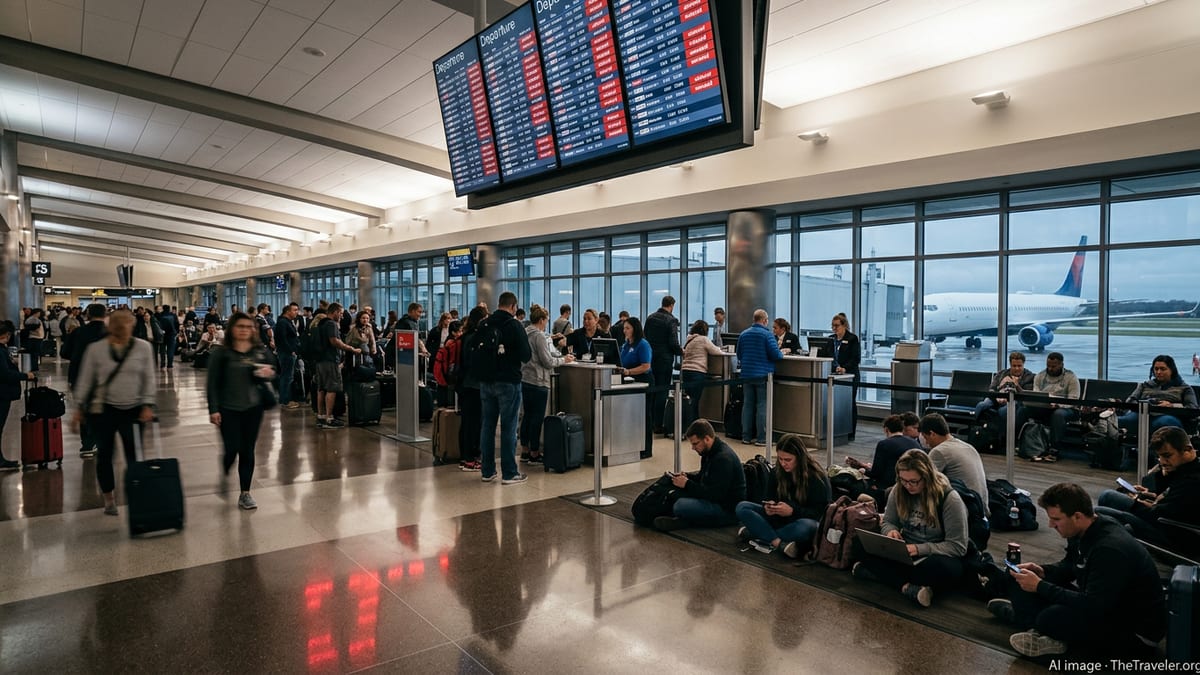
A fresh wave of flight disruptions at John Glenn Columbus International Airport in Ohio has cascaded across multiple major U.S. hubs, with publicly available data indicating 83 delays and 80 cancellations and leaving passengers in Boston, New York City, Chicago, Minneapolis and Washington, D.C. scrambling for alternative ways to reach their destinations.
Get the latest news straight to your inbox!
Chain Reaction From a Midwest Bottleneck
The disruption at John Glenn Columbus International Airport, a key connector for both legacy and low-cost carriers, has rippled outward into already busy air corridors along the East Coast and Upper Midwest. Flight-tracking dashboards and airline status pages show that services linking Columbus with Boston, New York, Chicago, Minneapolis and Washington, D.C. are among the hardest hit, tightening capacity on some of the country’s most heavily traveled business routes.
John Glenn Columbus International handles a mix of point-to-point and connecting traffic to these hubs, meaning a relatively modest number of local cancellations can quickly translate into missed onward connections, aircraft and crew imbalances, and rolling delays throughout the day. With dozens of departures from Columbus disrupted, schedules at larger hub airports have been forced into rapid, unscheduled adjustments.
Airline operations centers typically rely on Columbus flights to feed morning and evening banks in Chicago, New York and Washington, D.C., where passengers connect to cross-country and international services. When those feeder flights stall, carriers often reshuffle aircraft, delay downline departures or consolidate lightly booked services, further expanding the geographic footprint of the disruption.
East Coast Corridors Strained as Capacity Tightens
On the East Coast, the impact is most visible on routes serving Boston Logan International Airport, New York’s major airports and the Washington, D.C. region. Publicly available schedule tools already list constrained options between these cities and Columbus, and the spike in same-day cancellations has sharply reduced remaining seat availability.
In Boston and New York City, where winter and early spring storms have already produced a turbulent travel season, the latest disruptions are adding to a sense of fragility in the system. Historical data from recent winter storms shows that when even a handful of mid-continent airports experience severe disruption, New York and Boston often feel the fallout in the form of crowded terminals, overbooked flights and aircraft out of position.
Washington-area airports, particularly Washington Dulles and Reagan National, are also feeling the strain. With multiple daily links to Columbus affected, travelers bound for government, business and conference travel in the capital region are facing extended layovers, forced overnight stays in intermediate hubs, or detours through secondary airports if they can secure seats at all.
Chicago and Minneapolis Grapple With Knock-On Delays
In the Midwest, Chicago O’Hare and Minneapolis–St. Paul are working through their own share of complications as the Columbus disruption ripples along airline networks. Both airports routinely rank among the busiest in the nation and serve as central nodes in domestic and international route maps, so any imbalance in feeder traffic from a market like Columbus can have outsized consequences.
According to operational performance reports, Chicago and Minneapolis already contend with significant delay volumes in a typical year, driven by congestion, complex runway operations and challenging weather. When an upstream airport such as Columbus suddenly sends fewer aircraft and crews into this system, dispatchers may delay departures while they reposition equipment, extending the wait for passengers across multiple cities.
Travelers departing Chicago and Minneapolis for destinations beyond Columbus, including connections to the East Coast and Southeast, are reporting longer-than-usual queues at service counters and tighter competition for remaining seats. With aircraft rotations disrupted, some flights are leaving with every seat filled while others vanish from departure boards entirely as airlines consolidate schedules to restore stability.
Travelers Turn to Trains, Cars and Secondary Airports
As the day’s cancellations mount, travelers affected by disrupted Columbus services are increasingly turning to ground transportation and secondary airports in search of alternatives. Publicly available information from intercity rail and bus operators indicates rising demand on routes linking Columbus with Chicago, Washington, D.C. and New York, as stranded passengers seek options that avoid further time in congested terminals.
In the short-haul corridor between Columbus, Cleveland, Cincinnati and Pittsburgh, rental car agencies are experiencing elevated bookings, reflecting a pattern seen during recent winter storms across the United States. When flights between closely spaced cities fall through, many passengers opt to drive several hours rather than gamble on standby lists or rolling delays at major hubs.
Secondary and regional airports within driving distance are also absorbing overflow. Some travelers are rebooking through alternative departure points such as Dayton, Akron–Canton or larger hubs within a half-day’s drive, then connecting onward to East Coast or Midwestern cities. This patchwork of improvised itineraries underscores the vulnerability of tightly coupled airline networks when a mid-sized connector airport experiences sudden disruption.
Broader Questions About System Resilience
The latest wave of delays and cancellations at John Glenn Columbus International arrives against a backdrop of scrutiny over the reliability of air travel in the United States. Congressional and aviation-oversight reports have highlighted the scale of passenger time lost to delays each year, particularly at busier hubs such as Chicago O’Hare, Boston Logan, Minneapolis–St. Paul and Washington Dulles.
Performance benchmarking published by aviation authorities shows that, even as on-time arrival rates have improved in some markets, the overall system remains vulnerable to cascading disruptions when weather, staffing constraints or technical issues strike at multiple airports simultaneously. The situation unfolding across Columbus and its linked hubs illustrates how quickly a localized operational problem can ripple into a multi-city travel challenge.
With spring break and early summer travel seasons approaching, the latest disruptions are likely to intensify calls from consumer advocates for clearer communication tools, more robust rebooking options and better contingency planning across airline networks. For now, publicly available data suggests that passengers in Boston, New York City, Chicago, Minneapolis and Washington, D.C. will be watching departure boards closely as carriers work to absorb the impact of 83 delays and 80 cancellations originating in Columbus.