

More news on this day
Travellers across Germany faced renewed flight chaos on Thursday as more than 20 departures operated by major carriers including Lufthansa, KLM Royal Dutch Airlines, Icelandair, Gulf Air and Air France were cancelled, disrupting links to Bahrain, Amsterdam, Keflavik, Paris, Brussels, Stockholm, Copenhagen, Tel Aviv and other key destinations.
Get the latest news straight to your inbox!
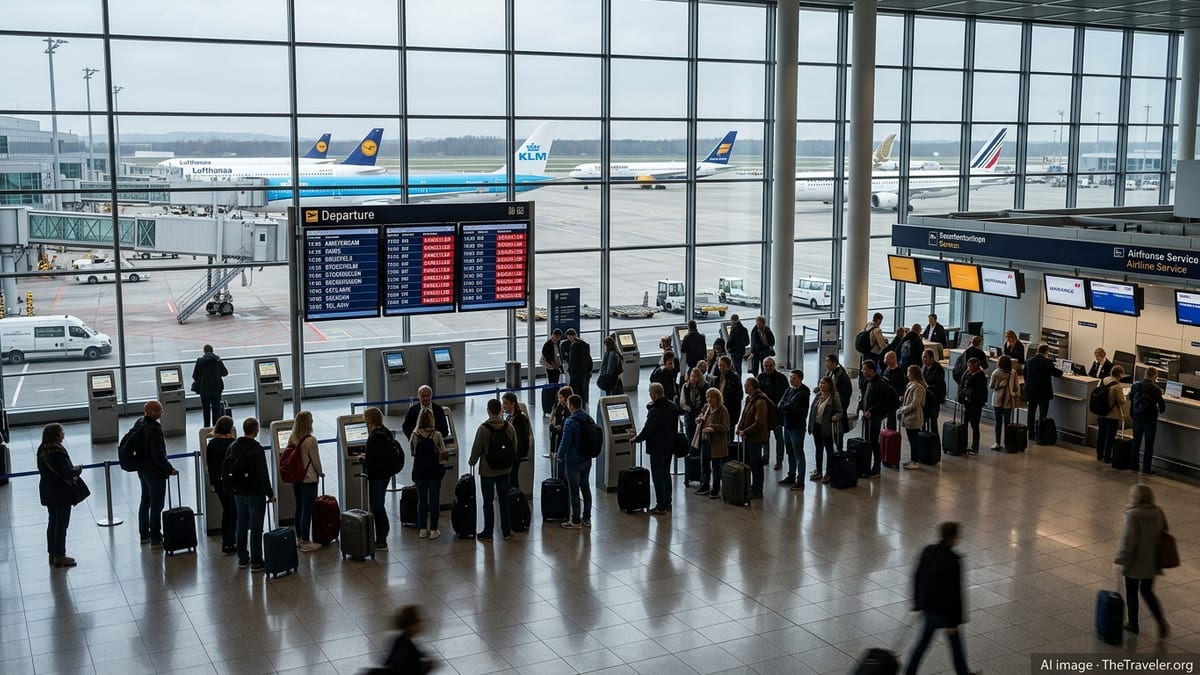
German Hubs Hit by Fresh Wave of Cancellations
Major German airports reported a fresh cluster of cancellations on Thursday morning, affecting both short haul and medium haul routes. Publicly available departure boards in Frankfurt and Munich showed a string of scrubbed services operated by Lufthansa and partner airlines, while regional airports also registered pockets of disruption.
The latest wave of cancellations involved at least 20 departures, according to live scheduling data reviewed at Germany’s main hubs. Affected flights included services to European capitals such as Amsterdam, Paris, Brussels, Stockholm and Copenhagen, as well as departures bound for Keflavik in Iceland and Tel Aviv.
The disruption followed weeks of heightened schedule volatility in Germany, where airline rosters have already been pressured by a mix of strike action, winter weather and operational constraints at key European air traffic control centers. On Thursday, passengers once again arrived at terminals to find departure boards marked with "cancelled" notices and long lines at airline service counters.
While the cancellations were concentrated at Frankfurt and Munich, delays rippled across wider networks as feeder flights into Germany were held back or retimed to avoid missed connections and aircraft rotations.
Multiple Airlines, From Europe to the Gulf, Affected
The impact stretched well beyond Germany’s flag carrier. In addition to Lufthansa, schedules published by major booking platforms and airport operators showed cancellations affecting services operated by KLM Royal Dutch Airlines, Icelandair, Gulf Air and Air France, among others.
Routes between Germany and the Netherlands were hit as at least one KLM departure to Amsterdam was removed from the departure board, forcing travelers to rebook on later flights or connect through alternative hubs. Icelandair passengers heading to Keflavik reported last-minute itinerary changes as the carrier adjusted its German services amid the broader disruption.
Connections between Germany and the Gulf were also affected. Gulf Air’s link between Frankfurt and Bahrain, a key route for business travelers and Middle East connections, appeared on revised schedules with disrupted timings and at least one cancelled rotation. Air France’s joint operations with Lufthansa on routes to Paris Charles de Gaulle were similarly reduced for parts of the day, narrowing options for travelers connecting onward to long haul networks.
Industry observers noted that the cancellations cut across airline alliances, affecting Star Alliance, SkyTeam and unaffiliated carriers. The pattern suggested a mix of local German issues and wider European network strains rather than a single airline-specific problem.
Routes to Bahrain, Tel Aviv and Northern Europe Disrupted
The list of affected destinations underscored how quickly a localized disruption in Germany can spread across wider regional networks. Flight tracking and schedule data for Thursday showed cancellations or severe delays on departures to Bahrain, Tel Aviv and several northern European capitals.
The Frankfurt to Bahrain route, served by Gulf Air and codeshare partners, saw at least one rotation removed from the schedule, compressing capacity for passengers traveling onward to Asia and other Gulf destinations. Travellers reported being rerouted via other European hubs such as Paris and Amsterdam as airlines attempted to preserve onward connections.
Links to Tel Aviv, long a focus of schedule adjustments for European carriers, remained fragile. Recent timetable updates have already reduced frequencies or temporarily suspended some German departures to Israel, and Thursday’s cancellations further limited options for passengers needing to travel on short notice.
In northern Europe, services from German hubs to Stockholm, Copenhagen and other Scandinavian cities faced a cluster of cancellations aligned with tight aircraft and crew availability. Passengers connecting from regional German airports onto these flights were among the most affected, often needing overnight stays or complex rebookings via alternate hubs such as Zurich or Vienna.
Operational Pressures Behind the Flight Chaos
Travel industry reporting over recent weeks points to a convergence of factors behind the latest turmoil. German aviation has been contending with a series of labor disputes, including recent industrial action involving cockpit and ground staff that has repeatedly forced airlines to thin their timetables and build in extra slack.
Alongside labor issues, winter weather across northern and central Europe has periodically reduced runway capacity and slowed air traffic flows. Earlier in the season, severe storms and snow prompted hundreds of cancellations in Germany and neighboring countries, creating a backlog of crew and aircraft repositioning that carriers are still working through.
European air traffic control capacity remains another constraint. Published coverage has highlighted how congestion and staffing challenges at key control centers, particularly in France and parts of Central Europe, can trigger flow restrictions that cascade across airline networks. On days when these restrictions coincide with local staffing shortages or technical issues at German airports, airlines often preemptively cancel flights to stabilize operations.
Analysts say the resulting pattern is one of rolling disruption. Even when weather at German airports is calm, knock-on effects from previous days’ irregular operations, coupled with tight schedules and high aircraft utilization, can push carriers to trim less critical frequencies, notably short haul links between major European cities.
Passengers Face Long Queues, Limited Options and Rights Questions
The immediate impact for travellers on Thursday was felt in long queues at check in, transfer and customer service desks as passengers scrambled to rebook. Social media posts and traveler forums carried reports of disrupted itineraries, with some customers being shifted onto next day departures or routed through alternative hubs at short notice.
For passengers departing from or transiting through Germany, European air passenger rules generally provide a framework for assistance and, in some cases, financial compensation. Public information on these regulations indicates that travelers whose flights are cancelled at short notice may be entitled to rerouting, meals and accommodation, and in certain circumstances compensation, depending on the cause of disruption and the length of delay.
Consumer advocates routinely urge passengers to retain boarding passes, booking confirmations and receipts for additional expenses such as hotels and meals when disruption occurs. Travellers are also advised to check both their airline’s dedicated disruption resources and any travel insurance policies that may offer supplemental coverage during major irregular operations.
With schedule volatility likely to remain elevated through the tail end of the winter season, travel industry commentary suggests that passengers flying through German hubs in the coming days should monitor their bookings closely, allow extra time for connections and be prepared for last minute changes as airlines continue to adjust their operations.