


More news on this day
Hundreds of travelers across Canada are facing unexpected overnight stays and missed connections as a fresh wave of flight disruptions hits major hubs and remote communities alike, with publicly available tracking data indicating at least 38 cancellations and 93 delays affecting services operated by Air Canada, Air Canada Rouge, Jazz, Inuit, Pacific Coastal and other carriers.
Get the latest news straight to your inbox!
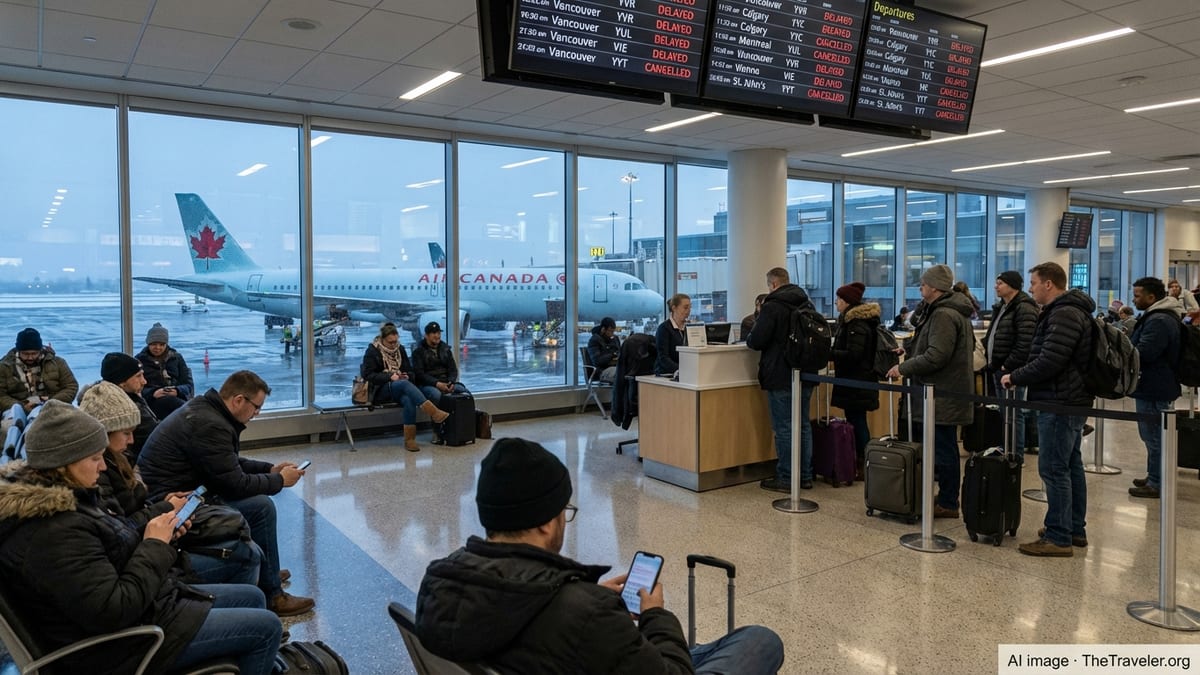
Major Hubs See Mounting Disruptions
Data compiled from live flight-status dashboards and airline travel outlook pages on June 13 indicate that Toronto Pearson, Vancouver International, Montréal Trudeau and Ottawa International are all reporting clusters of cancellations and late departures on services operated by Air Canada and its regional partners. These irregular operations are contributing to bottlenecks across Canada’s busiest corridors, particularly on east west routes and key transborder connections.
In Toronto, a concentration of cancelled departures and rolling delays on short haul routes has left passengers queuing for rebooking, with some forced to wait until later in the weekend for alternative seats. Similar patterns are visible in Vancouver and Montréal, where multiple departures are tagged as cancelled or significantly delayed rather than simply retimed by a few minutes.
Ottawa, though smaller, is also experiencing knock-on effects as aircraft and crews arrive late from disrupted hubs. Publicly available flight boards for the city show a series of evening flights departing well behind schedule, underscoring how quickly operational issues at one airport can ripple across the domestic network.
The disruption is not limited to a single airline. While Air Canada and its Rouge and Jazz-branded operations account for a large share of affected flights, independent regional and charter carriers are also appearing among today’s cancellations and long delays, highlighting the sensitivity of Canada’s integrated air network during peak travel periods.
Remote Communities Cut Off as Northern Routes Affected
Beyond the major urban centers, the latest round of disruptions is having an outsized impact on northern and remote communities. Flight-tracking platforms and carrier advisories show cancellations and extended delays on services linking hubs such as Montréal and Québec City with destinations in Nunavik and Nunavut, including Puvirnituq.
For travelers in communities like Puvirnituq, a single cancelled rotation can effectively isolate residents and visitors for an entire day or longer, since many routes operate only once or twice daily with limited backup capacity. Reports from recent disruption events in similar regions suggest that passengers can face multi day waits when aircraft or crews are out of position.
Regional airlines serving the North, including Inuit and Pacific Coastal, typically operate smaller fleets with tight schedules. When poor weather, congestion at southern hubs, or technical checks disrupt those schedules, there is often no immediate spare aircraft to plug into the rotation. This reality is reflected in today’s boards, where cancelled segments on remote routes are not immediately followed by additional relief flights.
Travelers bound for remote destinations are particularly vulnerable to missed connections from Toronto, Montréal, Vancouver or Ottawa. A delayed mainline flight into these hubs can mean a missed same day link to a northern community, leaving passengers stranded far from their final destination even when their specific regional flight has not been cancelled outright.
Weather, Congested Skies and Operational Strain Intersect
While no single nationwide weather event appears to be responsible, satellite imagery and air traffic status pages for June 13 indicate scattered thunderstorms and low cloud over parts of central and eastern Canada and adjacent U.S. airspace, conditions that frequently trigger flow restrictions and ground delay programs. Similar patterns in recent weeks at major North American hubs have produced significant knock on effects for Canadian carriers.
Analysts tracking earlier disruptions in 2026 have pointed to a combination of weather volatility, tight crew scheduling and high aircraft utilization as recurring stress points. When storms or low visibility force even modest schedule adjustments, airlines already operating close to capacity can rapidly run out of available crews or spare aircraft, leading to preemptive cancellations rather than minor retimings.
Publicly available consumer reports and passenger accounts over recent months also suggest that recovery from such events can be slow. Once aircraft and crews are scattered away from their planned rotations, airlines may take several days to restore normal patterns, particularly on long haul and northern routes where turn times and duty limits leave little flexibility.
Today’s pattern of 38 cancellations and 93 delays across multiple carriers fits this broader picture of a system that can be highly efficient when running smoothly but is prone to widespread disruption when several operational challenges converge at once.
Passenger Rights and Rebooking Challenges
The latest wave of cancellations and delays is once again drawing attention to passenger rights under Canada’s Air Passenger Protection Regulations. According to publicly available guidance from regulators and consumer advocates, travelers may be entitled to rebooking, refunds, meal vouchers or accommodation depending on the cause and length of the disruption, as well as the size of the carrier.
For disruptions within an airline’s control, such as certain crew or maintenance issues, compensation and care obligations can be more extensive than in cases involving severe weather or air traffic control restrictions. However, passengers have repeatedly reported difficulties in determining how a specific cancellation has been categorized, particularly when airline status pages list only generic disruption codes.
Rebooking is proving complicated for many of those caught up in today’s irregular operations. High load factors on summer flights mean that spare seats on alternative departures are limited, especially on routes linking major hubs with smaller regional airports. Travelers attempting to switch to other airlines often encounter higher last minute fares or limited availability, making it difficult to salvage tight itineraries or onward connections.
Consumer advocates generally recommend that stranded travelers keep detailed records of boarding passes, delay notifications and any additional expenses, and to follow up with airlines through official complaint channels if initial claims are denied. Published guidance also notes that travelers booked through third party agencies may need to coordinate with both the agent and the airline to secure refunds or rebookings.
Broader Strain on Canada’s Air Network
Today’s disruptions arrive against a backdrop of heightened scrutiny on airline reliability in Canada following several high profile operational meltdowns earlier in the year. In previous incidents, clusters of cancellations and delays at hubs like Toronto Pearson have stranded hundreds of travelers for extended periods, prompting criticism over contingency planning and communication practices.
Industry observers note that Canadian airlines and airports are still adapting to shifting demand patterns in 2026, with strong leisure travel, resurging business demand and the added complexity of serving remote communities. Carriers such as Air Canada have been adjusting networks and capacity, including route suspensions and equipment changes, in an effort to balance profitability with reliability.
Regional partners and independent carriers face their own challenges. Smaller fleets, constrained staffing and the need to operate in difficult weather environments leave limited room to absorb shocks. When problems at major hubs coincide with local weather or technical issues, the result can be cascading disruption that leaves communities effectively cut off for days.
With the busy summer travel season underway, the latest tally of 38 cancellations and 93 delays across Toronto, Vancouver, Montréal, Ottawa, Puvirnituq and other points serves as another reminder of how quickly Canada’s aviation system can become stretched, and how profoundly even a single cancelled flight can affect travelers in both major cities and remote northern communities.