


More news on this day
Summer air travel across the United States is facing renewed turbulence as severe weather, staffing strains and viral images of crowded terminals combine to trigger fresh waves of flight delays and cancellations at major hubs.
Get the latest news straight to your inbox!
Storm Systems Collide With a Busy Travel Season
Powerful storm systems sweeping through key aviation corridors are again testing the resilience of the U.S. air travel network at the height of the vacation season. Recent severe weather in the Midwest and along the Eastern Seaboard has led to ground stops at major hubs, leaving aircraft and crews out of position and passengers facing long waits in terminals.
In Chicago, publicly available airport data this week showed hundreds of cancellations and lengthy delays at O’Hare International Airport after thunderstorms moved through the region and ground operations were periodically halted. Similar patterns have played out along the Northeast corridor as lines of storms force traffic management programs that meter arrivals and departures into already congested airspace.
Forecast services and televised weather segments have been highlighting repeated rounds of heavy rain, thunderstorms and low clouds over major hubs including Atlanta, New York and Boston. These conditions reduce the capacity of runways and airspace, which means that even moderate storms can quickly lead to backlogs when airlines are operating near their maximum summer schedules.
Weather-focused video reports have urged travelers to monitor conditions not only at their departure and arrival airports but across the wider region, noting that storms hundreds of miles away can trigger ripple effects and force airlines to adjust flight paths and schedules with little warning.
Video From Packed Terminals Fuels Passenger Frustration
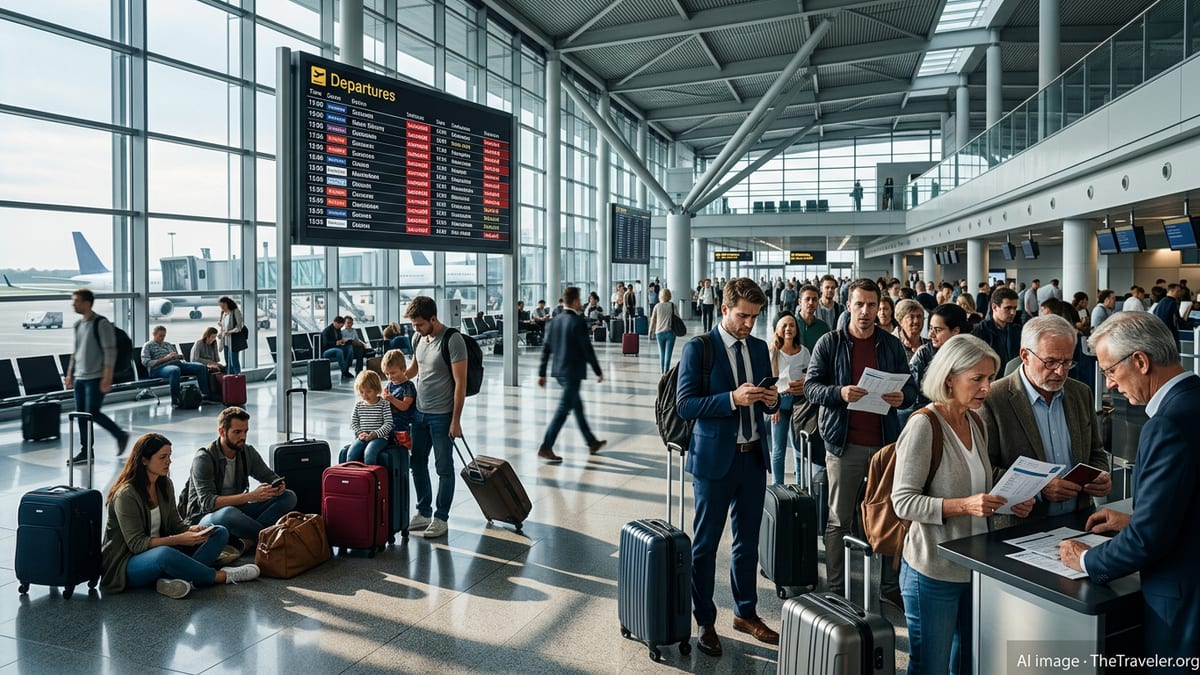
As disruptions mount, video filmed by passengers and airport agencies has become a central lens on the unfolding delays. Recent clips circulating on social platforms show early morning security lines stretching onto sidewalks in Austin, crowds camped out on terminal floors in the Northeast after overnight storms, and departure boards filled with red and yellow delay notices at New York and Chicago airports.
Airports themselves are increasingly using short video updates to show conditions inside terminals and to urge passengers to arrive early. One widely shared clip from a Texas airport showed security lines snaking through the concourse in the pre-dawn hours, underscoring how staffing constraints and sudden surges in demand can slow screening even before weather issues fully materialize.
These images have amplified public scrutiny of airlines and government agencies, particularly when airlines attribute long waits and cancellations to weather while passengers observe clear skies overhead. Aviation specialists note that such scenes can be misleading, as delays often stem from weather or congestion elsewhere in the national airspace system rather than at the specific airport where travelers are waiting.
Nonetheless, the spread of real-time video from terminals and aircraft cabins has made the broader public more aware of how quickly local disruptions can escalate, and how difficult it can be for airlines to recover once storms and staffing problems collide during peak periods.
Airline and Airport Staffing Remains a Vulnerable Link
Behind the scenes, staffing challenges continue to compound the impact of bad weather. Aviation unions and industry observers report that flight crews, air traffic controllers, meteorologists and ground staff are still under strain as schedules expand to meet strong demand. Even when overall staffing numbers have risen, localized shortages or tight crew scheduling can leave little margin when storms or technical problems force widespread rebooking.
Air traffic control staffing in particular has drawn sustained concern. Government accountability reports and congressional testimony in recent years have flagged shortfalls at key facilities and noted that controller training pipelines take years to replenish. When control centers are short staffed and thunderstorms reduce usable airspace, officials often respond by slowing traffic flows, which can trigger rolling delays far from the affected region.
On the ground, reports from major airports describe security checkpoint backups and long check-in lines when shifts run short or when workers call out after extended overtime. Some security officers and ground staff have cited rising costs and the need for second jobs as reasons for leaving the field, adding pressure as travel volumes approach or exceed pre-pandemic highs.
Flight attendant groups have also highlighted aggressive summer scheduling and reserve practices, warning that thin staffing can make it more difficult to recover from disruptions. When crews time out under federal duty rules because of prolonged delays, airlines can be forced to cancel flights even after weather has improved.
Recent Outages Highlight Systemic Fragility
Recent technology problems have further exposed how tightly coupled weather, staffing and scheduling have become. This week, an information technology outage at a major U.S. carrier prompted a temporary nationwide ground stop, according to published coverage that cited federal aviation advisories. Although some delays were formally categorized as weather related, the disruption quickly cascaded through the carrier’s network, leaving passengers stranded for many hours.
The incident drew comparisons to past large-scale meltdowns in which a single point of failure combined with winter storms or summer thunderstorms to produce days of rolling cancellations. Analysts note that when airlines operate dense schedules with limited spare aircraft and crews, any major outage or storm cluster can overwhelm recovery plans.
Data from tracking services and previous summer seasons show that the majority of flight disruptions still originate with weather and airspace volume constraints. However, once delays begin to mount, staffing gaps, gate availability issues and tight aircraft rotations can turn what might have been manageable interruptions into multi-day events for some travelers.
Observers point out that this pattern is increasingly visible in real time as passengers share videos of gate changes, crew timeouts and last-minute cancellations, adding a digital record to what was once largely an internal operational challenge.
What Travelers Can Expect Through the Rest of Summer
Looking ahead to August, forecasts suggest that storm risks will remain elevated over parts of the Midwest, Northeast and Southeast, areas that host some of the country’s busiest hubs and air traffic corridors. Combined with continued strong leisure travel demand, that raises the likelihood of additional days with widespread delays, particularly on Fridays and Sundays when schedules are heaviest.
Consumer advocates and transportation analysts recommend that travelers build extra time into their plans, favor early morning departures when possible and closely monitor both airline notifications and regional weather outlooks. Some carriers have issued periodic travel waivers during major storm systems, allowing passengers to change flights without additional fees when forecasts indicate significant disruption.
Publicly available performance dashboards from federal regulators show that, even in difficult conditions, most flights eventually operate, though often with extended delays. However, the gap between statistical performance and individual experience remains wide for travelers who find themselves sleeping on terminal floors after missed connections or waiting hours for rebooked flights.
With summer far from over, the intersection of volatile weather, lean staffing and near-capacity airline schedules suggests that viral airport videos are likely to remain a feature of the travel landscape. For now, the nation’s aviation system continues to operate, but with little spare room when storms and labor shortages converge at the same time and place.