


More news on this day
Hundreds of air travelers faced unexpected overnight stays and missed connections as KLM, Volaris, easyJet, British Airways, Air France, Norwegian Air Sweden and Austrian Airlines canceled 66 flights and delayed 564 more across Europe and Mexico, causing fresh disruption at already congested hubs.
Get the latest news straight to your inbox!
Disruptions Spread From Amsterdam to Mexico City
Publicly available data on recent operations shows that the latest wave of disruption has stretched from Amsterdam Schiphol and London airports to hubs in France, Austria and Mexico, with knock-on effects into surrounding countries. The affected network spans the Netherlands, Mexico, the United Kingdom, France, Austria and additional European destinations as delayed aircraft and crews cascade through tightly timed schedules.
Reports indicate that KLM and its partners experienced particularly sharp disruption at Schiphol, where a mixture of operational constraints and reactionary delays from earlier days left aircraft and crews out of position. As flights into and out of Amsterdam ran late, onward services to the UK, France, Austria and other European destinations also slipped behind schedule, multiplying the impact on passengers.
In parallel, low cost and leisure operations added further strain. Coverage from independent travel and disruption trackers shows easyJet and Norwegian Air Sweden facing elevated delay levels on intra-European routes, while Mexican carrier Volaris reported cancellations and delays on services linking Mexico with domestic and regional destinations. Austrian Airlines and Air France also appeared among the carriers with notable schedule changes, underscoring how widely the problems spread across airline groups.
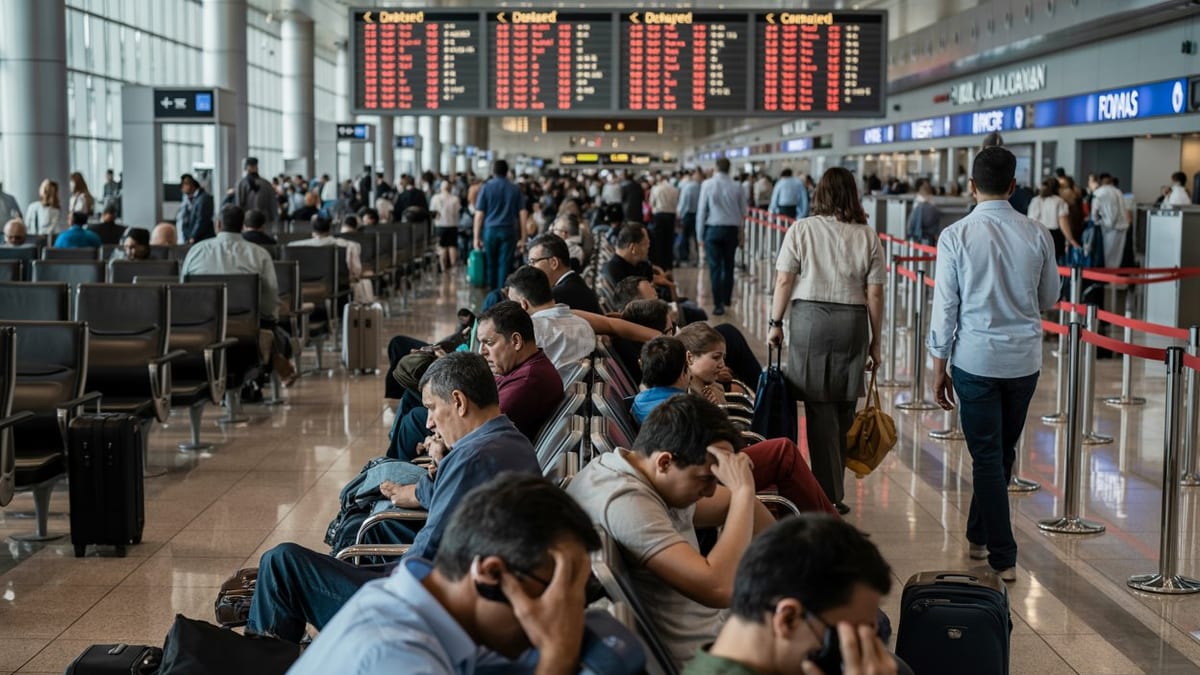
The cumulative effect left airport terminals crowded with travelers attempting to rebook, reclaim bags or secure overnight accommodation. While total passenger counts are not yet available, the combination of 66 cancellations and more than 560 delayed flights suggests that many hundreds, and likely several thousand, journeys were disrupted in a single operational window.
Operational Strain and Weather Add to Structural Pressure
Published coverage of recent European operations points to a mix of causes behind the latest episode. Industry analyses highlight air traffic control capacity limits, local weather and tight aircraft utilization as recurring pressure points that make networks vulnerable when any one element fails. Once a morning wave of flights falls behind, the remainder of the day often becomes a complex recovery exercise.
At large hubs such as Amsterdam Schiphol, Paris Charles de Gaulle, Vienna and major UK airports, dense schedules leave little room for error. Reports on earlier disruption days this year note that a relatively small number of cancellations or long delays in the first rotation can result in widespread missed connections later, particularly for carriers such as KLM, Air France and British Airways that rely heavily on connecting traffic.
Weather has also played a role in recent months, with earlier snow and low-visibility events in northern Europe leading to de-icing bottlenecks and temporary runway capacity restrictions. While the current 66 cancellations and 564 delays appear to stem largely from operational and network factors rather than a single severe weather event, the earlier disruptions have left some fleets and rosters less resilient, widening the impact when new problems emerge.
Analysts note that rising traffic volumes across Europe in 2025 and 2026 have added structural pressure. Data from regional aviation bodies shows daily flight counts climbing back above pre-pandemic levels on peak days, while staffing and infrastructure at some airports and air navigation providers have expanded more slowly. This imbalance heightens the risk that localized issues at one hub can quickly radiate into neighboring markets.
Passengers Face Long Queues, Missed Connections and Extra Costs
For travelers, the numbers translate into long hours in terminal corridors and departure halls. Accounts gathered by consumer-rights platforms and social media posts describe lengthy queues at airline customer service desks, with some passengers in Amsterdam, London and Paris waiting several hours for rebooking or accommodation vouchers after their flights were canceled.
Missed connections proved particularly disruptive for long haul passengers connecting through European hubs. A delayed departure from Mexico or a regional European airport often meant that onward flights to North America, Africa or Asia left before affected travelers could arrive, leaving them to be rebooked on later services that were already close to full during a busy travel period.
Accommodation became a pressure point as well. In cases where cancellations occurred late in the day, hotels near major hubs in the Netherlands, France and the UK reportedly saw a surge of stranded travelers looking for last minute rooms. Some passengers were able to secure airline-provided lodging, while others paid out of pocket and planned to seek reimbursement later under applicable passenger rights rules.
Baggage handling delays added another layer of frustration. When flights were canceled after boarding or during periods of heavy rerouting, bags were sometimes left behind at hub airports. Travelers reported using tracking tags and airline bag tracing tools to locate luggage that did not arrive with them on subsequent rebooked flights.
What Passenger Rights May Apply in Europe and Mexico
According to publicly available guidance on air passenger protections, many of the affected flights within and departing from Europe fall under European Union Regulation 261 and parallel UK rules. These frameworks generally provide travelers with a choice between a refund of the unused part of the ticket or rerouting at the earliest opportunity when a flight is canceled, along with a duty of care that can include meals, refreshments and hotel accommodation during extended waits.
Compensation in the form of fixed cash payments may also be available in some situations when flights are canceled or heavily delayed for reasons within an airline’s control, such as certain operational or technical issues. However, not every disruption qualifies for this type of compensation, and weather, air traffic control restrictions or airport infrastructure problems may fall into categories that limit eligibility.
For services involving Mexico, passenger protections depend on whether the flight is domestic, international, and which country’s laws apply to the ticket and operating carrier. Local regulations in Mexico include provisions on refunds and assistance when flights are canceled or subject to lengthy delays, and travelers are typically advised by consumer organizations to review both national rules and the specific conditions of carriage for their airline.
Specialist claims firms and non-profit passenger advocacy groups note that travelers should keep boarding passes, booking confirmations and receipts for food, transport and accommodation, as these documents can be essential when seeking reimbursement or statutory compensation after the fact.
Guidance for Travelers Caught in Ongoing Disruptions
As airlines work through the backlog created by the 66 cancellations and 564 delays, operational data suggests that residual knock-on effects may continue for at least another day on certain routes. Aircraft and crews remain out of their usual patterns, which can translate into further schedule adjustments even after the worst of the disruption has passed.
Travel experts frequently recommend that passengers due to fly with KLM, Volaris, easyJet, British Airways, Air France, Norwegian Air Sweden and Austrian Airlines monitor their bookings closely through official airline channels on the day of travel. Check-in times, departure gates and estimated departure times may change repeatedly as carriers attempt to consolidate lightly booked flights and redeploy aircraft to the most in-demand routes.
When faced with a cancellation or long delay, travelers are often encouraged by consumer advisers to act quickly but calmly, using a combination of airline apps, web tools and telephone lines to seek rebooking. In busy situations, digital channels can sometimes offer new itineraries more quickly than airport desks, particularly when lines are long and staff numbers limited at the terminal.
Industry observers add that, while occasional days of heavy disruptions may be unavoidable in a complex global aviation system, clear communication and consistent application of passenger rights remain crucial. The latest episode affecting KLM, Volaris, easyJet, British Airways, Air France, Norwegian Air Sweden and Austrian Airlines highlights how even a few dozen cancellations, when paired with hundreds of delays, can ripple across multiple countries and leave travelers relying on those protections to reach their destinations.