

More news on this day
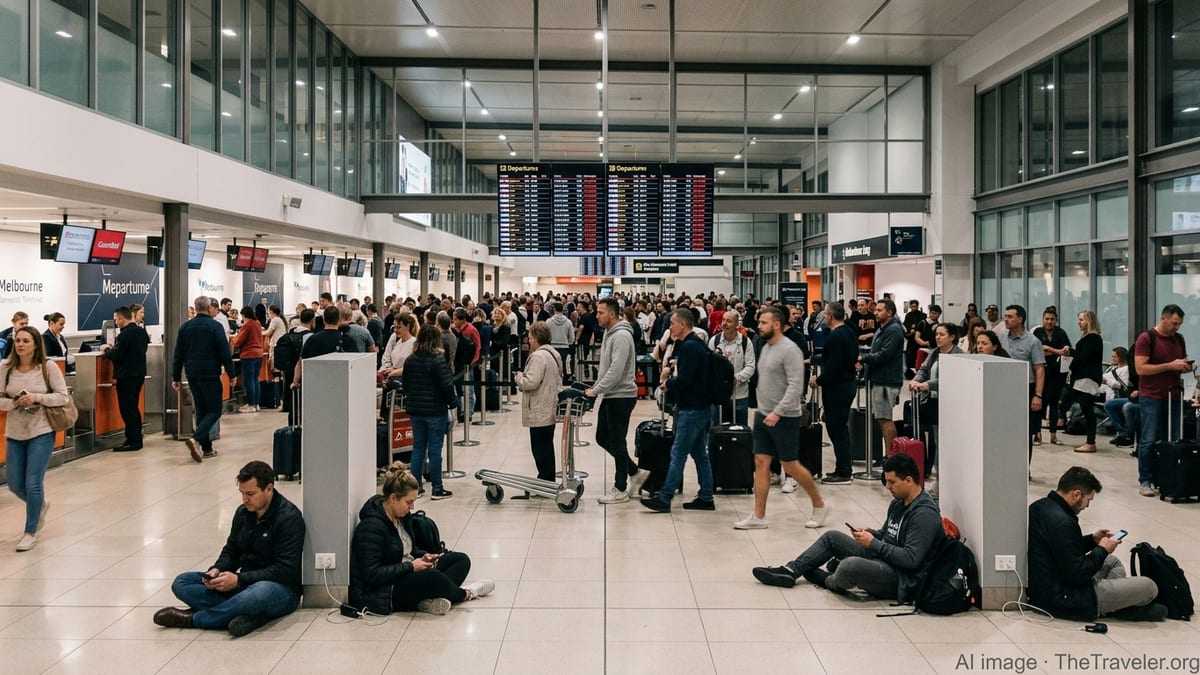
Hundreds of passengers were left stranded at Melbourne Tullamarine and Sydney airports after more than 40 flights on the busy east coast corridor were cancelled, creating long queues, missed connections and an evening of uncertainty for domestic and international travellers.
Get the latest news straight to your inbox!
Widespread Cancellations Disrupt Australia’s Busiest Air Route
Published coverage from Australian outlets indicates that the bulk of the disruption centered on services between Melbourne and Sydney, one of the world’s busiest short-haul routes, along with onward domestic connections. The wave of cancellations affected both peak-hour commuter traffic and leisure travelers, compounding pressure on terminals already handling heavy late-summer demand.
Reports describe more than 40 flights being cancelled or heavily delayed across the two airports within a single operational window, forcing airlines to re-accommodate passengers on already full services. Social media posts from stranded travelers showed departure boards dominated by “cancelled” notices and long lines at service desks as passengers tried to secure alternative routes.
Melbourne Airport, also known as Tullamarine, and Sydney Airport are Australia’s two busiest aviation hubs and key gateways for both domestic and international traffic. When services on the Melbourne–Sydney corridor are disrupted, the knock-on effect can quickly spread nationwide as aircraft and crews are left out of position.
Publicly available data on Australian domestic aviation shows that cancellation rates typically sit in the low single digits, but concentrated clusters of cancellations, as seen in this disruption, can overwhelm airline recovery plans and leave travelers with few same-day alternatives.
What Appears To Be Driving the Disruption
Early reports point to a mix of operational pressures rather than a single dramatic incident. Australian aviation observers note that the east coast network is particularly sensitive to compounding issues such as adverse weather, congestion in Sydney’s tightly regulated airspace, and staffing or maintenance bottlenecks that ripple through tightly scheduled fleets.
When multiple services on a single trunk route are removed in quick succession, airlines often consolidate remaining passengers into fewer flights to optimize capacity. While this approach can reduce the number of empty seats, it also means that later cancellations leave no buffer, as most subsequent flights are already full.
Analysts have also highlighted that Australia’s domestic aviation system is operating close to capacity on key routes, with limited slack for extended delays or equipment substitutions. In practice, this means that when one city experiences weather or air traffic control constraints, aircraft rotations between Melbourne, Sydney and other capitals can be disrupted for many hours.
Industry documents and recent government reports have drawn attention to the financial incentives for airlines to cancel underperforming services, since there are minimal penalties attached to scrapping flights while consolidating passengers onto others. This broader structural context helps explain why clusters of cancellations can emerge quickly during periods of heightened operational stress.
Impact on Passengers at Melbourne Tullamarine and Sydney
Travelers caught in the disruption reported lengthy queues at check-in and rebooking counters, with some passengers at Melbourne Tullamarine facing waits of more than an hour simply to speak with airline staff. Similar scenes were reported at Sydney’s domestic terminals, where passengers sought information about missed connections, overnight accommodation and baggage retrieval.
Families with children, international visitors unfamiliar with local consumer rules, and passengers with time-sensitive commitments such as business meetings or medical appointments appeared to be particularly affected. As cancellation waves took hold, options for same-day rebooking narrowed, especially on peak services between Melbourne and Sydney and onward flights to Brisbane, Adelaide and Perth.
Some travelers turned to alternative arrangements such as last-minute hotel stays near the airports, same-day car rentals for long interstate drives, or re-routing through secondary cities where spare capacity remained. However, these alternatives often came at significant additional cost, particularly during busy periods when accommodation near major airports is already in high demand.
The scenes reinforced longstanding concerns from consumer advocates that Australian passengers face a high level of disruption risk on core domestic routes, with limited guaranteed support when flight schedules unravel at short notice.
What Rights Passengers Have Under Australian Rules
Australian consumer law provides general protections for air travelers, but the framework differs from more prescriptive compensation regimes seen in some other regions. According to publicly available guidance from the Australian Competition and Consumer Commission, air tickets are treated as a service, which must be provided with due care and within a reasonable time, or else passengers may be entitled to a remedy such as a refund, credit or alternative service.
In practice, the assistance a traveler receives often depends on whether the cancellation is considered within the airline’s control, such as mechanical or staffing problems, or outside its control, such as severe weather or air traffic control restrictions. Airlines usually publish their own customer charters outlining how they respond in each scenario, with varying commitments on meals, accommodation and transfers.
Recent policy discussions in Australia have considered strengthening passenger protections through a formal charter of rights, reflecting rising public frustration over cancellations and delays. Consumer groups argue that clearer, enforceable obligations around compensation and care would give airlines stronger incentives to maintain reliability and provide consistent support when disruptions occur.
For now, passengers affected by events such as the recent cancellations in Melbourne and Sydney must typically pursue remedies directly with their airline, keeping detailed records of expenses and communications, and escalating complaints through internal processes or external dispute resolution bodies if needed.
Practical Steps for Travelers Facing Cancellations
Travel experts recommend that passengers confronting mass cancellations act quickly while maintaining clear documentation. As soon as a flight is listed as cancelled or severely delayed, travelers are advised to check their airline’s app or website, which may offer self-service rebooking tools that can be faster than waiting in terminal queues.
Where same-day alternatives are scarce, passengers may wish to consider nearby airports or indirect routings that still reach their destination within an acceptable timeframe. Flexible travelers might benefit from asking airline staff about re-routing via secondary cities, or from monitoring seat availability on other carriers, bearing in mind that separate tickets can complicate baggage and connection protections.
Keeping receipts for meals, transport and accommodation is important if travelers later seek reimbursement. Publicly available guidance suggests that detailed evidence of out-of-pocket costs, along with time-stamped communications from airlines, can strengthen any claim under consumer law or through an airline’s own goodwill policy.
Looking ahead, travel planners suggest building additional buffer time into itineraries involving key Australian hubs such as Melbourne Tullamarine and Sydney, particularly when connecting to international services. Leaving longer gaps between flights, avoiding the tightest possible connections, and considering travel insurance that explicitly covers disruption can all help reduce the personal and financial impact of sudden cancellation waves.