

More news on this day
Flights into Bogotá, Medellín and Cartagena are facing fresh disruption this week, as a mix of weather, labor slowdowns and access blockages ripple across Colombia’s busiest air corridors.
Get the latest news straight to your inbox!
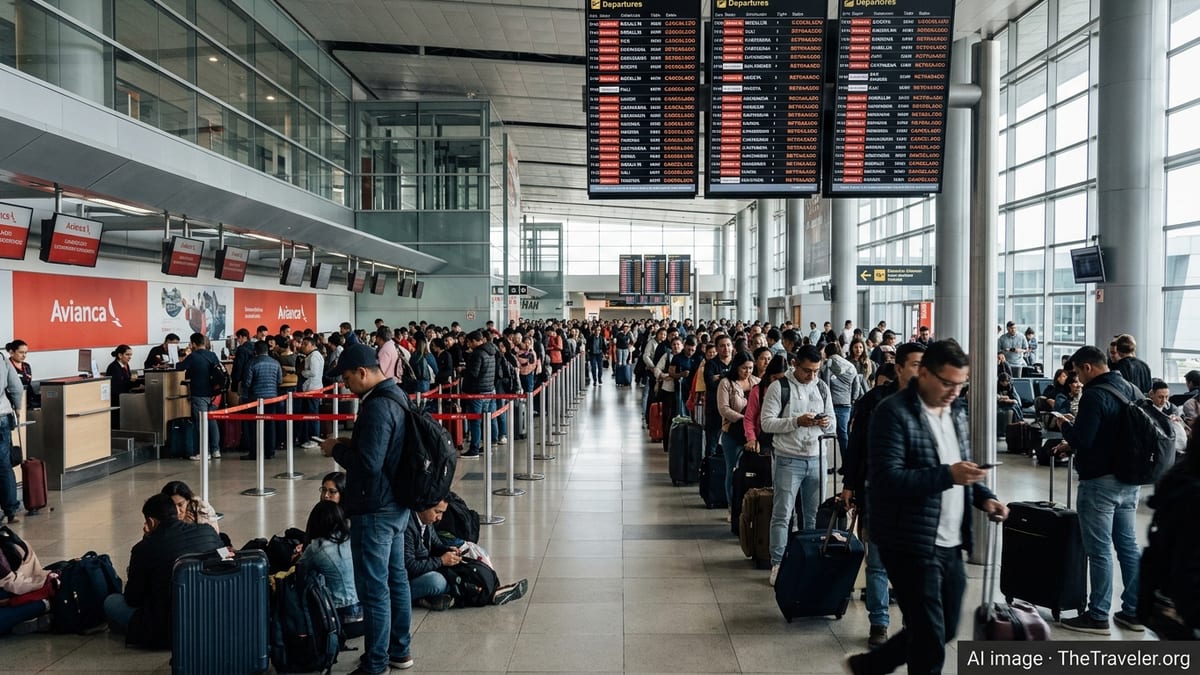
Weather and Capacity Strains Hit Bogotá Hub
Bogotá’s El Dorado International Airport, the country’s main gateway, has seen repeated delays in recent days attributed to low cloud ceilings and rain over the capital. Publicly available meteorological information points to periods of high cloud cover and showers that have limited runway capacity and slowed arrivals and departures, triggering knock-on delays on domestic routes linking Bogotá with Medellín and Cartagena.
El Dorado is operating under growing pressure as travel demand continues to rise. Data shared in recent months by airport operators and industry groups indicates that passenger numbers at the hub climbed to record levels in 2025, with more than 45 million travelers moving through the terminal in a single year. With traffic now approaching pre-pandemic growth trajectories, even short reductions in runway throughput can quickly translate into long queues on departure boards.
Industry analyses also highlight that Colombia’s domestic market relies heavily on single-aisle jets such as the Airbus A320 family, used intensively on the trunk routes between Bogotá, Medellín and Cartagena. Previous technical checks and fleet adjustments affecting these models have reduced scheduling flexibility, leaving airlines with fewer options to recover when weather or congestion force ground holds at El Dorado.
Recent operational bulletins from Colombia’s civil aviation authorities and partner organizations describe a broader effort to optimize airspace and runway use at Bogotá. Studies commissioned from international aviation bodies are examining how to improve capacity, but travelers this week are still facing real-time impacts as those long-term solutions remain in development.
Labor Actions and “Operation Turtle” Slow Border Controls
Beyond weather, staffing tensions have become a significant factor in the latest disruptions. Published coverage in Colombian media describes a so-called “operation turtle” implemented by some migration officials at El Dorado earlier this year, in which stricter step-by-step procedures and slower processing speeds were applied at passport control. The measures have contributed to extended lines for outbound and inbound travelers and, in some cases, missed connections onto onward domestic flights.
Reports indicate that the labor action is linked to long-running disputes over bonuses and working conditions at border-control agencies. A contingency plan was activated to reassign staff and open additional positions, but observers note that peak-hour strain persists, especially for morning departures toward the United States and other international destinations. When international flights depart late from Bogotá, aircraft and crew rotations onto domestic legs to Medellín and Cartagena can be pushed back as well.
Travel advisories circulating in local outlets now encourage passengers departing El Dorado on international services to arrive significantly earlier than usual to clear migration checks. Those additional buffers are spilling into domestic travel planning, as airlines ask connecting passengers to leave more time between flights in case of further delays at security or passport control.
While the most visible backlogs have appeared in Bogotá, the effects reach across the network. Carriers relying on tight turnarounds of aircraft and crews at smaller Colombian airports have less room to absorb late arrivals from the capital, which has contributed to rolling schedule adjustments on the Bogotá–Medellín and Bogotá–Cartagena corridors.
Road Protests Choke Access to Bogotá Airport
The latest challenge has come from the ground. On April 9, nationwide demonstrations by taxi drivers in Bogotá and rural groups across Colombia led to blockages on several key roads, including partial closures on access routes to El Dorado. National and international press reports describe long lines of taxis and intermittent barricades near the airport that have slowed passenger and staff movements in and out of the terminal.
Although airside operations at El Dorado have largely continued, the restricted road access has caused significant difficulty for travelers trying to reach flights on time. Airlines have been forced to manage an influx of late-arriving passengers, while some flights have departed with empty seats when ground transport problems prevented travelers from reaching the gates before boarding closed.
Observers note that disruptions of this kind are especially damaging for tightly timed domestic networks. Delayed departures from Bogotá to Medellín’s José María Córdova International Airport and Cartagena’s Rafael Núñez International Airport can force cascading adjustments later in the day, with aircraft arriving after curfew windows or missing planned rotations to other Colombian cities.
Travel forums and social media posts monitored by local outlets show some passengers rerouting via alternative cities or requesting last-minute hotel stays near El Dorado while waiting out the protests. Tour operators selling multi-city itineraries that combine Bogotá, Medellín and Cartagena also appear to be fielding increased inquiries about schedule flexibility and backup plans.
Knock-On Effects in Medellín and Cartagena
While Bogotá is the primary bottleneck, Medellín and Cartagena are feeling the downstream impact. Flight-tracking data and recent media coverage point to arrival delays on services from the capital into both cities, occasionally stretching beyond an hour during peak disruption. These late arrivals compress turnaround times at the gates and can affect subsequent departures, particularly on evening banks.
Medellín’s José María Córdova airport, which handles a mix of domestic and international services, has been absorbing a higher volume of travelers as airlines expand point-to-point routes that bypass Bogotá. However, the current wave of delays shows that many itineraries still depend on timely feeder flights from the capital. When those flights suffer, passengers can miss connections onward to secondary cities or face last-minute rebookings.
Cartagena, one of Colombia’s most visited leisure destinations, is similarly exposed. Tourism-focused carriers and charter operators rely on predictable schedules to align with hotel check-in windows and cruise departures. Late arrivals from Bogotá this week have led some travelers to arrive after dark or lose valuable vacation time, according to accounts collected by local tourism and hospitality outlets.
Airport operators in both Medellín and Cartagena have continued to emphasize that runways and terminal facilities are functioning normally. The core constraint remains the punctuality of inbound aircraft from Bogotá, which determines whether daily rotations stay on schedule or slip progressively behind throughout the day.
What Travelers Should Expect in the Coming Days
Industry briefings and public statements from aviation bodies suggest that the structural pressures behind these disruptions will not disappear immediately. Capacity upgrades, new procedures to manage bad weather at El Dorado and negotiated solutions to labor disputes are in progress but will take time to translate into consistently smoother operations on the Bogotá–Medellín and Bogotá–Cartagena routes.
In the short term, publicly available guidance advises travelers to build more slack into their itineraries. This includes arriving earlier at Bogotá’s airport, especially for international departures, allowing longer connection windows between flights and staying in close contact with airlines for real-time updates on schedule changes.
Tourism planners are also adapting. Some package providers are revising day-by-day programs to reduce same-day flight connections between Bogotá, Medellín and Cartagena, favoring either non-stop services or overnight stops that provide more room for delays. Hotel operators near major airports report an uptick in same-day bookings linked to missed flights and last-minute rebookings.
Despite the current turbulence, demand for travel within Colombia remains strong. Industry data for early 2026 points to continued growth in domestic and inbound tourism, suggesting that once operational bottlenecks ease, routes among Bogotá, Medellín and Cartagena will remain among the busiest and most strategically important in the country’s aviation network.