


More news on this day
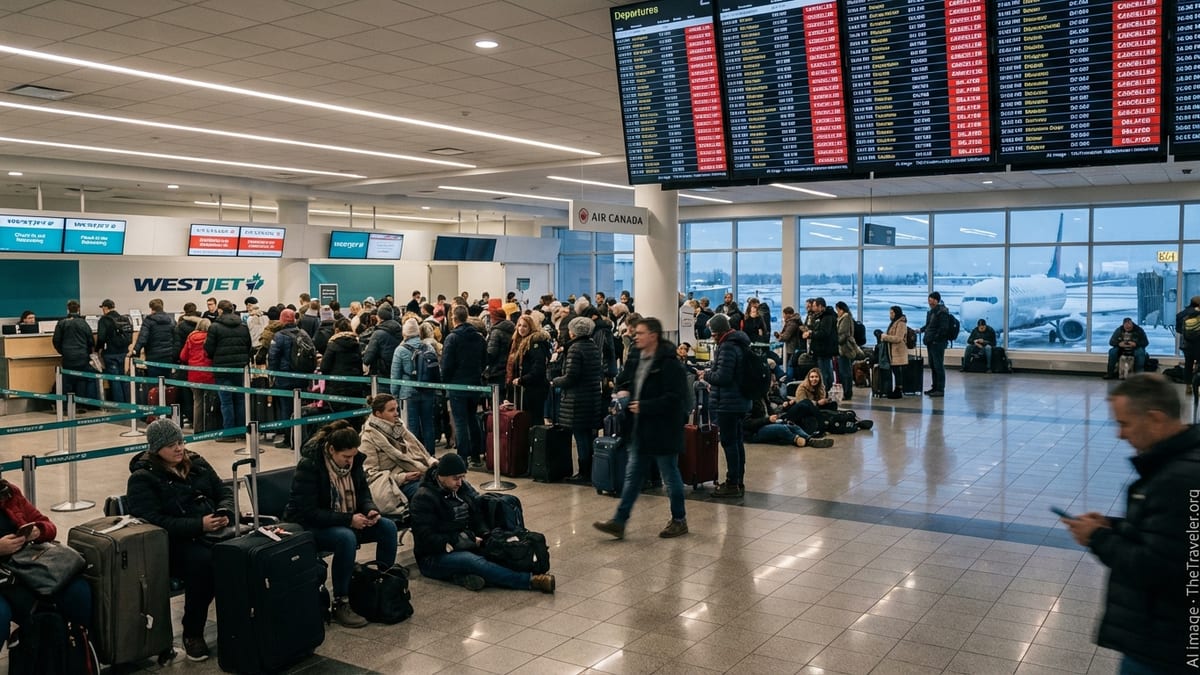
A fresh wave of flight disruptions at Calgary International Airport is rippling across Canada, as publicly available tracking data shows at least 36 delayed departures and arrivals and five outright cancellations affecting major carriers including WestJet, Air Canada Rouge, United Airlines and KLM, with knock-on impacts for passengers traveling through Toronto, Vancouver and other key hubs.
Get the latest news straight to your inbox!
Hub Turbulence at Calgary Sends Disruptions Nationwide
Calgary International Airport functions as a primary hub for WestJet and an important connecting point for Air Canada and international partners such as KLM and United. When operations slow in Calgary, the effects extend quickly along the country’s busiest corridors, including links to Toronto Pearson and Vancouver International, as well as crossborder and transatlantic services. Industry data and live tracking platforms on June 16 pointed to a concentrated cluster of irregular operations centered on Calgary, with dozens of delayed flights and a series of cancellations across multiple airlines.
Reports from flight status and aviation schedule services indicate that WestJet, Air Canada Rouge, United and KLM all had aircraft operating through Calgary caught up in the disruption. Although the specific causes varied by flight, the result was a day of extended waits at departure gates, missed connections and last minute rebooking for passengers traveling across Canada. Routes between Calgary and major cities such as Toronto and Vancouver were among those showing recurrent delays, compounding congestion at already busy terminals.
As the day unfolded, at least five flights linked to the Calgary hub were listed as cancelled in national schedules, while more than 30 others recorded significant delays. These figures represent only a snapshot of activity at one point in time but illustrate how quickly conditions at a single hub can translate into a wave of inconvenience for travelers right across the network.
Because Calgary also serves as a launch point for long haul services to Europe and seasonal leisure destinations, some of the delays extended well beyond domestic itineraries. Passengers on international connections found themselves facing tighter transfer windows or forced overnight stays when early segments departed behind schedule.
Domestic Corridors to Toronto and Vancouver Hit Hard
Canada’s two busiest domestic routes from Calgary, to Toronto and Vancouver, felt the effects sharply. Tracking boards on Monday showed westbound and eastbound services repeatedly tagged with late departure times, including both WestJet and Air Canada mainline flights shuttling between Alberta and the country’s two largest metropolitan areas. Even where aircraft ultimately departed, altered timings began to erode planned connections to onward flights across Canada, the United States and overseas.
Publicly available data for flights such as Air Canada’s Toronto to Calgary services and WestJet’s Calgary to Montreal and Seattle links highlighted the sensitivity of the network to delays at a key hub. Aircraft arriving late in Calgary led to compressed turnaround windows, while crews and ground operations attempted to keep subsequent departures within allowable duty and scheduling limits. In some cases, delays that initially appeared modest grew longer as aircraft missed their assigned slots and had to be re-sequenced.
While Calgary experienced the core of the disruption, Toronto and Vancouver also showed secondary effects on their departure boards, as aircraft originating from Alberta failed to arrive on time. Travelers booked on later segments from those airports, including short haul hops and international departures, were advised through airline channels and airport information systems to monitor their flight status closely and prepare for potential changes.
For passengers whose journeys spanned multiple carriers, the knock-on delays created particular challenges. Missed domestic links could jeopardize international departures operated by partner airlines, leaving travelers dependent on same day rebooking options that were limited by high summer demand and aircraft availability.
International Carriers and Partner Airlines Entangled
Calgary’s role as a connecting point for transborder and transatlantic traffic meant that disruptions quickly enveloped international carriers as well. Flight status services showed United Airlines services between the United States and Calgary facing altered schedules, while KLM-linked operations routed through the Alberta hub also experienced irregular timings. These impacts reflected how code share partnerships and alliance networks tie Canadian domestic operations to a much wider web of routes.
For KLM, Calgary functions as an important spoke feeding into European services, with passengers often combining domestic segments operated by Canadian partners with long haul flights to Amsterdam and beyond. When those feeder flights are delayed or cancelled, travelers can lose their onward connections, triggering complex re-accommodation processes that stretch across different reservation systems and time zones.
Similar patterns emerged for United, which relies on coordinated schedules with Canadian partners to move passengers between U.S. hubs and points across Western Canada. A delayed or cancelled Calgary segment can reverberate throughout that network, affecting everything from short haul business trips to longer itineraries involving multiple stops. On days when operational stress is high, even a small number of cancellations can translate into hundreds of passengers requiring new arrangements.
Seasonal and leisure focused services operated by Air Canada Rouge also faced pressure. With aircraft and crews already tightly scheduled for peak travel periods, irregular operations in Calgary left few spare resources to absorb extended delays, increasing the likelihood that selected flights would be consolidated or cancelled outright.
Weather, Congestion and Operational Strain Combine
On complex travel days, no single factor fully explains the scale of disruption. Aviation tracking tools and recent coverage of operations at Calgary point instead to a mix of contributing elements that can include adverse weather patterns in Western Canada, air traffic control flow restrictions, crew duty limitations and ground handling bottlenecks. When several of these issues occur at once, the margin for recovery narrows quickly.
Calgary’s geography and climate mean that wind, storms or rapidly changing conditions can impose sudden constraints on arrivals and departures. If aircraft must be spaced further apart on approach or departure, or if runways require additional maintenance intervals, schedules designed for high throughput can quickly back up. De-icing requirements and low visibility procedures in particular have been cited in previous seasons as triggers for widespread delays, even when airlines have attempted to build additional buffer time into their timetables.
Operational strain can also arise from factors within carriers’ control, such as tight aircraft utilization plans that leave little room to reposition jets or crews when a disruption occurs. In those circumstances, an initial delay on a morning departure may cascade across a full day of flights, turning what began as a modest setback into missed connections and cancellations much later in the schedule.
Passengers traveling through busy hubs like Calgary therefore often experience disruption not as a single isolated event but as a sequence of shifting departure times, gate changes and rebookings, with limited visibility into the underlying operational decisions unfolding across multiple airlines and airport partners.
Passengers Navigate Canada’s Air Passenger Rules
For travelers caught in the latest round of disruptions, attention quickly turned to what assistance and remedies might be available under Canada’s air passenger protection framework. Public guidance from consumer advocates and government resources highlights that compensation and care obligations vary depending on whether a delay or cancellation is considered within an airline’s control, within its control but required for safety, or outside its control entirely, such as severe weather or air traffic control restrictions.
In practice, this distinction can be difficult for passengers to interpret as they navigate crowded terminals and rebooking lines. Online forums and travel advisory sites show that some travelers departing or connecting through Calgary have recently sought clarification on when airlines must provide meal vouchers, hotel accommodation or cash compensation. Experiences differ widely, with some passengers reporting proactive re-accommodation and others describing lengthy waits and minimal communication.
On days when multiple airlines are affected, airport services and call centers can quickly become overwhelmed, adding to traveler frustration. Experienced passengers increasingly turn to airline apps and digital tools in an effort to secure new itineraries before limited remaining seats are exhausted, particularly on peak travel days when alternative options are scarce.
Given the complexity of Canada’s passenger rights regime and the highly variable causes of each disruption, analysts regularly encourage travelers to document delay times carefully, retain boarding passes and booking confirmations, and follow up in writing with carriers after their journey if they believe compensation may be owed. For those passing through Calgary during a period of heightened disruption, that advice has taken on renewed relevance as operational stresses continue to reverberate across the national network.