

More news on this day
Hundreds of travelers at Baton Rouge Metropolitan Airport faced hours of uncertainty as a cluster of delays and cancellations affected at least five departures to major hubs including Atlanta, Dallas and Houston, disrupting operations for Delta Air Lines, American Airlines, United Airlines and other carriers.
Get the latest news straight to your inbox!
Weather and Network Strain Ripple Into Baton Rouge
Publicly available flight-tracking data and airline status boards show that the disruptions at Baton Rouge Metropolitan Airport were closely tied to broader operational strain across major Southern hubs. Recent severe weather systems affecting Atlanta, Dallas and Houston have produced rolling delays and schedule changes, leaving smaller airports like Baton Rouge particularly exposed when aircraft and crews cannot arrive as planned.
According to published aviation data, large hub airports such as Hartsfield-Jackson Atlanta International, Dallas Fort Worth International and Houston’s George Bush Intercontinental regularly act as collection points for traffic from regional cities. When storms or congestion slow these hubs, smaller spokes on the network often experience cascading effects, with delayed inbound aircraft leading to late or canceled departures.
Reports from airline tracking platforms indicate that the affected Baton Rouge flights were primarily regional or narrow-body services feeding into the mainline systems of Delta, American and United. Once those connections broke down, passengers heading to onward destinations across the United States were forced to rebook or wait for limited alternative options out of a relatively small airport.
While specific causes for each individual flight varied, the pattern at Baton Rouge mirrored a broader trend seen across the national network during recent severe-weather episodes in the South: when a major hub slows down, outlying airports feel the impact quickly and often lack spare capacity to recover.
Five Key Departures Delayed or Canceled
Across the day, at least five departures from Baton Rouge to major hubs were listed as significantly delayed or canceled, according to real-time airport and airline information. Affected routes included services to Atlanta, Dallas and Houston, core connections that typically offer Baton Rouge travelers access to dozens of onward domestic and international destinations.
On the Delta side, a Baton Rouge to Atlanta service experienced prolonged disruption as aircraft positioning and congestion at Atlanta limited available slots. American Airlines flights to Dallas Fort Worth were similarly affected, with one departure canceled outright and another pushed back well beyond its scheduled time. United’s connection to Houston saw delays that extended into later bank waves, complicating evening travel plans.
The majority of the affected flights were scheduled during peak connection periods, when Baton Rouge travelers rely on timely departures to make evening or next-morning links. Once those flights moved off schedule, passengers faced a shrinking set of options, particularly those with nonrefundable tickets, checked luggage or tight onward itineraries.
Tracking tools showed knock-on effects as well, with some later flights leaving Baton Rouge with heavier passenger loads than usual as airlines attempted to consolidate disrupted travelers onto remaining departures.
Hundreds of Passengers Scramble to Rebook
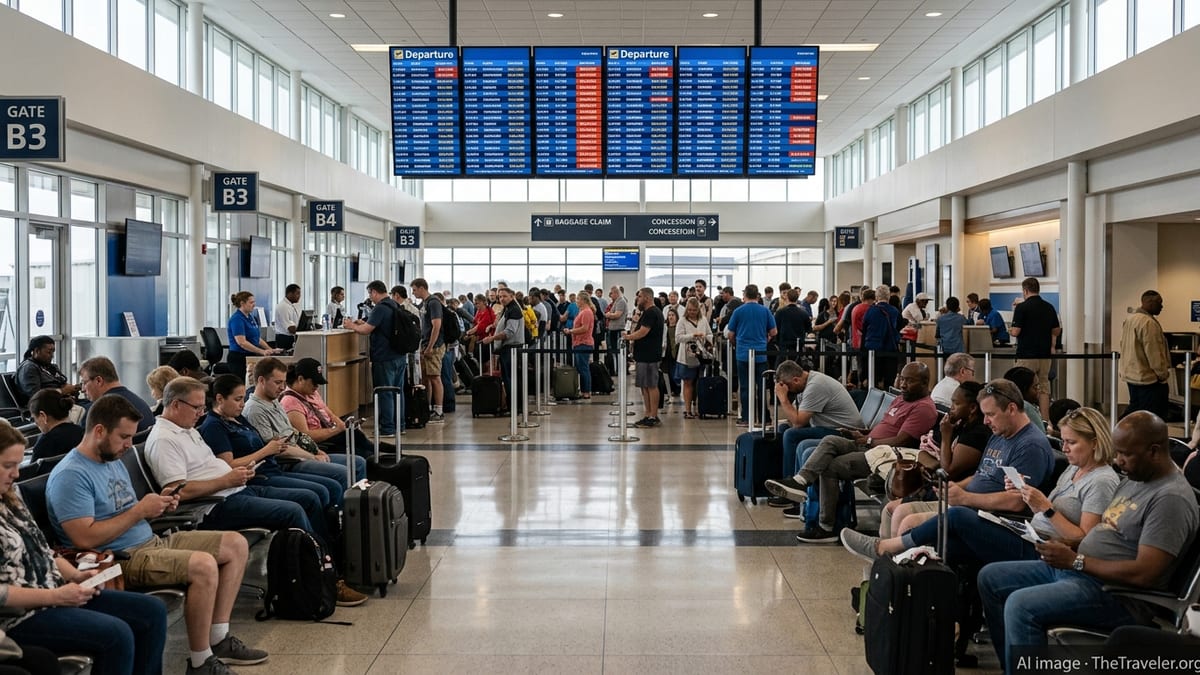
Airport terminal conditions grew increasingly strained as departure boards filled with red and amber status updates. With only a handful of mainline carriers operating at Baton Rouge Metropolitan, disruptions on five key flights translated into hundreds of stranded or delayed passengers seeking help at the same time.
Publicly shared accounts from recent disruption events at similar regional airports describe long lines at check-in counters, crowded seating areas and limited access to customer service agents during peak irregular operations. At Baton Rouge, the combination of multiple carriers experiencing issues within a short window appears to have created similar pressure points.
Travelers heading to major hubs such as Atlanta, Dallas and Houston often depend on tightly timed connections for business meetings, family events or international departures. When those first legs from Baton Rouge fail to operate on schedule, rebooking can be challenging, particularly if partner flights from nearby airports like New Orleans or Lafayette are already near capacity.
According to information shared by consumer travel advocates, passengers in these situations may be offered rebooking on the next available flight, meal vouchers in some circumstances, or overnight accommodation when disruptions extend late into the night and are tied to airline-controlled issues. When weather is the primary factor, options can be more limited, and travelers are often encouraged to explore alternative routings, including ground transport to larger nearby airports.
Baton Rouge’s Limited Capacity Exposes Travelers to Knock-On Delays
Unlike larger metropolitan airports with multiple daily departures on the same route, Baton Rouge typically offers a relatively small number of frequencies to each major hub. This structure works efficiently during normal operations but provides little buffer when several flights in a single day are disrupted.
Industry data from the U.S. Department of Transportation highlights how smaller regional airports can experience proportionally greater impacts from a handful of cancellations or extensive delays. When one or two aircraft serving a city like Baton Rouge are out of position, there are fewer backup planes and crews available locally to restore the schedule quickly.
In practice, this means that a single weather system affecting an airline’s large hub can lead to extended waits for passengers in Baton Rouge. Even once conditions improve at the hub, crews may be out of legal duty time, or aircraft may be prioritized for busier routes, slowing recovery at smaller stations.
The situation is further complicated when multiple airlines are affected on the same day, as appears to have been the case in this Baton Rouge disruption. With Delta, American and United all facing constraints, travelers who might otherwise switch carriers for a faster option may find far fewer available seats than usual.
What Passengers Can Do During Future Disruptions
Consumer travel guidance suggests a number of practical steps for passengers departing from smaller airports like Baton Rouge when severe disruptions unfold. One common recommendation is to use airline mobile applications and flight-tracking tools to monitor status changes in real time, which can sometimes provide faster updates than overhead screens in the terminal.
Travel experts often advise that, when significant delays or cancellations appear likely, passengers should immediately explore alternative routings, including nearby airports within driving distance, before remaining seats are taken. For travelers heading to critical events or international connections, booking earlier departures in the day and avoiding the last flight of the evening can also reduce the risk of overnight stranding.
Publicly available information from federal transportation agencies underscores that passenger rights and available compensation vary depending on whether disruptions stem from weather, air traffic control restrictions or airline-controlled issues such as crew or maintenance. Travelers are encouraged to review airline customer service commitments and to keep receipts for meals, hotels and transport in case reimbursement is possible.
As Baton Rouge Metropolitan Airport continues to function as a regional gateway to major hubs, recent disruptions highlight how quickly routine schedules can unravel when weather and network pressures converge. For now, the episode serves as a reminder that in tightly interconnected air travel systems, events in distant hubs can have immediate consequences for passengers waiting at smaller hometown airports.