

More news on this day
A proposed mega cruise terminal on Florida’s lower Tampa Bay is facing its most serious challenge yet, as state lawmakers advance legislation designed to sharply limit dredging in the Terra Ceia Aquatic Preserve, dealing a major blow to plans for a new cruise port in Manatee County.
Get the latest news straight to your inbox!
Coastal Resiliency Bill Targets Terra Ceia Dredging
The flashpoint for the dispute is Senate Bill 302, a wide-ranging coastal resiliency measure that now includes language aimed squarely at the waters surrounding the proposed cruise terminal site near the Sunshine Skyway Bridge. According to published coverage, the bill passed the Florida Senate with unanimous support and has now cleared the House as well, positioning it for final consideration by Governor Ron DeSantis.
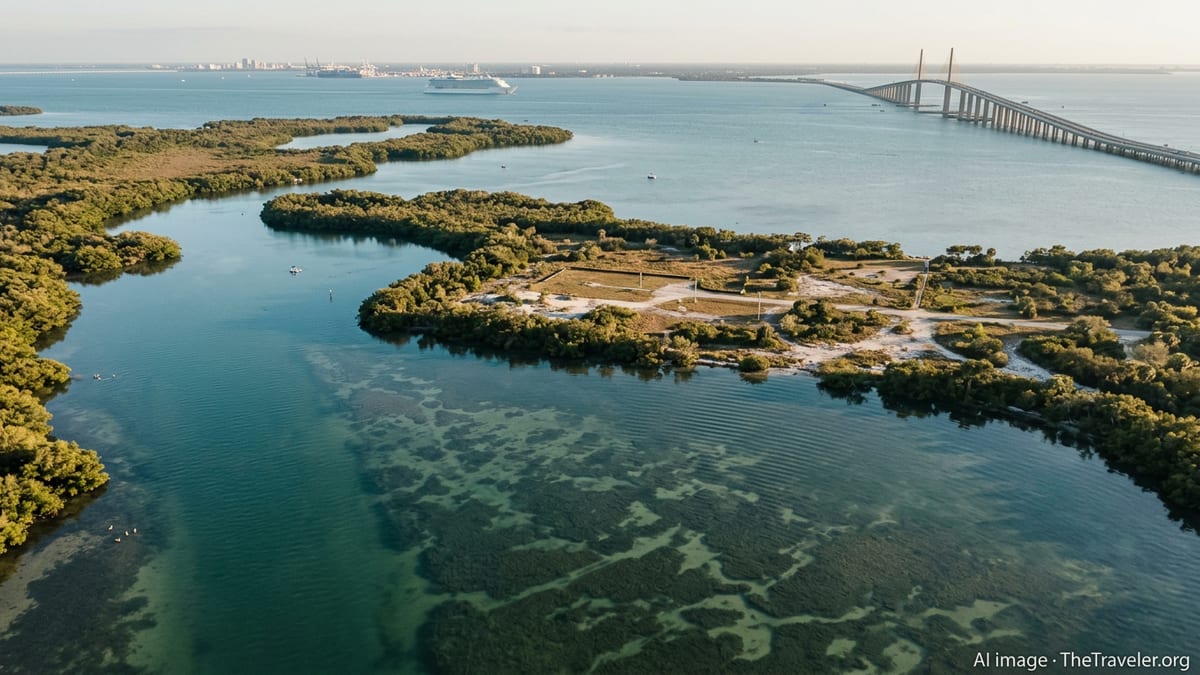
The legislation includes an amendment focused on the Terra Ceia Aquatic Preserve, a protected estuarine system adjacent to the privately owned Knott-Cowen tract where the terminal has been proposed. Reports indicate the amendment would greatly narrow the circumstances under which dredging can occur in the preserve, a core requirement for carving a deep-water approach channel for the large cruise ships envisioned for the site.
Supporters of the bill describe the new limits as a critical safeguard for one of the region’s remaining relatively undeveloped coastal habitats. Publicly available information shows that the language is drafted broadly enough that it would be difficult for the Manatee County cruise port proposal to proceed without substantial changes, if it remains viable at all.
Environmental and community advocates have framed the legislative move as a turning point, arguing that state-level protections were needed to complement ongoing local resistance. At the same time, legal and planning documents referenced in local reporting suggest that property owners may still assert historic dredging rights, leaving open the possibility of future challenges or litigation.
Years of Port Ambitions Collide With Protected Waters
The cruise port concept has been tied to a 328-acre site on the Knott-Cowen tract southwest of the Sunshine Skyway Bridge, near Rattlesnake Key and the mouth of Tampa Bay. Developers, including global terminal operator SSA Marine and landowner Slip Knott LLC, have promoted the location as a rare opportunity to host new-generation cruise ships too tall to clear the Skyway’s 180-foot vertical clearance at existing ports farther inside the bay.
Plans outlined in public materials describe a multi-berth facility capable of receiving several large vessels, supported by extensive upland infrastructure for passenger processing, parking, and logistics. The proposal would require rezoning and a large-scale comprehensive plan amendment at the county level, along with a suite of state and federal environmental permits that hinge on dredging approvals.
That location, however, overlaps with some of the most sensitive and heavily studied waters in the region. The Terra Ceia Aquatic Preserve and surrounding estuaries support seagrass meadows, shellfish beds, and nursery habitat for fish and other marine life. Reporting by regional outlets has highlighted concerns that widening and deepening shipping channels could damage seagrass, increase turbidity, and alter circulation patterns that underpin the local ecosystem.
Public documents also note that Manatee County’s coastal waters support a significant share of Florida’s shellfish aquaculture sector, tying environmental conditions directly to working waterfront livelihoods. Critics of the port argue that even small declines in water quality could ripple through higher-value tourism, fishing, and recreation economies across lower Tampa Bay.
Environmental Backlash and Grassroots Mobilization
Since the cruise port concept was unveiled in early 2026, opposition has mounted rapidly across Manatee County and the broader Tampa Bay area. Environmental organizations such as Suncoast Waterkeeper, regional conservation coalitions, and neighborhood groups have launched online petitions, letter-writing campaigns, and public demonstrations challenging the project.
Coverage by local broadcasters and newspapers describes rallies drawing hundreds of residents to Terra Ceia and nearby communities, with participants raising concerns about seagrass loss, harm to fisheries, and the risk of fuel spills or ship groundings in shallow, hurricane-prone waters. Organizers have highlighted the proximity of the proposed terminal to the aquatic preserve boundaries and to shorelines popular with paddlers, anglers, and birdwatchers.
Petitions circulating online have gathered thousands of signatures, reflecting unease over both environmental and quality-of-life impacts. Residents have voiced worries about increased truck and passenger traffic, parking demand, and potential pressure for additional industrial development once a deep-water cruise facility is in place.
Regional tourism advocates have also questioned whether introducing a mega cruise port at the mouth of Tampa Bay aligns with coastal branding that often emphasizes quiet beaches, wildlife refuges, and low-rise waterfront communities. The prospect of frequent large ship calls, plume emissions, and shoreline congestion has become a central talking point for opponents seeking stronger protections for the area.
Lawmakers Reverse Course on Port Governance Push
While the dredging limits included in SB 302 have drawn the most attention, they are not the only sign of shifting political winds around the Manatee cruise port concept. In recent weeks, local reporting shows that members of the Manatee County legislative delegation withdrew a separate bill that would have overhauled the governance structure of SeaPort Manatee, the county’s existing cargo-focused facility.
That earlier proposal would have reshaped the Manatee County Port Authority from a body controlled by the elected county commission into an independent special district led mainly by gubernatorial appointees. Critics questioned the timing of the measure, noting that it emerged amid early discussions of the cruise terminal and could have altered who ultimately oversaw port-related decisions.
According to regional political coverage, lawmakers cited heightened public concern about the cruise project as one factor in stepping back from the port governance bill. Its withdrawal was interpreted by many residents as a sign that state leaders were increasingly wary of being seen as fast-tracking structural changes while the environmental implications of the terminal remained under scrutiny.
Together, the stalled governance bill and the forward movement of SB 302 have shifted expectations about the political viability of a large new cruise facility in Manatee County, at least in the near term. Observers note that any future effort to reconfigure port authority oversight is likely to face closer public examination because of the current controversy.
Developers Hold Firm as Future of Project Remains Uncertain
Despite the mounting legal and political obstacles, the companies behind the Manatee cruise port proposal have not yet abandoned their plans. Public statements referenced in local and national coverage indicate that SSA Marine and its partners continue to emphasize potential economic benefits, including construction-related jobs, long-term terminal employment, and new tourism spending tied to cruise calls.
The developers point to their existing presence at major Florida cruise and cargo hubs as evidence of operational experience and argue that a new deep-water facility at the mouth of Tampa Bay could relieve congestion and create fresh itineraries for larger vessels. They have also promoted a vision that pairs the terminal with environmental mitigation and restoration projects, positioning the port as compatible with long-term resource stewardship.
However, the future of the project now appears to hinge on a complex mix of legal interpretations and political decisions. If SB 302 is signed into law in its current form, questions will center on how its dredging restrictions interact with any historic rights asserted by the landowners and how permitting agencies apply the new standards. Litigation over those issues is possible, and observers note that court challenges could prolong uncertainty for years.
For travelers and cruise lines, the immediate effect is a continued reliance on existing Gulf Coast ports, including Port Tampa Bay, while Florida’s newest cruise hub remains stalled on the drawing board. For residents along Terra Ceia and lower Tampa Bay, the legislative shift marks a rare moment in which environmental protections appear to be gaining ground over large-scale waterfront development, even as the final outcome for the controversial Manatee County cruise terminal is still to be written.