

More news on this day
Flydubai has reported its strongest-ever annual performance for 2025, with record passenger traffic and revenue underscoring the Dubai-based carrier’s rapid ascent and setting the stage for another year of network and fleet growth in 2026.
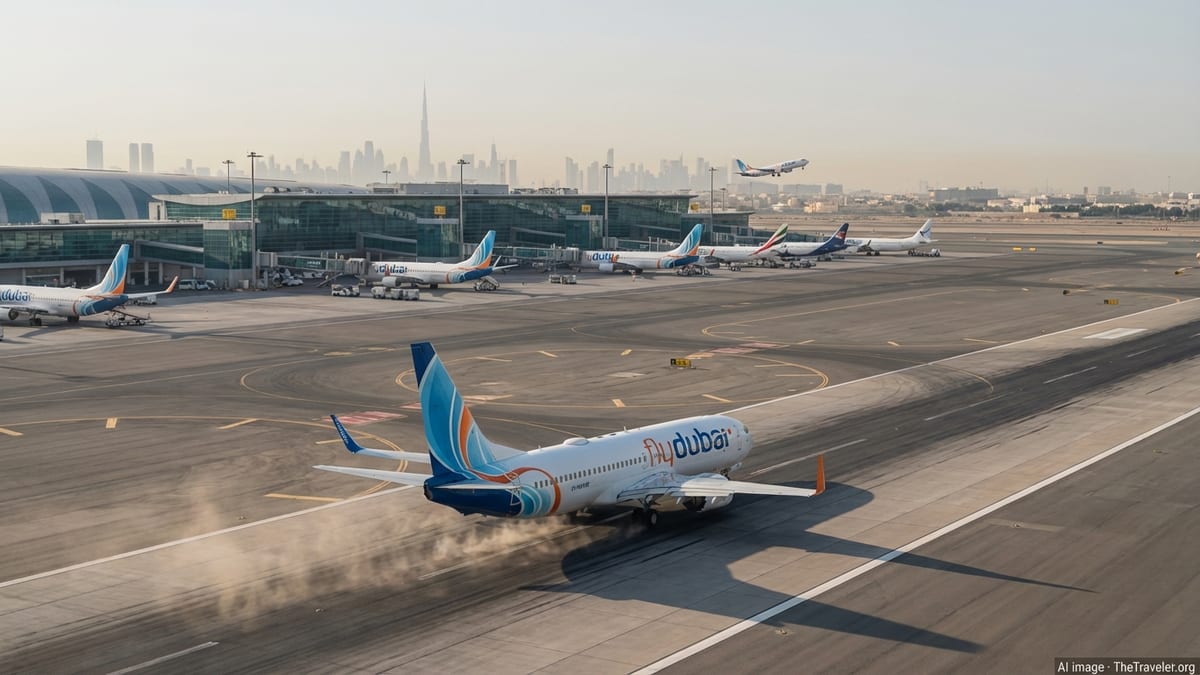
Record 2025 Results Cement Flydubai’s Growth Trajectory
The airline posted a profit before tax of 2.2 billion dirhams (about 591 million dollars) for the year ending December 31, 2025, according to figures released in Dubai on February 26, 2026. Total revenue climbed to 13.6 billion dirhams, roughly 3.7 billion dollars, representing a six percent increase on 2024 and marking a new high for the carrier’s top line.
Profit after tax reached 1.9 billion dirhams, reflecting Flydubai’s ability to balance rising operating costs with disciplined capacity deployment and yield management. Earnings before interest, taxes, depreciation and amortisation came in at 4.0 billion dirhams, highlighting a resilient underlying performance despite supply chain constraints and higher maintenance expenses.
The figures confirm a trend of sustained outperformance for the Dubai carrier, which has already notched record-breaking results in both 2023 and 2024. Executives said the 2025 outcome was driven by strong demand across business and leisure segments, supported by Dubai’s continued rise as a global travel hub.
Fuel costs accounted for about a quarter of total operating expenses in 2025, a lower share than in some previous years, aided by the growing share of more fuel-efficient aircraft in the fleet. The company’s cash and bank balance, including pre-delivery payments, stood at 5.6 billion dirhams at year-end, providing ample liquidity to fund future expansion.
Passenger Numbers Hit New High Across Expanding Network
Flydubai carried a record 15.7 million passengers in 2025, a two percent increase on the already elevated levels of 2024. The airline operated 126,604 flights during the year, reinforcing its position as one of the largest operators at Dubai’s main airport and the second-highest by number of departures in the United Arab Emirates.
Network growth and increased frequencies across key routes underpinned the rise in traffic. Flydubai’s network reached 140 destinations in 58 countries, with new services launched to cities including Al Alamein in Egypt, Antalya in Türkiye, Iași in Romania, Nairobi in Kenya, Riga in Latvia and Vilnius in Lithuania, as well as additional points in Iran and Pakistan.
Demand in Business Class proved particularly robust, with uptake rising by 19 percent compared with 2024 as the airline continued to move away from its origins as a purely low-cost operator. Middle East routes recorded the strongest regional growth, followed by Africa and Europe, as Flydubai catered to both point-to-point flows and connecting traffic via Dubai.
Available Seat Kilometres increased by six percent, matched by a similar gain in Revenue Passenger Kilometres, while passenger yield improved by three percent. The carrier also reported a six percent improvement in on-time departure performance across its network, a key metric in an increasingly competitive Middle East aviation market.
Fleet Expansion, Major Orders and Product Upgrades
The airline expanded its fleet to 97 aircraft in 2025 after taking delivery of 12 Boeing 737 MAX 8 jets, while retiring three older 737-800s that were returned to lessors. The average fleet age stood at 5.5 years, keeping Flydubai among the operators of younger, more efficient narrow-body aircraft.
In a significant move at the Dubai Airshow, Flydubai placed headline orders for 150 Airbus A321neo aircraft alongside an additional 75 Boeing 737 MAX jets. The dual-manufacturer strategy broadens the airline’s long-term fleet plan and is expected to provide greater flexibility on capacity, range and cabin configuration as it targets new markets over the coming decade.
Within the existing fleet, Flydubai completed a retrofit programme covering eight more 737-800s, bringing the total number of upgraded aircraft to 25. The project aims to harmonise the onboard product and ensure a more consistent experience across both Business and Economy cabins.
Customer experience enhancements were a prominent feature of 2025. The carrier introduced complimentary meals and inflight entertainment across all Economy Class fares, a notable shift in its service model. It also signed an agreement to roll out high-speed Starlink inflight connectivity starting in 2026, positioning itself among the first regional airlines to adopt the technology fleetwide.
Strategic Partnerships and Workforce Investment
Partnerships remained a central pillar of Flydubai’s growth strategy. Its deepening tie-up with Emirates enabled more than 2.5 million passengers to benefit from seamless itineraries over Dubai in 2025, via a combined network of more than 240 destinations in over 100 countries. The arrangement has become an important driver of feed traffic into Flydubai’s narrow-body operations.
The airline also expanded its portfolio of interline and codeshare agreements, adding 11 new interline partners during the year and bringing the total to more than 40, alongside existing codeshare deals with Air Canada, Emirates and United Airlines. These partnerships extend the reach of Flydubai’s network and provide customers with access to over 300 destinations when combined with partner services.
On the human capital front, headcount rose by 11 percent to 6,763 employees, reflecting continued recruitment of pilots, cabin crew, engineers and support staff. The company launched an Ab Initio Pilot Training Programme and an Aircraft Maintenance and Engineering Apprenticeship to build a long-term talent pipeline tailored to its expanding fleet.
New executive and management training schemes were introduced to prepare future leaders, while Flydubai’s dedicated flight training centre, now equipped with four full-flight simulators, offers greater control over pilot training schedules and potential capacity to support other airlines in the region.
2026 Outlook: Capacity Growth, Technology and Sustainability
Looking ahead, Flydubai expects travel demand to remain healthy in 2026 despite geopolitical tensions and lingering supply chain issues for aircraft and components. The airline plans to take delivery of 12 new aircraft during the year, including seven Boeing 737 MAX 9s and five 737 MAX 8s, subject to manufacturer timelines. The larger MAX 9s will add Business Class capacity and support growth on higher-demand routes.
The carrier intends to add frequencies on selected routes and is evaluating new destinations, including the planned launch of flights to Bangkok later in 2026, which would mark a key gateway into Southeast Asia for its network. An Aircraft Maintenance Centre at Dubai South is scheduled for completion in the final quarter of 2026, promising faster turnaround times and increased in-house control over maintenance operations.
Digitisation and the use of artificial intelligence are set to feature prominently in Flydubai’s strategy, with investment earmarked for AI-driven technologies to optimise operations, enhance customer personalisation and streamline back-office processes. Executives have stressed that these initiatives will be underpinned by continued focus on punctuality and service reliability.
Sustainability measures are also advancing. The Boeing 737 MAX family remains central to Flydubai’s efforts to improve fuel efficiency, delivering double-digit savings compared with previous-generation jets. In 2025, the airline introduced a large solar power project at its training and office campus, expected to cut annual carbon dioxide emissions by more than a thousand tonnes. The carrier also joined an international transport taskforce aimed at combating illegal wildlife trafficking, aligning itself with broader environmental and conservation goals.
Industry observers say the combination of record financial results, measured capacity growth and ongoing investment in technology and people leaves Flydubai well positioned to capitalise on regional and global travel demand in 2026, while further strengthening Dubai’s status as one of the world’s leading aviation hubs.