

More news on this day
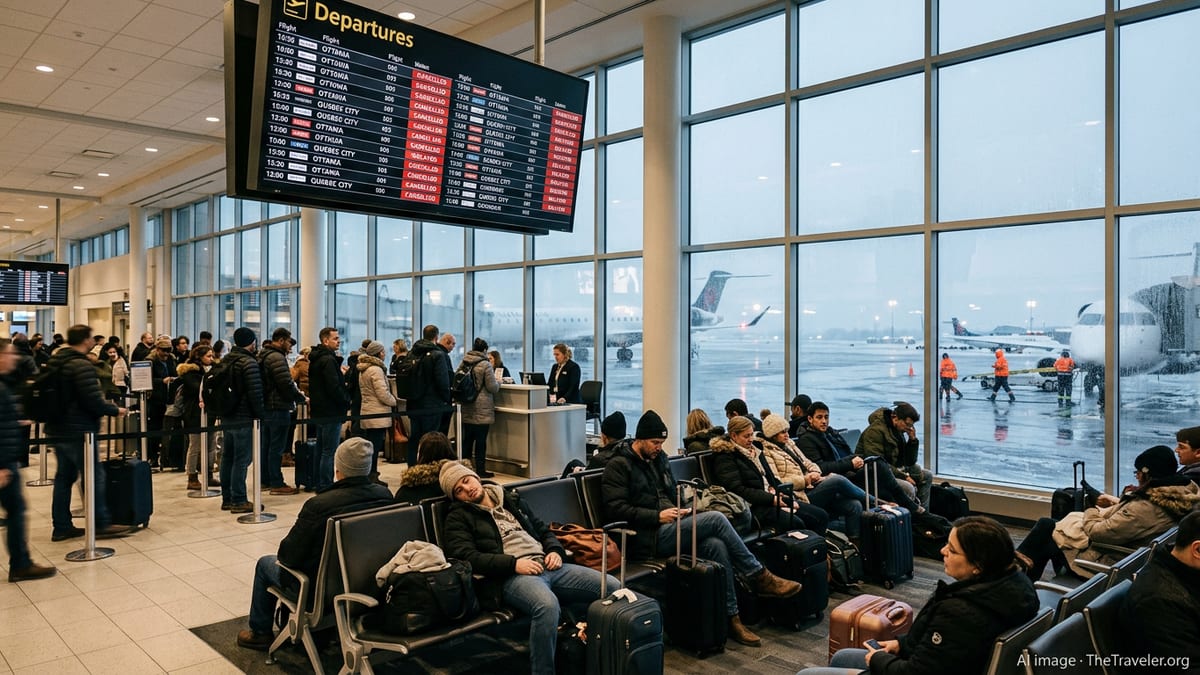
More than 70 flights were cancelled at Ottawa and Quebec City Jean Lesage International Airport on Wednesday as a powerful freezing rain system swept across eastern Ontario and Quebec, stranding hundreds of passengers and rippling delays across the Canadian air network.
Get the latest news straight to your inbox!
Storm Slams Eastern Ontario and Quebec, Air Travel Stalls
The midweek storm arrived exactly as forecasters had warned, coating runways, taxiways and aircraft in layers of ice and forcing airlines to thin out their schedules for safety reasons. By early Wednesday morning, the Ottawa International Airport Authority was reporting around 50 cancellations, while Quebec City’s Jean Lesage International Airport had scrubbed more than 20 departures and arrivals, pushing total cancellations in the two cities past the 70-flight mark.
The impact extended far beyond local travelers. Many of the cancelled flights were key domestic connectors, linking Ottawa and Quebec City to major hubs such as Toronto, Montreal and Calgary. Knock-on delays quickly spread throughout the national network as aircraft and crews were left out of position, and travelers found themselves rebooked on later services or rerouted through already busy airports.
Carriers including Air Canada, WestJet, Porter and regional airlines reduced flying into the storm-affected zone as Environment Canada issued freezing rain warnings for large parts of eastern Ontario and southern Quebec. Airlines said safety and de-icing capacity were the primary constraints, with ground teams working at full tilt to keep remaining flights operating.
Why Freezing Rain Disrupts Flights So Severely
While snow is a familiar winter challenge for Canadian airports, freezing rain is among the most disruptive forms of weather for aviation. Super-cooled droplets freeze on contact with aircraft surfaces and airport infrastructure, quickly building up ice that can affect lift, control surfaces and engine performance. That reality leaves airlines and pilots with little margin for risk when the kind of prolonged ice event seen on Wednesday settles over a region.
At the airport level, heavy icing sharply slows ground operations. De-icing cycles take longer, and treatment often has to be repeated when precipitation remains intense. Runway and taxiway clearance also becomes more complex, as crews combat both slick ice and standing water. Even when skies begin to clear, residual ice in critical areas can keep operations at reduced capacity until conditions stabilize.
Airlines say that is why passengers often see preemptive cancellations during such storms. Removing flights from the schedule early helps avoid last-minute scrambles at the gate, reduces time that passengers and crews spend waiting on aircraft, and frees up scarce de-icing and runway capacity for essential services that can still operate safely.
How Passengers Are Being Rebooked and What Relief Is Available
With dozens of flights dropped from the schedule, rebooking has become the main challenge for stranded travelers in Ottawa and Quebec City. Airline call centers and airport ticket counters saw a sharp spike in demand as passengers sought new itineraries, often accepting indirect routes with additional connections to reach their destinations later in the week.
Several carriers have issued weather-related travel waivers for affected routes in Quebec and eastern Ontario, allowing customers to change travel dates without standard change fees, provided they keep the same origin and destination and travel within a specified window. Those waivers are particularly helpful for travelers who can afford to delay nonessential trips until conditions and schedules normalize.
For passengers already at the airport, staff have been distributing meal vouchers in some cases and assisting with overnight accommodation when disruptions stretch into late-night or early-morning hours. However, because severe weather is generally considered outside an airline’s control, Canada’s air passenger regulations typically do not require carriers to pay cash compensation for these types of cancellations, even when delays are extensive.
What Travelers Should Do If They Are Booked Through Ottawa or Quebec City
Travelers slated to fly into or out of Ottawa (YOW) or Quebec City (YQB) over the next several days are being urged to check their flight status frequently, as further schedule adjustments remain possible while the system moves through the region. Airline and airport apps are generally the fastest way to receive real-time updates, gate changes and rebooking options.
Experts recommend that passengers avoid heading to the airport until they have confirmed that their flight is still operating and that check-in is open. Those whose itineraries involve tight connections through Toronto, Montreal or other hubs should consider requesting longer layovers or alternative routings, as delays on the first leg of a journey can quickly cascade into missed onward flights when the network is disrupted.
Travelers with flexibility are being encouraged to push nonessential trips later into the week, particularly if they are flying for leisure rather than for fixed-date events such as weddings, conferences or cruises. For those who must travel, carrying essentials in hand luggage, including medications, chargers and a change of clothes, can make an unplanned overnight stay more manageable if they become stuck en route.
Wider Ripples Across Canada’s Already Strained Winter Travel System
The latest round of cancellations in Ottawa and Quebec City comes during an already bruising winter for Canadian air travel, marked by repeated storms, cold snaps and operational bottlenecks that have tested airline resilience. Recent days have seen significant delays and cancellations at major hubs such as Toronto Pearson and Montreal Trudeau, and the freezing rain now hitting eastern Ontario and Quebec is adding fresh pressure to carriers and airports.
Tourism and business travel are feeling the effects. Conference organizers, tour operators and hotels report a rise in last-minute schedule changes and late arrivals, while regional communities that depend on reliable air links are facing renewed uncertainty. Each wave of weather-related cancellations forces airlines to rebuild their networks, reposition aircraft and reassign crews, a process that can take days even after skies clear.
Industry analysts note that while Canadian airports and airlines are experienced in winter operations, extreme ice events such as this week’s storm have become more frequent and intense in recent years. For travelers, that means building in more buffer time, purchasing flexible or refundable tickets when possible, and recognizing that during severe weather there are limits to what even the best-prepared carriers can do to keep every flight in the sky.