


More news on this day
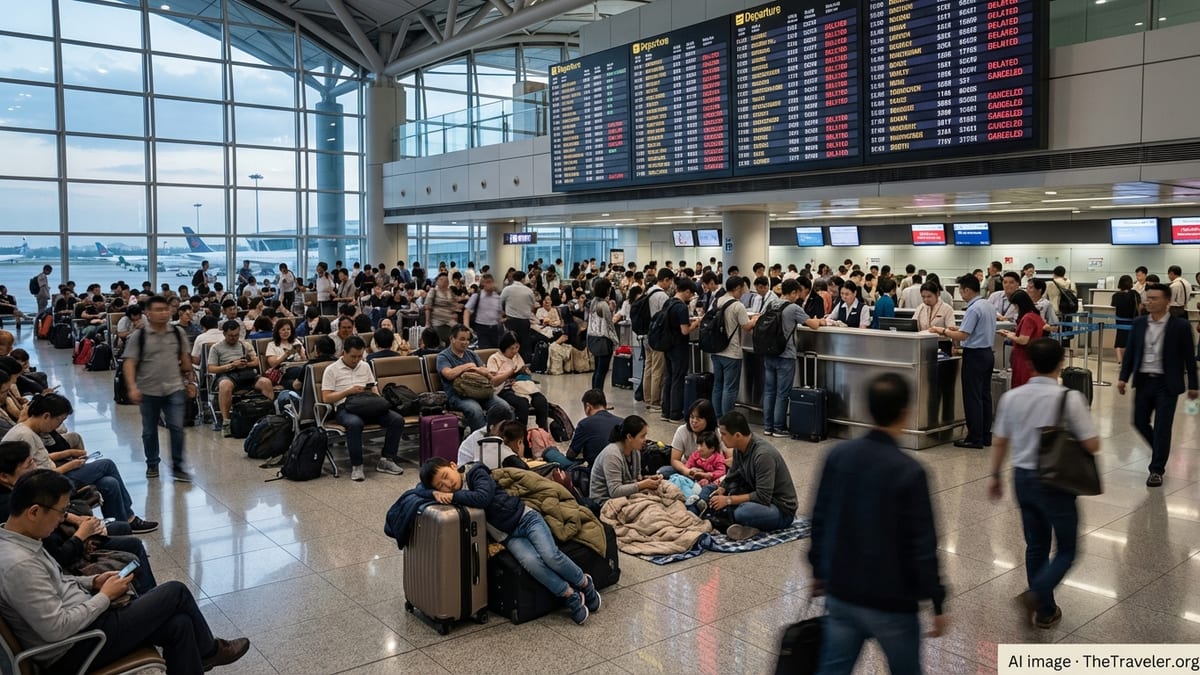
Beijing Capital International Airport has plunged into a fresh wave of aviation disruption, with new data indicating at least 20 flights withdrawn from service and around 175 departures running behind schedule, hitting key routes between China, Japan and South Korea and leaving passengers facing long waits and missed connections.
Get the latest news straight to your inbox!
New Operational Turbulence at Beijing Capital
The latest disruption follows a broader pattern of instability across China’s aviation network in June 2026, when industry trackers recorded thousands of delays and cancellations at major hubs including Beijing, Shanghai and Guangzhou. Publicly available monitoring of Beijing Capital International Airport on 30 June and 1 July shows pressure building again on departure banks, with knock-on effects across domestic and regional routes.
Industry analytics platforms that compile real-time schedule and performance information indicate that around 20 flights linked to Beijing Capital have been withdrawn from schedules over the latest 24-hour period. Most are short and medium haul services operated or marketed by Chinese carriers, reflecting an effort to consolidate operations and prioritize higher-demand sectors.
Alongside the cancellations, approximately 175 flights have been recorded as significantly delayed, creating bottlenecks through the afternoon and evening peaks. Analysts note that Beijing Capital’s role as a primary hub for connections into Northeast Asia means even modest disruption can rapidly cascade across international routes.
This renewed turbulence comes as airlines continue to rebuild regional capacity after the pandemic while also grappling with higher fuel costs, variable demand on Northeast Asia routes and periodic bouts of severe weather that hit on-time performance.
Air China and Hainan Airlines at the Center of the Disruption
Air China, headquartered in Beijing and using Beijing Capital as a core hub for both domestic and international operations, is among the most affected carriers in this latest wave of disruption. Monitoring of recent schedules shows the airline adjusting frequencies on a number of routes and cancelling selected rotations to ease pressure on aircraft and crew utilization.
Hainan Airlines, which also operates a major base at Beijing Capital, is similarly exposed. The carrier has been rebuilding its long haul and regional network but has faced repeated reports of last-minute changes, including cancellations affecting itineraries from Europe and Australia into China and onward to Japan. Recent passenger accounts highlight a pattern of rerouting through alternative Chinese cities and short-notice schedule changes that complicate onward travel planning.
These operational strains come on top of a longer-running reshaping of Chinese capacity to Japan and parts of Southeast Asia, where airlines have periodically thinned routes or suspended services in response to political tensions, softer demand or cost pressures. Air China and Hainan Airlines have both been involved in previous rounds of adjustments on Japan-bound services, including the suspension of some seasonal and provincial routes.
Aviation analysts say that when multiple Chinese network carriers, including Air China and Hainan, make concurrent cuts or day-of-operation cancellations at the same hub, passengers are left with fewer rebooking options and longer waits for open seats, especially on high-demand regional corridors.
Regional Impact on China, Japan and South Korea Routes
The latest disruption at Beijing Capital is being felt most acutely on corridors linking China with Japan and South Korea. These short-haul international routes rely heavily on tight connection windows through Beijing, Shanghai and other major hubs, making them vulnerable when departure banks start to slip by 30 minutes or more.
Published coverage in recent months has already documented elevated cancellation levels on China–Japan routes, with dozens of flights withdrawn across multiple carriers, including Air China and Hainan Airlines. Travelers have reported abrupt changes to itineraries linking Chinese cities with Tokyo, Osaka and other Japanese gateways, often being rebooked via alternate hubs or on different travel dates.
South Korea is also exposed. Historic and current schedule data show Air China and other Chinese airlines operating frequent services between Beijing Capital and Seoul Incheon, forming a critical bridge for both business and leisure traffic. When departure times out of Beijing are pushed back or aircraft are rotated away to cover domestic shortfalls, connections into and out of Incheon and other Korean airports can be disrupted, amplifying queues and missed onward flights.
The compounded effect is a less predictable travel environment across Northeast Asia, where passengers increasingly face the prospect of last-minute changes, extended layovers or overnight stays when disruptions at Beijing Capital ripple into international networks.
Passengers Stranded and Rebooking Challenges
Travelers caught up in the latest wave of delays and cancellations at Beijing Capital report being stranded at the airport or in intermediate cities while they wait for replacement flights. Public posts and travel forums describing recent operations on Air China and Hainan Airlines detail a mix of outcomes, ranging from successful same-day rebooking to overnight waits and complex reroutes through secondary hubs.
In some cases, passengers holding through-tickets with connections to Japan or South Korea have been forced to abandon original routings after the Beijing segment was delayed or withdrawn, seeking alternative paths through other Asian gateways once seats became available. Others have highlighted the difficulty of securing clear information on revised departure times and compensation when disruptions are attributed to weather or broader operational reasons.
Guidance from airlines such as Hainan Airlines explains that passengers affected by cancellations or extended delays may be eligible for meals, accommodation or alternative transport, depending on the cause and the jurisdiction where the disruption occurs. However, navigating these rules can be challenging in real time, particularly for travelers who do not speak Mandarin or who are operating on separate tickets for different legs of their journey.
Consumer advocates suggest that travelers transiting Beijing Capital build in longer connection times where possible, monitor their flights closely through airline apps and third-party trackers, and familiarize themselves with each carrier’s irregular operations policy before departure in order to respond quickly if cancellations or long delays occur.
What Travelers Should Watch in the Days Ahead
With Beijing Capital continuing to record elevated delay levels and a notable cluster of cancellations, travel analysts expect the knock-on effects to linger beyond the initial 24-hour disruption window. Aircraft and crew displaced by late arrivals or scrubbed flights can take several days to be fully repositioned, prolonging schedule instability even after weather conditions or other immediate triggers improve.
On China–Japan and China–South Korea routes in particular, the combination of strong seasonal demand and constrained capacity means that even a modest number of cancellations can leave remaining flights heavily booked. This raises the risk that travelers who are displaced from one flight may not find open seats for a day or more, especially on peak weekend departures.
Observers note that Chinese airlines have been continually fine-tuning their international networks, canceling underperforming rotations while adding capacity on stronger routes. This evolving pattern means that schedules, especially on regional international sectors through Beijing Capital, remain more fluid than they appeared before the pandemic period.
For travelers planning itineraries through Beijing in the coming days, the latest wave of disruption at Beijing Capital International Airport is a reminder that flexibility, real-time monitoring and contingency planning are essential when relying on tight regional connections between China, Japan and South Korea.