

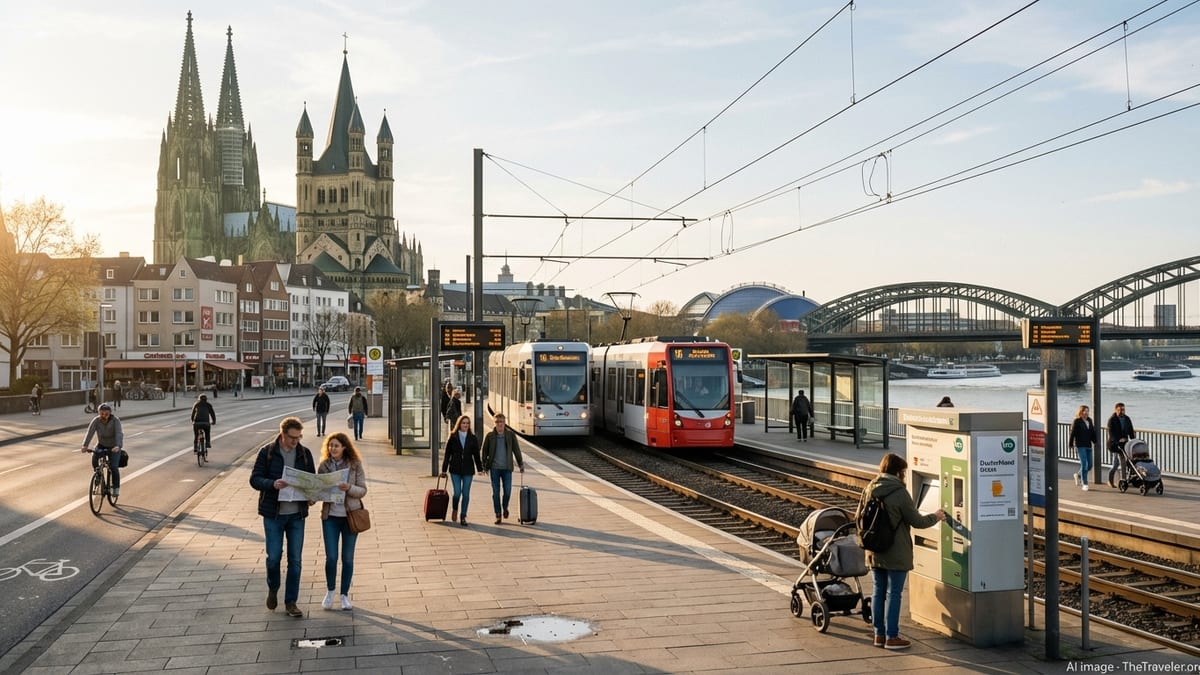
Cologne is one of Germany’s most walkable cities, yet it is also woven together by a dense network of trams, city rail and regional trains that make getting around fast and straightforward. Visitors can step off a plane, train or long-distance bus and be in the old town within minutes, then rely on frequent services to explore its neighborhoods, riverfront and green belt. Understanding how trams, trains and pedestrian routes fit together is the key to enjoying the city without the stress of driving or parking.
Understanding Cologne’s Transport Network
Easy transport makes it simpler to cover the main things to do in Cologne. Public transport in Cologne is run primarily by Kölner Verkehrs-Betriebe, known locally as KVB. The network combines classic street trams, underground light rail, buses and regional trains. These transport options also enable popular day trips from Cologne.
Many lines are branded as Stadtbahn, a hybrid between tram and metro that runs both underground in the city center and on surface tracks in the outer districts. This system connects the main train station at Köln Hauptbahnhof with major hubs such as Neumarkt, Heumarkt, Rudolfplatz and Ehrenfeld.
Cologne sits inside the Verkehrsverbund Rhein-Sieg (VRS) tariff area, which coordinates fares across local operators. This matters because a single ticket usually covers trams, buses and local trains within the zones you travel through, rather than forcing you to buy separate tickets for each mode. The Deutschlandticket, introduced nationally and now available for 63 euros per month in 2026, is accepted on KVB trams and most regional services in Cologne, making it particularly attractive for longer stays or multi-city itineraries.
For short visits, zone-based single and day tickets remain the simplest option. Machines and apps sell VRS tickets that are valid for a set time window, typically 90 minutes for a short urban journey, with the price increasing as you cross into more municipalities. Single-trip prices for journeys between Cologne Bonn Airport and the city center, for example, are now around the 4 euro mark depending on the exact ticket type and zone. You can usually use the same ticket to transfer between tram and train as long as you remain within its time and zone validity.
The network is intentionally redundant along key corridors, so in central Cologne you will often have several ways to get where you are going. Lines 16 and 18, for instance, form a north-south spine, while lines 1, 7 and 9 traverse the city from east to west. This gives travelers flexibility when a line is disrupted or when platforms are crowded, particularly during big events such as Carnival or matches at the RheinEnergieSTADION.
Trams and Stadtbahn: The Backbone of Urban Travel
For most visitors, trams and Stadtbahn lines are the most visible and useful parts of Cologne’s transport network. Bright red or white KVB vehicles glide along the Rhine, dive into tunnels under the old town and re-emerge in residential neighborhoods. They offer frequent service, clear signage and simple boarding procedures, making them ideal for travelers who might be using German public transport for the first time.
Key destinations are closely linked by tram. From Hauptbahnhof, lines 16 and 18 reach Neumarkt and Barbarossaplatz, providing access to the Belgian Quarter, the shopping streets along Schildergasse and the nightlife around Zülpicher Straße. Line 1 runs west to the stadium and green belt, then on toward Weiden, while line 7 carries passengers east across the Rhine to Deutz and the trade fair grounds. Many stops are shared by several lines, so if one service is delayed another is often close behind.
Service frequency is one of the system’s strengths. On busy inner-city stretches, trams and Stadtbahn lines commonly run every few minutes during daytime hours, tapering to less frequent but still regular services late in the evening. Vehicles are clearly labeled with line numbers and termini, and electronic displays on platforms show the next arrivals in real time. On many routes, low-floor cars provide level boarding, which is particularly useful for travelers with luggage, strollers or mobility challenges.
Using the trams is straightforward once you understand the ticketing routine. On most KVB services, you buy a ticket before boarding from machines at the stop or via the KVB or VRS apps. If you are using paper tickets that require validation, make sure to stamp them at the small orange or yellow machines on the platform before you step onto the tram. Inspections are conducted regularly, and riding without a valid ticket can result in an on-the-spot fine. Digital tickets purchased through the official apps are time-stamped automatically and do not need further validation.
Regional and S-Bahn Trains: Beyond the City Center
While trams and Stadtbahn lines handle most inner-city trips, Cologne’s regional trains and S-Bahn services are essential for reaching the airport, neighboring cities and outlying districts. From Köln Hauptbahnhof and Köln Messe/Deutz, frequent S-Bahn and RegionalExpress trains fan out toward Bonn, Düsseldorf, the Ruhr region and the smaller towns along the Rhine and in the Eifel hills. Travelers can easily pair a city break in Cologne with day trips by rail using the same integrated fare system for most regional journeys.
The most relevant S-Bahn lines for visitors are S13 and S19, which connect Cologne Bonn Airport with central stations such as Köln Messe/Deutz and Hauptbahnhof. These trains typically run every 20 minutes during the day, with a travel time of roughly 15 to 20 minutes between the airport and the city center. Tickets are sold from standard VRS ticket machines at the airport station and at city stations, and they are valid across KVB trams and buses within the taken zones. For a straightforward hotel transfer, travelers can board S13 or S19 at the airport, ride to Hauptbahnhof, and then continue on foot or by tram.
RegionalExpress trains offer another layer of connectivity. From Cologne, these faster services link major Rhine and Ruhr cities in under an hour, including Bonn, Düsseldorf, Duisburg and Essen, often with only a few stops. On some routes, they also stop at Cologne Bonn Airport, shaving a few minutes off the journey compared with S-Bahn services. Separate long-distance Intercity and ICE trains run on the same tracks but require different tickets and are not covered by local VRS single tickets or most city tourism cards.
For travelers holding a Deutschlandticket, the distinction between S-Bahn and RegionalExpress is less stressful. Both are considered local or regional services and fall under the nationwide ticket’s validity, as long as you remain in second class and avoid long-distance categories such as ICE. This arrangement makes it easy to base yourself in Cologne and make spontaneous day trips to nearby destinations without purchasing new tickets each time, provided the trains you choose are categorized as regional.
Ticket Types, Apps and Practical Tips
Ticketing in Cologne offers a range of options from quick one-way trips to monthly passes. For short urban journeys, standard VRS single tickets remain the basic choice, with prices rising in small increments as you cross additional municipalities. Time-based validity, commonly around 90 minutes for inner-city trips, allows travelers to transfer between KVB trams, buses and local trains without paying again, as long as the journey is continuous and within the zones paid for.
Day tickets and group tickets are often better value for sightseeing-heavy days. A 24-hour ticket allows unlimited travel within its selected zones for one person, while group variants cover up to five people traveling together. These tickets pay off quickly if you plan to move between several districts, visit attractions on both banks of the Rhine, or head out to more distant spots such as Brühl or Königswinter. Machines at larger stations offer English-language interfaces, and staff at KVB customer centers can explain which ticket combination best suits your plans.
For digital convenience, the KVB app and the broader VRS apps have become central to how people move around Cologne. They allow you to search routes, see real-time arrival information, and purchase tickets such as singles, day tickets and in many cases the Deutschlandticket. Digital tickets are tied to your smartphone, so you should ensure your battery has enough charge for inspections. Payment methods usually include credit card and online banking tools, and the apps display tickets in a format recognizable to inspectors.
Travelers planning longer stays or multi-city trips should consider the Deutschlandticket, now priced around 63 euros per month in 2026. It acts as a nationwide pass for most local and regional public transport services across Germany, including KVB trams and buses, S-Bahn and RegionalExpress trains operated by Deutsche Bahn and other companies. It does not cover long-distance trains such as ICE or most private sightseeing services, but for everyday movement within Cologne and neighboring regions it is one of the most cost-effective options available.
Walking Cologne: From Cathedral to Green Belt
Despite its extensive rail network, Cologne is a city that rewards walking. Many of the main sights sit within a compact area around the cathedral and the old town, and streets are largely flat. From Köln Hauptbahnhof, visitors can reach the cathedral steps in under two minutes, the Rhine riverfront in about five, and the shopping boulevards in ten. The walk from the cathedral to Neumarkt, a central square and tram hub, takes roughly 10 to 15 minutes at a relaxed pace.
The riverside promenade on the left bank is one of the most pleasant walking routes in the city. Starting near the Hohenzollern Bridge below the cathedral, you can stroll south past the old town, with its narrow lanes and brewery pubs, then continue toward the chocolate museum and Rheinauhafen with its distinctive crane houses. Along the way, side streets lead uphill into central neighborhoods where you can pick up trams or buses if you prefer not to walk back.
Crossing the Rhine on foot adds another perspective. The Hohenzollern Bridge has a dedicated pedestrian path that links the cathedral area with Deutz, where Köln Messe/Deutz station and the trade fair grounds are located. The view back toward the cathedral and old town is one of the most iconic panoramas in Cologne. From Deutz, you can extend your walk along the right riverbank, or cut inland toward Rheinpark and the cable car, picking up tram lines 3, 4 or others at nearby stops to return to the center.
Farther out, Cologne’s Grüngürtel, or green belt, creates semi-continuous bands of parks and pathways around the city. The outer green belt, established on former fortification land, offers long walking and cycling routes through wooded sections, lakes and open lawns. Tram and Stadtbahn lines intersect the green belt at various points, making it easy to walk a section then hop on a train back to your accommodation. On weekends, locals fill these spaces for picnics, jogging and relaxed strolls, giving travelers an easy way to experience everyday life in the city.
Planning Routes Between Key Districts
For visitors staying a few days, a basic mental map of how major districts connect can save time. The area around Hauptbahnhof and the cathedral is the historic heart and rail hub, with quick pedestrian access to old town streets and the Rhine. Just west of the center, the Belgian Quarter around Rudolfplatz and Friesenplatz is known for boutiques, bars and cafes. Farther south, the Südstadt and areas around Chlodwigplatz and Bonner Wall have a more residential feel, dotted with independent shops and leafy squares.
To move between these zones, trams and Stadtbahn lines create several easy corridors. From Hauptbahnhof, line 5 runs toward Friesenplatz and Ehrenfeld, a neighborhood that has evolved into a creative hub with street art and converted industrial spaces. Lines 16 and 18 connect the main station area with Neumarkt, Rudolfplatz and Barbarossaplatz in one sweep, tying together the shopping streets, Belgian Quarter and student nightlife district around Zülpicher Straße. Southbound services continue into the Südstadt and beyond, often following broad avenues that are fairly pleasant to walk or cycle alongside.
On the east side of the Rhine, Deutz functions as a second major center. From Hauptbahnhof, you can walk across the Hohenzollern Bridge in roughly 10 to 15 minutes or take a short tram ride via lines that cross the river. Köln Messe/Deutz station connects to regional and long-distance trains, and the surrounding area includes the trade fair, concert arenas and riverfront parks. Those staying in Deutz can easily reach the old town by a combination of S-Bahn and tram or a direct walk over the bridge.
Travelers headed to the stadium or Lindenthal district in the west can rely on line 1, which runs from the center through the university area and out toward the sports complex and green belt. For business travelers, line 7 serves the trade fair and continues to the eastern suburbs, while various other lines branch toward Mülheim, Nippes and Chorweiler in the north. With frequent services and clear signage, the challenge is often choosing between multiple viable routes rather than finding a single correct one.
From Cologne Bonn Airport to the City
Cologne Bonn Airport sits southeast of the city and is directly linked to the rail network via an underground station between the terminals. For most travelers, S-Bahn lines S13 and S19 provide the simplest route into the center. Trains usually run around every 20 minutes, with a travel time of approximately 15 to 20 minutes to Köln Hauptbahnhof or Köln Messe/Deutz, depending on the specific service and intermediate stops. Electronic displays in the airport station show the next departures, and platforms are accessible by lifts and escalators.
Tickets for this journey fall under the VRS tariff and are sold from vending machines at the airport station. Prices fluctuate slightly with periodic adjustments, but a one-way ticket from the airport to central Cologne is currently around the mid four euro range. For travelers planning to use public transport extensively on the day of arrival, a 24-hour ticket or coverage from a Deutschlandticket can reduce overall costs and simplify onward travel onto trams and buses once you reach the city.
Beyond the S-Bahn, RegionalExpress trains and occasional long-distance services also connect the airport with the city and other destinations. RegionalExpress services can cut a few minutes from the journey time but typically operate less frequently. Long-distance trains such as ICE link the airport to farther cities but require separate tickets and are not covered by standard VRS city tickets or most local passes. For straightforward arrivals with luggage, the S-Bahn remains the most convenient choice, balancing speed, cost and simplicity.
Once at Hauptbahnhof or Messe/Deutz, onward connections are plentiful. From Hauptbahnhof, many central hotels are walkable, and tram lines departing in several directions cover the rest. At Messe/Deutz, trams and Stadtbahn lines radiate toward Deutz neighborhoods, the trade fair and the right-bank riverfront, while frequent S-Bahn services continue under the Rhine to other city districts. For first-time visitors arriving late in the evening, checking the latest timetables in the KVB or VRS app before flying can help ensure smooth transfers if services are operating on reduced night schedules.
Accessibility, Safety and Night Travel
Cologne’s transport authorities have invested steadily in accessibility improvements, though conditions still vary by line and station. Many central tram and Stadtbahn stops now feature raised platforms that provide level or near-level boarding with low-floor vehicles, making it easier for travelers with wheelchairs, strollers or heavy luggage. Elevators and ramps are available at major nodes such as Hauptbahnhof, Neumarkt and Messe/Deutz, although occasional maintenance work can temporarily limit access at specific entrances.
On the trains themselves, reserved wheelchair spaces and priority seating are usually marked near the doors, and visual as well as audio announcements indicate upcoming stops. Digital displays list the next station, and in newer vehicles, they also show connecting lines. Traveling with a bicycle is permitted on many trams and trains, subject to space and certain time restrictions, and separate bicycle tickets or add-ons may be required depending on the fare product you hold.
In terms of safety, Cologne’s trams and trains are generally considered secure, especially during the day and early evening. As in any large city, pickpocketing can occur on crowded services, particularly around tourist-heavy stops like Hauptbahnhof and Heumarkt, so it is wise to keep bags closed and valuables out of sight. Surveillance cameras and periodic patrols by staff and security personnel add a layer of reassurance, and emergency intercoms are installed in vehicles and on platforms for immediate assistance.
Night travel is supported by reduced but still workable services on many lines, with some routes operating through the night on weekends. Night buses supplement the rail network after regular tram and Stadtbahn services taper off, connecting inner districts and suburban areas. Planning return journeys in advance is advisable, especially if you are staying outside the very center. The journey planner in the KVB or VRS app will usually flag night routes and show exact departure times, helping you avoid long waits on platforms during quieter hours.
The Takeaway
Cologne offers an unusually easy blend of walkable streets, frequent trams and straightforward rail connections that make exploring the city both efficient and enjoyable. Visitors can step from the airport straight onto an S-Bahn, arrive in the cathedral’s shadow within minutes, and then rely on a grid of trams and Stadtbahn lines to move between neighborhoods, parks and cultural sights. When paired with thoughtful walking routes along the Rhine and into the green belt, the city’s transport network turns getting around into part of the experience rather than an obstacle.
Understanding the basic structure of KVB services, the role of the VRS tariff system and the advantages of options like day tickets or the Deutschlandticket gives travelers confidence to move beyond the obvious tourist paths. Whether you are darting between museum districts, heading out for a match at the stadium or taking a regional train for a day by the river, Cologne’s integrated system of trams, trains and pedestrian spaces is designed to keep the city both accessible and inviting.
FAQ
Q1: Do I need a car to get around Cologne as a visitor?
For most travelers, a car is unnecessary. The historic center is compact and walkable, and trams, Stadtbahn lines and regional trains cover virtually all areas you are likely to visit, including the airport, stadium and major attractions.
Q2: Which ticket should I buy for a short stay of two or three days?
If you plan several journeys each day, a 24-hour ticket or multi-day pass within the VRS zones you need is usually more economical than repeated single tickets. For longer or multi-city stays, the nationwide Deutschlandticket can be cost-effective if you will use public transport frequently.
Q3: Can I use the same ticket on trams, buses and local trains?
Yes, most VRS tickets are valid across KVB trams, buses, Stadtbahn lines and local or regional trains within the zones and time limits printed on the ticket. Long-distance services such as ICE are excluded and require separate tickets.
Q4: How do I get from Cologne Bonn Airport to the city center?
The most convenient option is usually the S-Bahn. Lines S13 and S19 run from the airport station to Köln Hauptbahnhof and Köln Messe/Deutz in about 15 to 20 minutes. Buy a VRS ticket from the machines at the airport or via the official apps before boarding.
Q5: Is public transport in Cologne safe at night?
Public transport in Cologne is generally considered safe, though it is sensible to take standard precautions such as keeping valuables secure and staying in well-lit areas. Night services operate on many lines, especially during weekends, and are supplemented by night buses.
Q6: Are trams and trains in Cologne accessible for wheelchair users and travelers with strollers?
Many central stops and vehicles are designed with low floors, ramps and raised platforms that allow relatively easy boarding. Major stations usually provide elevators and accessible routes, although conditions can vary by line and occasional maintenance may affect certain facilities.
Q7: Do I need to validate my ticket before boarding?
Paper tickets that are not time-stamped at purchase generally need to be validated in the small machines on platforms or at station entrances before boarding. Digital tickets bought through official apps are usually time-stamped automatically and do not require additional validation.
Q8: How walkable is the route between the cathedral and the Rhine?
The cathedral sits only a short distance from the river, and the walk takes about five minutes on mostly level ground. From there, you can continue along the riverside promenade south toward the old town and Rheinauhafen or cross the Hohenzollern Bridge on foot to Deutz.
Q9: Can I bring luggage onto trams and S-Bahn trains?
Yes, luggage is common on both trams and S-Bahn trains, especially on routes serving the main station and airport. Aim for doors near open spaces or multi-purpose areas, keep bags clear of aisles and doors, and be prepared to move them if the vehicle becomes crowded.
Q10: Is it worth getting the Deutschlandticket for a one-week visit?
It depends on how intensively you plan to travel. For a week focused mainly on central Cologne with only a few trips per day, day tickets or singles may be sufficient. If you expect to use local and regional transport extensively, including day trips to nearby cities, the monthly Deutschlandticket can still offer good value despite its longer validity period.