

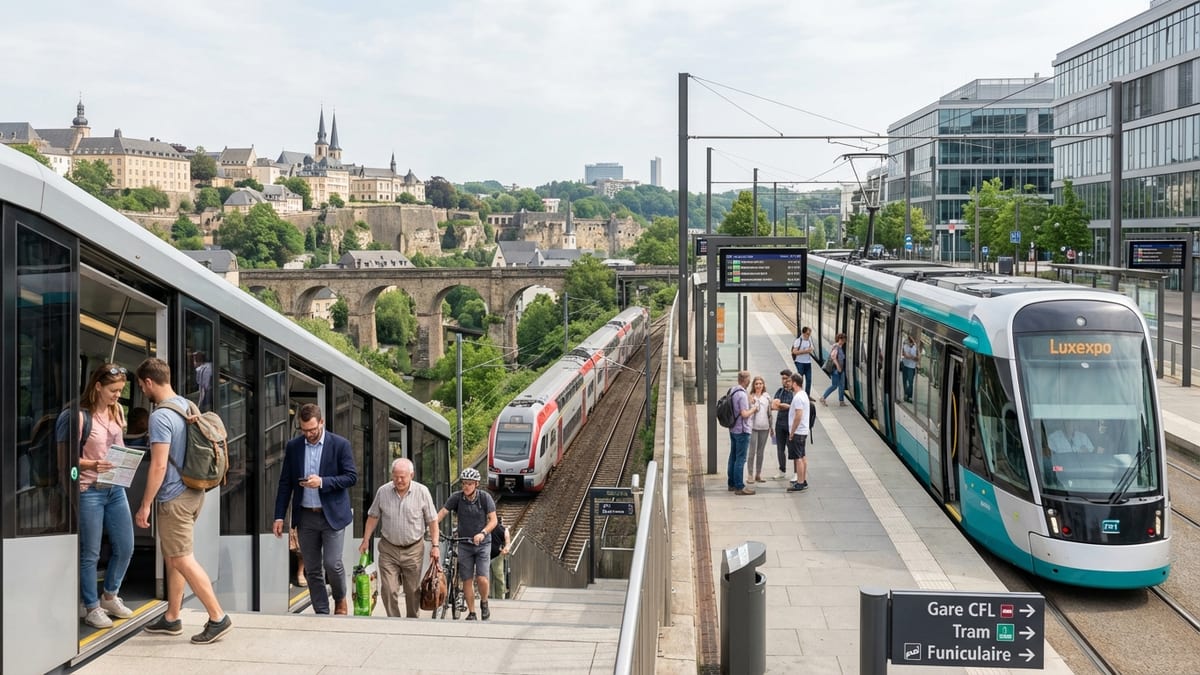
Luxembourg has quietly pulled off one of Europe’s most remarkable transport experiments. Since 2020, almost all public transport across the Grand Duchy has been completely free to use, turning trains, buses, trams and even the airport funicular into an easy, low‑stress way to get around.
For visitors, this means you can explore the country’s castles, vineyards and villages without once queuing at a ticket machine or puzzling over fare charts. Yet free travel does not mean you can simply ignore timetables, routes or the occasional exception to the rules. Easy transport makes it simpler to cover the main things to do in Luxembourg City.
Understanding how the system works will help you move around Luxembourg efficiently, from a single afternoon in the capital to a multi‑day journey across the country and into its neighbouring regions.
How Luxembourg’s Free Public Transport Works
Luxembourg’s free public transport policy covers virtually all regular public services within the country’s borders. Since 1 March 2020, residents, cross‑border workers and tourists can board any tram, most buses and all domestic second‑class trains without buying a ticket.
You simply walk on, find a seat and travel to your destination. The system is funded through general taxation, so there is no need to register in advance, carry a special card or show proof of residence. Luxembourg’s transport system also enables popular day trips from Luxembourg City.
The key limitation is geography and class of travel. Free travel applies only within the territory of the Grand Duchy and only in second class on trains. Once a bus or train crosses the national border into Belgium, France or Germany, a valid cross‑border ticket is required for any section outside Luxembourg. On domestic rail services, passengers who want the extra space and quiet of first class still have to pay a fare, even when their entire journey stays inside the country. These rules apply to everyone, including tourists spending just a day or two in Luxembourg.
In practical terms, free travel changes how you plan your days. Instead of calculating zones and comparing ticket types, you can concentrate on routes and timing. Want to hop off at an interesting village and take the next train an hour later? There is no financial penalty. Feel like switching from bus to tram or combining a country walk with a quick rail trip back to the city? You can improvise freely, knowing each ride is already covered.
There are still checks and expectations. Ticket inspectors continue to patrol, especially on trains and cross‑border routes, and all passengers are required to carry some form of official identity document that can be shown on request. Inspectors focus mainly on first‑class and international tickets, but it is wise to treat the system with the same respect you would a conventional paid network. Giving up reserved spaces, keeping luggage clear of doors and boarding in an orderly way help keep services reliable for everyone.
Trains: Fast Connections Across a Compact Country
Luxembourg’s national railway company, CFL, runs a hub‑and‑spoke network that fans out from Luxembourg City to almost every corner of the country. For visitors, trains are the backbone of longer day trips, linking the capital to destinations such as Vianden, Clervaux, Echternach, Esch‑sur‑Alzette and the Moselle wine villages. Services are modern and frequent on the main lines, with free second‑class travel automatically included for journeys within the Grand Duchy.
Planning a train trip is straightforward. Timetables and real‑time information are available through national journey planners and the CFL mobile app, which is especially useful if you are coordinating connections between buses and trains. Many stations are relatively small and simple to navigate, with clear signage in several languages and electronic boards indicating platforms and departure times. The principal hub, Luxembourg City station, has multiple platforms but remains manageable in size compared to the huge termini of Paris or Brussels.
On board, you can sit anywhere in second class without a reservation. Doors usually open automatically or at the push of a button. Luggage racks are provided at carriage ends and above the seats, and bicycles are accepted on many services; dedicated bike spaces are clearly marked. For travellers with reduced mobility, CFL and the transport authorities have invested heavily in accessible infrastructure, from low‑floor trains to raised platforms and tactile paving. If you need assistance boarding or alighting, it is advisable to contact CFL in advance, particularly if you are connecting to services across the border.
For longer excursions, trains form the spine of many classic touring routes. You might, for example, take a direct train from Luxembourg City to Ettelbruck, connect to Diekirch by rail, then transfer to a bus for the final climb to Vianden and its hilltop castle. On the return leg you could choose a different combination of train and bus without once needing to think about ticket prices inside Luxembourg. This flexibility is one of the practical advantages of a system where the fare has effectively disappeared from your planning.
Buses and Trams: Navigating Cities and Villages
While trains cover the main arteries, buses and trams fill in the finer details of Luxembourg’s transport map. Several networks operate under the national system: RGTR buses connect towns and villages across the country, AVL buses serve Luxembourg City, and TICE runs services in the southern, more industrial parts of the country. In the capital, the modern tram line cuts through the city’s new business districts, historic centre and university area, linking key transport hubs and park‑and‑ride sites.
For visitors, the tram is often the easiest way to orient yourself in Luxembourg City. The line now runs from the Cloche d’Or district in the south through the central plateau to Kirchberg and onward to Luxembourg Airport, with stops at major points of interest and interchanges. Trams are low‑floor, fully accessible and frequent throughout the day, with more intensive service at rush hour and early evening. The ride is smooth and quiet, and electronic displays announce each stop in several languages.
City buses extend this reach into residential districts and up the steep hills that define Luxembourg’s geography. Stops are clearly signposted, with route numbers and destination names displayed on the front and side of each bus. Because travel is free, passengers board at any door, though in practice many still enter near the driver. Luggage, strollers and bicycles are generally allowed, but space can be limited at busy times and priority is given to passengers with reduced mobility.
Beyond the capital, the RGTR interurban bus network fills in the gaps between rail lines, especially in more rural areas and along the country’s scenic borders. These buses are invaluable for reaching trailheads in Little Switzerland, small villages along the Moselle or viewpoints in the Ardennes. Services may be less frequent on weekends and in the evening, so it is worth checking the timetable when planning a hike or countryside excursion. Once you know the departure and return times, you can relax in the knowledge that boarding the bus is as simple as stepping aboard when it arrives.
Air, Funiculars and Special Services
Luxembourg’s main gateway by air is Findel Airport, officially Luxembourg Airport, located northeast of the capital. Thanks to the extension of the tram line, the airport is now directly connected to central Luxembourg City by a combination of tram and funicular transfers, all within the free public transport system. Arriving passengers can walk out of the terminal, follow signs to the tram stop and ride into town without paying a fare, making the transition from plane to city centre unusually smooth.
An important piece of this puzzle is the funicular at Pfaffenthal‑Kirchberg. This hillside railway links the rail station in the valley with the tram and bus network on the Kirchberg plateau. It operates like any other public transport service and is fully included in the free scheme. For travellers, it provides an effortless way to overcome Luxembourg’s steep topography, whether you are commuting between business districts or combining a walk through the old city with a quick hop back to your accommodation.
Within Luxembourg City, a few niche services sit alongside the main network. A door‑to‑door Call‑a‑Bus scheme runs for residents aged 70 and over, operating within city limits for a fee. This service is not generally relevant to short‑term visitors, but it is useful to be aware of it if you are travelling with older family members staying longer in the city. Taxis also operate throughout the country at standard European prices, and ride‑hailing platforms are present but less dominant than in some larger capitals.
For travelers who enjoy combining modes of transport, Luxembourg’s integrated approach offers interesting possibilities. You might land at Findel Airport, take the tram to Kirchberg, switch to the funicular, catch a train from the valley to the north of the country, then complete the last kilometre to your guesthouse by bus. With coordinated timetables and unified passenger information, these multimodal journeys usually feel coherent and well signposted.
Tickets, Exceptions and Cross‑Border Travel
Although domestic public transport is free in second class, tickets remain part of the picture in several scenarios. The most common is cross‑border travel. Free travel stops at Luxembourg’s national border, so if your bus or train continues into Belgium, France or Germany you must have a valid ticket for the portion outside the country. The authorities have simplified this through flat‑rate RegioZone bus tickets, which cover a wide range of cross‑border lines for a set price and time period.
RegioZone tickets are designed primarily for bus connections between Luxembourg and neighbouring regions. A two‑hour ticket allows unlimited travel on eligible cross‑border buses for two hours from the moment of validation, while a one‑day ticket is valid until 4 a.m. the following day. Prices remain modest by Western European standards. These tickets are not valid for international train journeys, which require separate fares based on the normal tariffs of CFL and its partner railways.
On trains, you might also choose to pay for first‑class travel. Within Luxembourg, first‑class tickets are inexpensive, and a small number of regular travellers prefer the quieter carriages and extra seating space. National first‑class tickets come in various formats, such as two‑hour or all‑day passes and longer subscriptions. They are only valid inside Luxembourg’s borders, so anyone continuing into another country must combine them with international fares if they remain in first class beyond the border.
The way tickets are sold is also changing. Luxembourg is in the process of moving cross‑border and first‑class ticketing to primarily digital platforms. This means that traditional smartcards and on‑board paper sales are being phased out in favour of the CFL mobile app and ticket machines at stations. For occasional visitors, this mainly affects how you buy a ticket if you are heading to cities such as Trier, Metz, Nancy or Arlon. Downloading the CFL app before you travel, or familiarising yourself with station ticket machines, is a sensible step if you plan to explore regions outside Luxembourg’s borders.
Practical Tips for Using the Network
Despite its innovative free‑fare policy, Luxembourg’s public transport runs on familiar European rules of etiquette. On trains, check carriage labels before you board; first‑class sections are clearly marked, often near the ends of the train. If you sit in first class without a valid ticket, you can be fined, even though the rest of the train is free. In second class, seats are unreserved, but priority places are set aside for people with reduced mobility, pregnant women and passengers with small children.
When boarding buses and trams, allow passengers to alight before you get on, and avoid blocking doors with bags or strollers. Because there is no ticket validation step, boarding can be particularly quick; keep an eye on stops and be ready to press the stop button in advance of your destination. Most stops have names displayed on shelters and interior screens, and announcements are made over the public address system. If you are unsure about where to get off, the driver or fellow passengers will often be willing to help in English as well as French or German.
Digital tools make a big difference in a system where switching modes is so easy. The national journey planner and CFL app provide real‑time updates, alternative routes and notifications of any disruption. These services cover trains, national and regional buses and the tram, simplifying route planning. Bringing a portable battery for your phone is a good idea if you plan to rely heavily on these apps while exploring all day. Maps at bus stops and stations provide a useful backup in case your battery runs low.
Safety and personal security levels are generally high, but the usual common‑sense precautions apply. Keep bags close, particularly in busy evening services in the city, and avoid leaving valuables unattended on overhead racks. At night, services may become less frequent, especially in rural areas, so check the timing of your last bus or train home. If you miss it, taxis are available from major towns and can be booked by phone, although they may be costly for long rural journeys.
Accessibility, Bikes and Sustainable Travel
Luxembourg’s decision to make public transport free was motivated in part by environmental concerns and the desire to reduce road congestion. For travellers, this has created an unusually sustainable way to explore a country. Using trains, buses and trams instead of renting a car significantly reduces your trip’s carbon footprint, and the integrated design of the network means that many tourist destinations are easily reachable without driving.
Accessibility has been a parallel focus. Stations and stops across the network have been upgraded with ramps, elevators, tactile paving and clear audio‑visual information. Trams are fully low‑floor, and most city buses are equipped with ramps or kneeling functions to ease boarding. Many regional buses and trains offer dedicated spaces for wheelchairs, with restraint systems and call buttons to request assistance. If you use a wheelchair or other mobility aid, contacting operators ahead of longer train journeys is recommended, particularly for cross‑border routes where foreign stations may have different accessibility standards.
Cyclists are well served by the system. Bicycles are allowed on many trains, particularly outside peak commuter times, and some regional buses provide external racks or interior spaces for bikes. This opens up possibilities for one‑way cycling routes: you can ride through the countryside or along the Moselle, then return to your base town by train at no extra cost. In Luxembourg City, bike‑sharing schemes complement public transport, letting you cycle short distances that do not justify a bus or tram ride.
If you are aiming for a low‑impact holiday, Luxembourg’s approach makes it easier than in many destinations. You can land at the airport, move into the city, take trains and buses to national parks and historic sites, all without hiring a car. Because every domestic journey has zero marginal cost, you may find yourself taking public transport for trips you would otherwise have walked or driven, further embedding sustainable travel into your stay.
The Takeaway
Luxembourg’s free public transport system transforms the way you experience the country. Instead of weighing up ticket options or worrying about the cost of each leg, you can treat trains, buses, trams and the airport funicular as a shared resource, available whenever you need it. For travellers, this means more spontaneous detours, easier day trips and a calmer approach to getting around, whether you are in the capital for a single day or touring the countryside for a week.
To make the most of this experiment in fare‑free mobility, it helps to remember a few rules. Travel is free only in second class and only within Luxembourg’s borders. Cross‑border journeys and first‑class upgrades still require tickets, increasingly purchased through digital platforms. Timetables and real‑time information remain essential, especially in rural areas where evening services can be sparse. With these points in mind, you can confidently rely on public transport as your main mode of travel.
Ultimately, Luxembourg offers a glimpse of what a more accessible, environmentally conscious transport future might look like. For visitors, it is also an invitation to slow down, explore by rail and bus, and enjoy a country that has made moving around both simpler and more sustainable. By stepping aboard, you become part of that story, carried across the Grand Duchy by a network that asks only that you show up and take a seat.
FAQ
Q1. Is public transport really free for tourists in Luxembourg?
Yes. All regular public transport within Luxembourg’s borders is free in second class for everyone, including tourists, regardless of nationality or length of stay.
Q2. Do I need any kind of card or registration to use free transport?
No. You do not need a pass, card or registration. You simply board the bus, tram or second‑class train and travel to your destination, carrying an identity document in case inspectors ask to see it.
Q3. When do I still need to buy a ticket in Luxembourg?
You need a ticket if you travel in first class on trains or if your journey crosses the national border into Belgium, France or Germany. Cross‑border buses and all international train services require paid tickets for the sections outside Luxembourg.
Q4. How can I travel between Luxembourg Airport and the city centre?
You can use the free tram and connecting buses or trains. The extended tram line links the airport with Kirchberg and onward to central Luxembourg City, and all these services are included in the free transport scheme.
Q5. Are pets and luggage allowed on Luxembourg’s public transport?
Yes. Pets and service animals may travel on public transport, and there is no charge for luggage. Animals must be kept under control, and you should ensure that bags and suitcases do not obstruct aisles or doors.
Q6. How do I plan routes and check timetables?
Use the national journey planner and the CFL app for up‑to‑date timetables and real‑time information on trains, buses and trams. Printed timetables and network maps are also available at major stations and some bus stops.
Q7. Can I take a bicycle on trains and buses?
Bicycles are accepted on many trains, often free of charge, with dedicated spaces in certain carriages. Some regional buses also allow bikes, sometimes using external racks. It is wise to avoid peak commuter hours if you are travelling with a bicycle.
Q8. Is the public transport network accessible for wheelchair users?
Yes. Trams are fully low‑floor, many buses offer ramps or kneeling functions, and stations have been upgraded with lifts and accessible platforms. For assistance with boarding or alighting on trains, you should contact CFL in advance, especially for cross‑border trips.
Q9. What happens if I sit in first class by mistake?
First‑class carriages are not included in the free scheme. If you sit in first class without a valid ticket and are checked by an inspector, you risk being fined. Always check carriage markings before you board and choose second class unless you have paid for an upgrade.
Q10. Are services frequent enough to explore the countryside without a car?
On main routes and around Luxembourg City, services are generally frequent throughout the day. In rural areas, especially evenings and weekends, timetables can be sparser, so you should check departure and return times in advance when planning hikes or countryside excursions.