

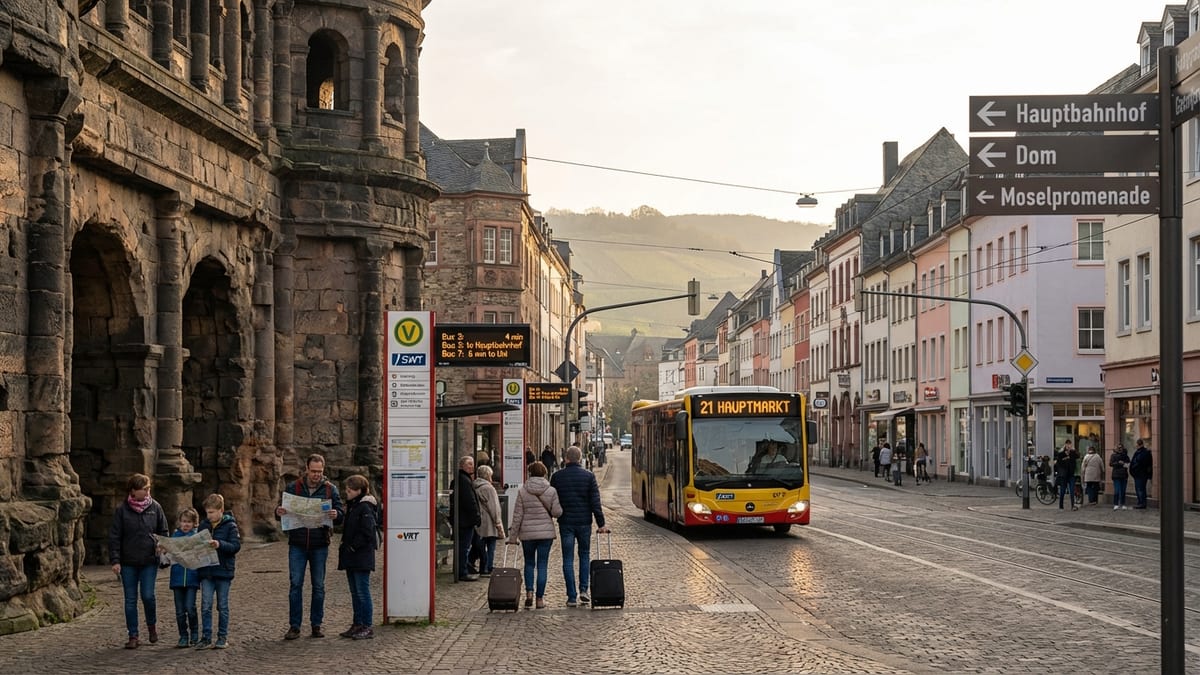
Trier is a compact Roman-era city where most of what you want to see lies within a short stroll, yet it is also a regional hub with a busy bus network and frequent train connections along the Moselle and toward Luxembourg and Cologne.
For visitors, getting around is usually a matter of combining leisurely walks through the historic core with timely hops on buses or regional trains. Easy transport makes it simpler to cover the main things to do in Trier.
Understanding Trier’s Layout and Transport Hubs
Trier sits in a narrow Moselle valley framed by vine-covered hills, which means the city stretches lengthwise along the river rather than spreading in every direction. The UNESCO-listed Roman and medieval sights cluster in and around the pedestrianized old town, between the Porta Nigra at the northern edge and the Imperial Baths and Amphitheater toward the southeast. This dense core is what most first-time visitors focus on, and it is compact enough that walking is usually the fastest way to get between landmarks.
The practical gateway to Trier is Trier Hauptbahnhof, the main railway station. It lies roughly 500 meters east of the inner city and within a quick 10-minute walk of the Porta Nigra. The station forecourt is also one of the city’s primary bus hubs, with Stadtwerke Trier (SWT) services radiating out to the university, suburbs, and nearby villages. If you arrive by regional train from Luxembourg, Koblenz, Saarbrücken, or Cologne, your onward journey into the historic center will almost always start here.
At the heart of the old town, Porta Nigra itself functions as a second major node. It marks the northern entrance to Simeonstrasse, Trier’s main shopping street and a busy pedestrian artery leading to the Hauptmarkt and cathedral. Buses loop around Porta Nigra to access the inner-city stops, and this is often the easiest point to orient yourself if you have just stepped off a train and walked into town. From here, everything from the cathedral to the Electoral Palace is within 10 to 15 minutes on foot. The transport options also support popular day trips from Trier.
The Moselle waterfront forms the third reference point. While it is less of a public transport hub, several bus lines touch the riverfront, and river cruise docks sit within walking distance of the old town. For many travelers, a day in Trier loosely traces a triangle between the station, the Roman monuments around the old town, and the river, with buses and trains taking care of the approach and onward journeys.
Exploring Trier on Foot: Classic Inner-City Routes
Walking is the most rewarding way to explore Trier’s historic core. The main monuments lie close together, and the city has invested in broad, well-maintained pedestrian zones. The most classic route begins at Porta Nigra, where you can climb the ancient city gate for views over the rooftops, then continue down Simeonstrasse toward the Hauptmarkt. This stretch links Roman stonework with medieval houses and busy shopfronts, and it provides an easy visual primer on Trier’s layered history.
From the Hauptmarkt, a short detour brings you to the cathedral and Church of Our Lady, two of the city’s key UNESCO-listed churches. The squares around them are typically lined with cafés, and the pedestrianized streets make it simple to weave between side alleys and quieter courtyards. Continuing south, you can pass the Basilica of Constantine and the pink Electoral Palace before descending into the Palastgarten, a formal garden that leads almost seamlessly toward the Moselle promenade.
Several organized city walking routes and self-guided tours follow similar patterns, looping the old town in 60 to 90 minutes. Some circuits begin at the station, run past the Karl Marx House, swing by the Porta Nigra, and circle the Electoral Palace before returning. Even without a formal route, the distances involved are modest. A complete loop taking in the major Roman sites, cathedral precinct, Palastgarten, and a stretch of riverfront typically runs three to four miles, easily manageable over the course of a day with frequent breaks.
Because so much of central Trier is flat and paved, walking suits a wide range of travelers, including families and casual strollers. However, cobblestones can be uneven in older alleys and around some ruins, so sturdy footwear is advisable. In summer, shaded sections are limited in the wider squares, and it pays to plan rest stops in churches, museums, or cafés during the hottest midday hours.
The Pedestrian Core: Simeonstrasse, Hauptmarkt, and Palastgarten
Central Trier is defined by a broad spine of pedestrian space that links many of the main sights. Simeonstrasse, which runs from the Porta Nigra to the Hauptmarkt, is officially designated a pedestrian zone along most of its length. Buses still pass by the gate itself and on short connecting sections, but visitors wandering the street will mostly encounter shoppers, students, and street performers rather than heavy traffic. This car-light environment makes navigation straightforward and safe, particularly if you are traveling with children.
The Hauptmarkt serves as a natural midpoint in many walking routes. It is a classic German market square, ringed by historic façades and punctuated by a market fountain. This is also a sensible place to pause and reorient yourself, since directions to the cathedral, the Karl Marx House, and the Palastgarten all radiate outward from here. Wayfinding signage is generally clear, and the density of shops and cafés means you are rarely more than a few steps from a break.
South of the basilica, the Palastgarten opens up as one of Trier’s most inviting green spaces. Formal gravel paths cross the lawn in straight lines, but informal routes lead into side streets, down toward the Moselle, or back into the old town around Kornmarkt. For a relaxed half-day, many visitors choose to walk from Porta Nigra through Simeonstrasse and Hauptmarkt, loop the cathedral and basilica, wander the Palastgarten, and then continue to the river before doubling back along different side streets. Even at a leisurely pace, this route fits comfortably within an afternoon.
Evenings are particularly atmospheric in this pedestrian core. Lit façades and the relative quiet after day trippers have departed create a calmer feel. For those staying overnight, neighborhoods just beyond the strict pedestrian zone offer additional walking routes, including residential streets in Trier-Süd and along the riverfront promenades that let you see the city from slightly outside the tourist bubble.
Navigating Trier’s Bus Network
While walking covers the inner city, buses are essential for reaching outlying neighborhoods, the university, hilltop residential districts, and some Roman sites on the fringes. Local buses are operated by Stadtwerke Trier and integrated into the Verkehrsverbund Region Trier, the regional transport association. For visitors, this means unified tickets and passes are valid across most urban bus routes and, within designated zones, on certain local trains as well.
Trier’s bus system runs in two complementary patterns. On weekdays during daytime hours, lines numbered roughly in the 1 to 30 range provide regular services across the city. Frequencies vary by route, but many lines run every 10, 20, or 30 minutes between morning and early evening. In the evenings and at weekends, the network shifts to a star-shaped pattern with lines in the 80s converging at the main station and central points such as Porta Nigra at coordinated times. This structure allows transfers between routes that would otherwise not meet as often.
Key hubs for visitors include Trier Hauptbahnhof, Porta Nigra, and busy inner-city stops near the basilica and Viehmarkt. For example, buses linking the station and Porta Nigra typically take only a few minutes and are useful if you are carrying luggage or arriving late at night. Other lines connect the center with the university on the Petrisberg hill, the industrial areas of Zewen and Euren, and residential districts like Tarforst and Trier-Nord. Stops are clearly signposted, and digital displays at major hubs generally show the next departures with destination and line numbers.
Ticketing is zone-based within the VRT system. The city is divided into an inner city zone and additional rings covering the outskirts. Single-ride fares for a single zone are modest, and day tickets for individuals or small groups often offer good value if you plan to make several trips in one day. It is possible in many cases to use the same tickets on local Deutsche Bahn trains within the city area, which can be helpful if your accommodation lies near one of the suburban stations rather than along a bus route. Check the current tariff details on arrival, as prices and product names can change over time.
Buses for Sightseeing and Daily Errands
Beyond simply linking residential neighborhoods, Trier’s bus network is surprisingly handy for sightseeing. Several lines serve famous Roman and medieval landmarks directly, allowing you to save your energy for walking among the ruins rather than along the busy connecting roads. Visitors heading to the Imperial Baths, Amphitheater, or outlying churches on the hillsides often combine a bus ride in one direction with a leisurely walk back through the inner city.
Lines that link the Hauptbahnhof with Porta Nigra are particularly useful at the start or end of a day. If you are staying in a hotel near the station or arriving by train and want to head straight into the pedestrian zone, a short bus hop eliminates the effort of walking with bags. Similarly, if you have an early train out of town, catching the first morning bus from near your accommodation can spare you a chilly pre-dawn trek through empty streets.
The buses are also helpful for accessing the university campus and the Petrisberg plateau above the city. These higher districts provide sweeping views over Trier and the Moselle valley, and a bus ride up followed by a gradual walk down through side streets can be a pleasant way to spend part of an afternoon. Families and older travelers may especially appreciate the option to avoid steep uphill gradients while still enjoying elevated viewpoints.
For everyday errands like reaching supermarkets, out-of-center shopping areas, or the Messepark retail parks, buses are often more straightforward than driving, particularly for visitors unused to German parking rules. Services typically begin around the early morning, running into the late evening, but it is wise to consult current timetables or a VRT app, especially if your plans depend on the last bus of the night.
Train Travel: Arriving, Departing, and Day Trips
Trains are less important for moving within Trier itself than for connecting the city with the rest of the Moselle region and neighboring countries. Trier Hauptbahnhof is the main rail hub, with multiple platforms handling regional services in several directions. From here, trains follow the river toward Koblenz, run west into Luxembourg, and link south and east toward Saarbrücken and Cologne via intermediate towns.
For many visitors, Luxembourg City is the most convenient cross-border day trip. The journey by regional train typically takes under an hour, and thanks to Luxembourg’s policy of free public transport within its borders, onward travel from the Luxembourg station to the city center or Kirchberg area is straightforward once you arrive. Regular trains also make it easy to visit wine villages along the Moselle and explore castles, hiking routes, and vineyard landscapes without renting a car.
Trier’s position along the river corridor also makes northbound excursions toward Koblenz attractive. The Moselle line threads through a series of picturesque towns, each with its own cluster of half-timbered houses and riverside promenades. While many travelers choose to cruise this stretch by boat, the regional trains provide a faster, year-round alternative that can be combined with walking segments or bicycle routes along the riverbanks.
Within the city limits, local stations such as Trier Süd and smaller stops to the north can function as convenient access points if your accommodation lies nearby. In some fare configurations, city bus tickets and VRT regional tickets include travel on local trains in designated zones, which can shorten a trip across town. That said, for purely urban journeys between the old town, station, and riverfront, walking or bus travel usually remains more practical than riding a train one or two stops.
Tickets, Passes, and Practical Tips
Navigating Trier’s buses and trains is straightforward once you understand the basic ticket types and where to buy them. For short stays, single tickets and day passes are usually the most relevant. Single tickets are suitable if you plan only one or two bus rides in a day, for example between your accommodation and the old town. Day tickets become better value if you anticipate using buses multiple times, such as returning to your hotel for a break before heading back out in the evening.
Tickets can typically be purchased from machines at the Hauptbahnhof, from vending machines at some larger stops, and, on many buses, directly from the driver. Card payments are increasingly accepted, but carrying a small amount of cash is still prudent in case of technical problems. When using regional trains, standard Deutsche Bahn machines and smartphone apps can issue tickets valid from Trier to destinations across Germany and into bordering countries where agreements apply.
If you plan to use regional trains for day trips combined with urban transport, consider whether a VRT regional ticket or a nationwide day pass product fits your itinerary. These passes often allow unlimited travel within certain zones or during specific off-peak hours. While residents and long-term visitors may benefit from monthly passes, short-term travelers generally find that a mix of individual tickets and day passes offers the best flexibility without overcommitting to a single product.
Regardless of the ticket type, always check the zones for which your fare is valid before boarding. Staff at the tourist information office near Porta Nigra and at the Hauptbahnhof can usually provide up-to-date maps and leaflets, and many travelers find it useful to take a photo of the zone map on their phone for quick reference while out and about.
Seasonal Considerations, Accessibility, and Safety
Season and weather strongly influence how you will want to move around Trier. In summer, long days and warm temperatures make extended walking routes appealing, and the Palastgarten and Moselle promenade come into their own as places to linger. Conversely, in winter, early nightfall and cold, damp weather mean you may rely more heavily on buses to minimize time spent outdoors, especially in the evening.
Trier’s historic core is generally flat, but accessibility can be uneven in practice. Many sidewalks in the old town are wide and well maintained, and pedestrian zones make it easier to navigate with a stroller or mobility aid. However, some alleys, older pavements, and areas immediately around ruins include uneven stones, unexpected steps, or narrow passages. Before embarking on longer walks, it is worth scanning a map for alternative routes that use main pedestrian streets and squares rather than back lanes.
Public transport vehicles in Trier increasingly offer low-floor access and designated spaces for wheelchairs and strollers, particularly on newer buses. At the Hauptbahnhof, elevators and ramps connect most platforms, but anyone with limited mobility should allow extra time for transfers, especially if the station is busy. If accessibility is a concern, planning routes that start and end at major hubs like the station and Porta Nigra can reduce unpleasant surprises.
From a safety perspective, Trier is widely regarded as a calm, visitor-friendly city. Standard urban precautions apply, particularly around crowded bus stops and trains during peak hours, but violent incidents are rare. At night, sticking to lit main streets and waiting for buses at major stops rather than isolated ones adds an extra layer of reassurance. Many visitors choose to walk back to central hotels after dinner, enjoying the quiet streets and illuminated monuments before turning in.
The Takeaway
Getting around Trier is fundamentally about balance. The city’s Roman and medieval core is small enough to reward slow exploration on foot, while its role as a regional hub ensures that buses and trains offer extensive coverage for outlying districts and neighboring towns. Travelers who understand how these modes fit together can move smoothly from a riverside stroll to a cathedral visit, then to a university viewpoint or Moselle village, all in a single day.
For most visitors, the practical strategy is simple: walk as much as you can within the pedestrian core, using the Hauptbahnhof and Porta Nigra as anchor points, and rely on buses when distances climb uphill or when time is short. Reserve regional trains for arrivals, departures, and day trips, taking advantage of fare structures that sometimes blend bus and rail travel in shared zones. With this approach, Trier reveals itself not only as Germany’s oldest city in terms of history, but also as a modern, manageable place where moving around rarely becomes a logistical headache.
FAQ
Q1: Is it realistic to explore Trier’s main sights entirely on foot?
Yes. The principal Roman monuments, the cathedral complex, the Hauptmarkt, and the Palastgarten all sit within a relatively compact area. Many travelers cover the key sights on foot in a single full day, although you may choose to add a short bus ride for hilltop areas or outlying attractions.
Q2: Which bus stop should I use if I arrive in Trier by train?
The main bus hub is directly outside Trier Hauptbahnhof. From there, frequent buses head toward Porta Nigra and other inner-city stops. If you prefer to walk, the old town and Porta Nigra are roughly 10 minutes on foot from the station.
Q3: Do I need a car to visit Trier and nearby Moselle towns?
No. Trier itself is highly walkable, and the combination of city buses and regional trains covers most nearby destinations along the Moselle and toward Luxembourg. A car can be convenient for very small villages or rural wineries, but for typical sightseeing, public transport works well.
Q4: Are bus tickets and train tickets interchangeable in Trier?
Within the Verkehrsverbund Region Trier, some tickets and passes are valid on both buses and certain local trains inside defined zones. However, not every bus ticket automatically includes rail travel, so it is important to confirm the validity of your ticket or pass before boarding a train.
Q5: How late do buses run at night?
Service generally starts early in the morning and continues until late evening, with special star-shaped routes operating in the evenings and on weekends. Exact times depend on the line and the day of the week, so you should always check a current timetable if you plan to travel late at night.
Q6: Is Trier’s old town suitable for travelers with limited mobility?
Many of the main streets and squares in the old town are flat and pedestrianized, which helps accessibility. However, there are sections with cobblestones, curbs, and occasional steps, especially near ruins and older buildings. Planning routes via broad streets like Simeonstrasse and using buses to avoid steeper climbs can make visits more comfortable.
Q7: What is the best way to reach Luxembourg City from Trier?
The most straightforward option is a regional train from Trier Hauptbahnhof to Luxembourg City. The journey usually takes under an hour, and once you arrive, Luxembourg’s domestic public transport is free, which simplifies onward travel inside the country.
Q8: Are there recommended walking routes along the Moselle from Trier?
Yes. Many visitors enjoy combining a loop through the old town with a section of riverside promenade, starting near Porta Nigra or the Palastgarten and descending toward the Moselle. Longer walks follow the riverbanks in either direction, often linked with parkland and residential neighborhoods that remain close to bus stops and, in some stretches, train stations.
Q9: Can I rely on English-language information for transport in Trier?
At major points such as the main station, tourist information office, and primary bus stops, you will usually find signage, timetable information, or staff able to assist in English. While not every announcement or leaflet is bilingual, apps and digital tools often provide English options to help you plan routes and check schedules.
Q10: When is walking less advisable and public transport more useful in Trier?
Walking becomes less attractive during heavy rain, winter cold, or when it is very dark, especially if you are unfamiliar with the city. In these conditions, using buses between your accommodation, the station, and the old town reduces exposure to the elements and shortens travel time. Similarly, if your plans include hilltop neighborhoods or multiple trips in one day, combining walking with buses or trains is usually more practical than relying on foot travel alone.