


Brussels, Ghent and Bruges sit so close together on the Belgian rail network that many visitors are tempted to “do” both historic Flemish cities in a single day. On paper the distances look easy. In reality, transfers, crowds and the sheer density of sights mean that combining Ghent and Bruges from Brussels creates a very different experience from dedicating a full day to just one. This guide uses current train information, city transport and price data for late 2026 to help you decide which option genuinely fits your travel style.
Get the latest updates straight to your inbox!
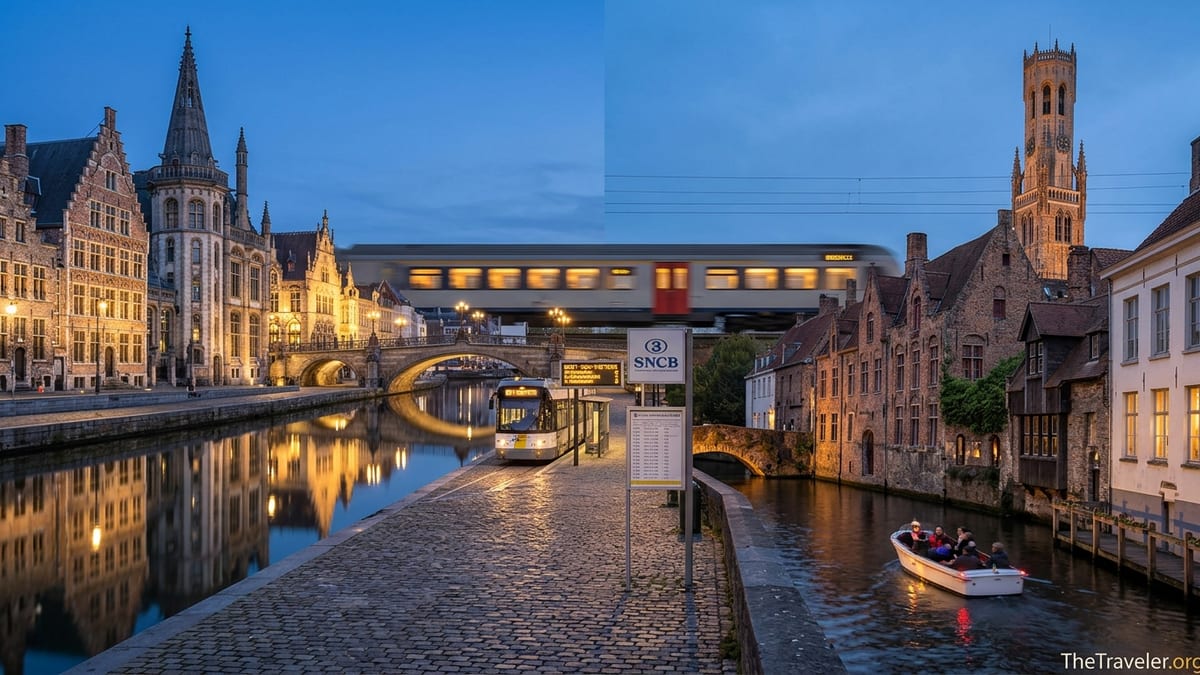
Understanding the Rail Geography and Timings
The practical starting point is the rail map. Direct InterCity trains link Brussels with both Ghent and Bruges throughout the day. In normal conditions, Brussels to Ghent takes around 35 to 45 minutes, Ghent to Bruges 25 to 30 minutes, and Bruges back to Brussels roughly one hour, depending on the station pair and train type. Real-time journey planners from the national rail operator confirm these ballpark figures for late 2026 services, with at least two direct trains an hour on each segment during the day.
Brussels itself has several major stations. For most visitors, the relevant trio is Brussels-Midi, Brussels-Central and Brussels-Nord. All three lie on the same north–south line used by InterCity trains to Ghent and Bruges. Central sits closest to the Grand Place and many hotels. Midi handles Eurostar and many international services, so it is the default if you are arriving from London or Paris. Nord is convenient for business districts and some chain hotels. From a pure travel-time perspective, differences between departing from Midi, Central or Nord to Ghent and Bruges are usually only a few minutes.
One critical detail is that the train timings assume you are already in the station and ready to board. Reaching Brussels-Central from the Grand Place area on foot can easily add 10 minutes. Arriving early for a Eurostar at Midi or navigating from a hotel near Nord adds similar margins. When planning a combined Ghent and Bruges day, it is realistic to factor at least 15 minutes at the start and end of the day for station access in Brussels, and to avoid the last train of the evening back.
Direct train frequency matters if you are trying to keep the day fluid. On a typical weekday, Brussels to Ghent and Brussels to Bruges both see InterCity departures roughly every 20 to 30 minutes in daytime, though you should always check exact times for your date. Evening services thin slightly but still offer multiple options before midnight, meaning a missed connection between Ghent and Bruges is usually an annoyance rather than a disaster.
Tickets, Discounts and What You Can Expect to Pay
Belgian rail tickets are generally flexible for domestic journeys. For late 2026, standard second-class fares on InterCity trains between Brussels and Ghent or Bruges are set on a distance-based scale but not tied to a specific departure. You can usually buy a ticket shortly before travel in the SNCB app, at station machines or ticket counters, and then board any appropriate train that day in the selected class. This flexibility makes it easy to adjust your Ghent and Bruges schedule on the fly if you linger over lunch or leave a sight early.
Weekend pricing is particularly relevant. SNCB applies a specific weekend product that discounts many leisure journeys between Friday evening and Sunday. Official fare information for 2026 confirms that weekend reductions remain in place, though the exact discount level and validity calendar are subject to periodic indexation and public-service-contract rules. Youth travellers under 26, seniors and some other categories benefit from at least 40 percent reductions compared with the base fare at all times, including weekdays. That means a 20-year-old paying a youth fare for Brussels to Bruges will typically pay substantially less than a 40-year-old buying a full-price ticket on the same train.
For a visitor planning Brussels–Ghent–Bruges–Brussels in one day, the question is whether to buy separate point-to-point tickets or look at a multi-journey product. Recent changes to SNCB’s range have simplified some options, and older products like certain 10-journey passes have been withdrawn. In practice, most short-stay visitors now either buy three separate single tickets for each leg, or combine a discounted weekend ticket with a railcard-style product such as Train+ if they are staying several days and making repeated trips. Train+ in 2026 remains a flat-rate monthly or annual add-on that reduces many leisure fares further, but it only makes financial sense if you are making multiple Belgian rail trips beyond Ghent and Bruges.
As a concrete example using late-2026 pricing structures, a standard second-class single between Brussels and Bruges might fall in the teens of euros at full fare, with Brussels–Ghent slightly cheaper because of the shorter distance. A youth traveller on the same routes could expect to pay something in the high single digits to low teens per leg, especially when weekend discounts apply. Because promotional details and exact euro amounts are frequently updated, it is wise to do a dummy booking in the SNCB app just before your trip and note the total for three separate legs compared with any bundled or weekend option available on your dates.
Reaching the Historic Centers from Ghent and Bruges Stations
Many one-day itineraries ignore a key factor: neither Ghent’s nor Bruges’s main stations sit in the medieval core. In Ghent, InterCity services from Brussels arrive at Gent-Sint-Pieters, which lies around 2 kilometres from the Graslei and Korenlei waterfronts. You cannot step off the train straight into the old town. The fastest link is tram line 1, operated by De Lijn. Before long-term works disrupted part of the route, this tram ran from Gent-Sint-Pieters through key stops to Korenmarkt in about 10 minutes. Recent guidance from city and event organisers still directs visitors to buy tickets at machines outside Gent-Sint-Pieters or to pay contactless on board, and to expect a short urban ride rather than a scenic approach.
Because of ongoing infrastructure works between the station and the core, tram services on parts of the Gent-Sint-Pieters to Korenmarkt corridor have faced temporary modifications. In practice, that can mean diversions, replacement buses or slightly longer journey times at certain moments between 2024 and 2028. Walking from Gent-Sint-Pieters to the historic center is technically possible in about 25 to 30 minutes along a mostly commercial corridor, but it is not especially atmospheric and can feel long if you are carrying a daypack or walking on a wet morning. Visitors with limited mobility, heavy luggage or tight schedules should factor 15 to 25 minutes from train arrival to standing on the Graslei, even when using trams.
In Bruges, the geography is a little more forgiving. Brugge station sits closer to the historic core, although you are still not on Markt itself when you step off the train. The walk from Brugge station to Market Square is roughly 1.5 kilometres and typically takes 18 to 20 minutes at a normal pace, passing through Minnewater park and the Beguinage if you choose the scenic route. Many visitors simply stroll in; the sidewalks are good but sections are cobbled and can be tiring for those with ankle or mobility issues.
For those who prefer not to walk, De Lijn buses 1 and 2 connect Brugge station with central stops near Markt and Dijver. Local transport and tourism information indicate departures every few minutes during the day, with ride times of around 8 to 12 minutes and a single contactless ticket at approximately 3 euros per person, valid for about an hour of travel. The total transfer from train platform to Markt, including waiting time for a bus, typically falls between 15 and 25 minutes. When you add these city transfers at both ends, the theoretical 25-minute Ghent to Bruges train ride often stretches to 45 minutes or more from “historic center to historic center.”
A Realistic Two-City Day: Sample Itinerary and What You Sacrifice
Assume you start in central Brussels. If you leave Brussels-Central around 8:30 in the morning on a direct InterCity, you could arrive at Gent-Sint-Pieters shortly after 9:00. Budget 15 to 20 minutes to reach the center by tram or on foot, and you will be standing on the Graslei around 9:30. That leaves roughly three hours to enjoy Ghent before you need to move on to Bruges if you also want meaningful time there and a relaxed return to Brussels.
From 9:30 to about 12:30 in Ghent, a concentrated plan might look like this: start by walking along the Graslei and Korenlei quays, taking in their guild houses and riverside views, then continue to Saint Bavo Cathedral to see the exterior and, if the timing works and queues are short, briefly step inside for a look at the interior and perhaps a very quick glimpse of the Ghent Altarpiece with a prebooked slot. You might then head to the exterior of Gravensteen castle for photos and a short canal-side loop around the surrounding streets. There will be time for a coffee on a terrace near Korenmarkt, but a full sit-down lunch could easily absorb an hour you do not have.
Around 12:30 you would make your way back towards Gent-Sint-Pieters, again allowing 20 to 25 minutes for tram and transfer. With a little margin, you could target a train to Bruges around 13:00 to 13:30 and arrive at Brugge station before 14:00. A 20-minute walk into town places you on Bruges’s Markt around 14:20. From 14:20 until perhaps 18:00 or 18:30 you can circle Markt, Burg Square, Rozenhoedkaai and some of the loveliest canal views on foot, maybe detouring via the Beguinage or a chocolate shop. At that point you will likely skip climbing the Belfry, skip interior museum visits and may only squeeze in a quick waffle or fries rather than a restaurant dinner before catching an evening InterCity back to Brussels, arriving between 20:00 and 21:00.
The sacrifices are clear. On a two-city day you will almost certainly miss the full interior experience of Gravensteen in Ghent, the Belfry climb or Groeningemuseum in Bruges, and any leisurely canal cruise. Bruges canal boats, which typically last around 30 minutes, operate on fixed schedules and draw queues in high season. Queuing for 20 minutes and cruising for 30 can cost almost an hour of your short afternoon. A relaxed three-course dinner on a quiet Ghent side street or a romantic evening meal overlooking Bruges’s canals also become impractical if you must be back on a train to Brussels the same night.
Ghent vs Bruges: Atmosphere, Crowds and When Each Shines
Choosing where to put your limited time is partly about atmosphere. Ghent is a larger working city with a major university, a more varied street life and a slightly edgy creativity that you notice in its cafes, street art and nightlife. The historic center still feels lived-in. You may find yourself sharing tram stops with students and locals heading to work rather than exclusively with tour groups. For many travellers, Ghent is at its best in the early evening, when the Graslei and Korenlei facades are illuminated, locals gather on the quays and the city’s famous lighting plan softens the medieval stone.
Bruges, by contrast, is compact and intensely picturesque, with its Markt, Burg and Rozenhoedkaai forming one of Europe’s most photogenic ensembles. It has earned its popularity and sometimes feels like an open-air museum. In high season, particularly on weekends from late spring through early autumn, Bruges’s central streets can be densely crowded with coach groups and cruise excursionists during late morning and mid-afternoon. Tourism bodies and local reporting note that the city experiences pronounced peaks when river-cruise buses and day-trip buses from Brussels or the coast all converge on the core simultaneously.
Crowding patterns shift in winter. Bruges hosts atmospheric Christmas markets and seasonal events typically from late November into December, drawing heavy weekend crowds, especially on Saturdays when Belgians and neighbouring Dutch, French and British visitors come for day trips. During these weeks it is common to see packed squares, long lines for popular waffle shops and very busy evening trains back towards Brussels. Ghent also holds winter festivities, but the tourist pressure in its lanes usually feels less intense than in Bruges.
If you visit in shoulder months such as March, early April or late October, you may find Bruges pleasantly busy but manageable and Ghent comparatively calm. In the peak of July and August on sunny weekends, experienced travellers often recommend either staying overnight in Bruges so that you can enjoy early morning and later evening windows before day-trippers arrive and after they leave, or shifting some of your time towards Ghent where crowds are more diffuse. This crowd dynamic strongly influences whether a two-city day feels inspiring or simply exhausting.
Costs on the Ground: Local Transport, Attractions and Meals
Beyond rail tickets, you should budget for local transport, sight entry, food and optional experiences. For late 2026, De Lijn’s single tickets for trams and buses in Flanders typically cost around 3 euros when purchased contactlessly on board or at machines, valid for roughly 60 minutes of travel. A traveller using tram 1 twice in Ghent and a bus once in Bruges would therefore spend in the region of 9 euros on local transport for the day. Check De Lijn’s latest fare tables shortly before travel, as regional pricing has seen several reforms in recent years.
Major attractions carry separate entrance fees. Access to Gravensteen’s interior in Ghent, including ramparts and exhibits, is usually priced in the low to mid-teens in euros for standard adult tickets, with discounts for youths and seniors. The Ghent Altarpiece in Saint Bavo Cathedral has its own ticketed system with timed entry, also in the low to mid-teens and separate from the general cathedral donation. In Bruges, canal cruises often cost around 15 euros per person for a 30-minute shared-boat experience, with winter schedules adjusted for weather and daylight. Climbing Bruges’s Belfry and visiting key museums such as the Groeningemuseum involve additional entry charges, again typically somewhere around 10 to 18 euros per adult depending on combined tickets and updated municipal pricing.
Food costs vary by taste and location. A quick lunch of fries with sauce near Korenmarkt, plus a soft drink, might cost around 10 to 12 euros. A simple sit-down lunch in a mid-range brasserie in either city, perhaps mussels or a Flemish stew with a local beer, is more realistically around 20 to 30 euros per person. Dinner in a well-regarded Bruges canal-side restaurant will typically be higher again. For budgeting purposes, a day-trip that includes one mid-range restaurant meal, coffees and snacks could land in the 40 to 60 euros per person range for food alone, excluding any fine dining splurges.
Adding up typical 2026-level expenses, a Brussels-based traveller doing both cities in one day might spend: three domestic train journeys in second class, local trams and buses in both cities, at least one paid attraction, a modest canal cruise in Bruges and two simple meals. Even with youth or weekend discounts, it is easy to approach or surpass 100 euros per person for the day, especially if you opt for interior visits or sit-down dinners. A single-city day can be a little cheaper because you make fewer transfers, perhaps use fewer local-transport rides and have more flexibility to choose a picnic or supermarket lunch rather than a restaurant pressed by time.
Luggage, Surfaces, Weather and Accessibility Considerations
Another often overlooked factor is luggage. If you are using Ghent and Bruges as stops while moving between hotels, both cities’ main stations provide luggage storage options. Belgian station lockers and staffed left-luggage services charge per day, with prices adjusted in line with national tariff changes announced in early 2026. These facilities are ideal if you arrive from Brussels with an overnight bag, store it in Brugge station lockers, then walk unencumbered into town for a long day before checking into your Bruges hotel. For pure day-trippers returning to Brussels the same night, it is usually easiest to leave larger suitcases at your Brussels base and carry only a small daypack.
Cobbled streets are part of the charm but can be punishing. The historic cores of both Ghent and Bruges feature stretches of uneven stone, especially around side lanes, bridges and older squares. Travellers with rolling suitcases, knee trouble or stroller-age children should allow more time and energy. Stable walking shoes with good cushioning are more useful here than fashion trainers with smooth soles. This is particularly relevant in wet weather, when cobbles become slick and puddles form in low spots.
Rain is common in Belgium across all seasons. A two-city day heavily exposed to the weather can quickly feel miserable if you are dashing between sights without a solid backup plan. Fortunately, both Ghent and Bruges offer covered alternatives. In Ghent, spending an extra hour inside Gravensteen or sheltering in a cafe near Sint-Michielsbrug is an easy adjustment if you are only focusing on that city. In Bruges, museums, churches and intimate cafes around Burg and side streets off the Markt provide indoor respite. However, if you are trying to squeeze both cities into a single day, poor weather on your scheduled train-transfer window can delay you and further compress sightseeing time.
Accessibility is mixed. Mainline trains between Brussels, Ghent and Bruges are generally step-free at platform level with assistance available when arranged in advance, but the older urban fabric contains narrow pavements, steps and canal bridges. Visitors using wheelchairs or pushing strollers should research step-free routes from Gent-Sint-Pieters to the center and from Brugge station to Markt, and consider focusing on one city to reduce transfers. The walk in Bruges from station to center is reasonably manageable with a stroller if you plan your route, while Ghent’s tram and ongoing works can pose a bigger planning challenge.
Alternative Itineraries: One-Day Ghent, One-Day Bruges and a Two-Day Ideal
If you choose to focus on Ghent alone, a satisfying day might start with a mid-morning InterCity from Brussels arriving in Gent-Sint-Pieters around 10:00, followed by tram or taxi into the core. You could then tour Gravensteen properly, including its ramparts and interpretations, visit Saint Bavo Cathedral with enough time to appreciate the Ghent Altarpiece without rushing, and wander the Patershol district and smaller canals. Lunch in a bistro near Vrijdagmarkt, a mid-afternoon coffee at a student-oriented cafe and a relaxed evening drink along the Graslei as the lights come on would all fit comfortably before an evening train back to Brussels.
A one-day Bruges itinerary from Brussels gives you a different rhythm. Arrive before 10:00, walk into town via Minnewater and the Beguinage, then spend the morning around Rozenhoedkaai and the canals. Late morning, queue for and take a canal cruise, then enjoy a long lunch on a side street away from the busiest rings of Markt. In the afternoon, climb or at least visit the Belfry, explore Burg Square’s Basilica of the Holy Blood and City Hall, and maybe visit one art museum. A late-afternoon break in a quiet cafe, followed by a golden-hour photographic stroll back towards the station, rounds out the day before your evening train to Brussels.
The ideal scenario for many culturally minded travellers is two days based in Brussels or split between the cities. Day one could be devoted entirely to Ghent, arriving mid-morning and staying into the evening to experience the city’s lighting and more local-feeling atmosphere. You might add a guided walking tour or a contemporary-art stop without feeling rushed. Day two could then focus on Bruges, with an early arrival to enjoy Markt and Burg before the heaviest tour-bus crowds, a canal cruise, a museum visit and an unhurried dinner. Splitting the cities this way makes missed trains and brief showers less consequential, since you have margin to move activities within the day.
For those willing to change hotels, spending a night in Bruges can be especially rewarding. Checking into a central Bruges hotel lets you experience the streets after day-trippers depart, when canals fall quiet and local restaurants feel more relaxed. The following morning you can photograph Rozenhoedkaai at dawn and linger over breakfast before heading to Ghent or back to Brussels. An overnight stay also eliminates the stress of keeping an eye on the last practical train back to the capital.
Final Verdict: Who Should Combine, Who Should Choose One and When to Stay Overnight
Visiting both Ghent and Bruges from Brussels in one day is possible, but it is best suited to travellers who are comfortable with early starts, brisk walking and a sight-heavy schedule. If your goal is to collect impressions of both cities, photograph the main squares and quays, and you are content to skip interiors and long meals, the combined itinerary can feel energising rather than punishing. It works particularly well outside the peak of summer and Christmas markets, when transfers and streets are less congested.
If you value depth over breadth, prefer to sit in a cafe and watch local life, or know that you tire quickly on cobbles, then choosing just one city for a day is significantly more satisfying. Ghent is a strong choice for those who like lived-in urban atmosphere, evening ambience and a mix of medieval and contemporary culture. Bruges is unbeatable if your priority is postcard-perfect medieval streets, photogenic canals and concentrated heritage, accepting that you will share them with many other visitors.
Families with younger children, travellers with mobility concerns and those visiting during peak weekends or Christmas-market periods may find that two cities in one day simply add stress without much gain. In those cases, structure your time around one city, arrive early and plan indoor options for rain or crowd surges. If your schedule and budget allow, an overnight stay, especially in Bruges, almost always yields a substantially better experience, opening up quiet early-morning and late-evening windows that day-trippers never see.
In short, the rail geography of Brussels, Ghent and Bruges makes a two-city day feasible on paper, but transfers, crowds and the richness of each destination mean that many travellers will enjoy their Belgian time more by slowing down. Decide honestly whether you want a checklist of landmarks or a deeper feel for place, and plan your trains, tickets and pacing accordingly.