

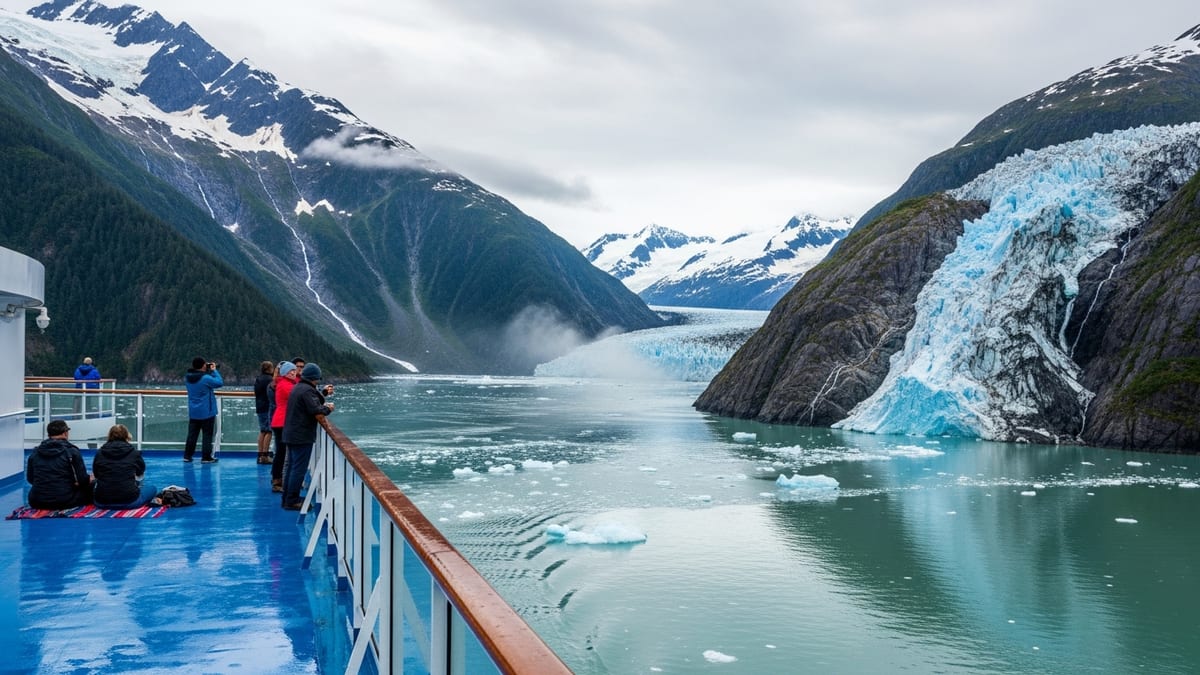
Glacier Bay days are often described as the soul of an Alaska cruise. The engines slow, the ship glides into a silent world of ice and granite, and suddenly the focus shifts from onboard entertainment to the raw spectacle outside.
For many travelers, this is the day that transforms an enjoyable voyage into a once in a lifetime experience. Understanding what Glacier Bay is, how cruise visits actually work, and how to get the best from your time there will help you see why this national park is considered a defining highlight of Alaska cruising.
What Makes Glacier Bay So Special?
Glacier Bay National Park and Preserve occupies a vast, fjord like basin carved by ice over thousands of years. Today, more than a thousand glaciers shape the landscape, with seven active tidewater glaciers still sending icebergs crashing into the sea. According to the National Park Service, glaciers still cover more than 1,500 square miles, roughly one third of the park, making this one of the most glacier rich regions in North America.
What makes a cruise through Glacier Bay so powerful is the sense of scale and isolation. Sheer rock walls, veined with waterfalls, rise thousands of feet from water that can plunge to depths of more than 1,000 feet. Snowcapped peaks such as Mount Fairweather tower over the inlets, and on a clear day you can see an unbroken panorama of mountains, ice, and sky that feels surprisingly untouched by modern infrastructure. There are no roads into the bay, no towns, and no cruise piers. Your ship becomes a moving observation platform in a protected wilderness.
The bay is also a living laboratory of change. Less than three centuries ago, a single massive glacier filled this entire basin. Since about 1750, the ice has retreated more than 60 miles, revealing new land, new islands, and new ecosystems as it goes. Scientists and park rangers point to Glacier Bay as one of the fastest documented examples of glacial retreat and ecological succession anywhere in the world, which makes a visit here not just visually dramatic but scientifically and historically significant.
How Glacier Bay Fits Into Alaska Cruise Itineraries
Glacier Bay is not automatically included on every Alaska cruise. The National Park Service strictly limits the number of large cruise ships allowed in the bay each day in order to protect wildlife, preserve air and water quality, and keep the experience from feeling crowded. As a result, cruise lines must apply for permits and plan their schedules years in advance, and only a subset of Alaska sailings each season includes a full day inside Glacier Bay.
Most Glacier Bay cruises follow the classic Inside Passage route, sailing from Vancouver, Seattle, or occasionally San Francisco. Glacier Bay day is typically the centerpiece of a seven night itinerary, sandwiched between port stops such as Juneau, Skagway, and Ketchikan. Ships normally enter the park early in the morning and leave in the late afternoon after nine to ten hours of scenic cruising. All of that time is spent in motion. Cruise ships do not dock or allow passengers to disembark inside the park, apart from park service staff who board and later depart by small vessel.
Because access is controlled, a visit to Glacier Bay often becomes a selling point for certain cruise lines and routes. Holland America Line, Princess Cruises, and a handful of others have established long term relationships in the region and regularly feature Glacier Bay on their Alaska seasons, while some other lines focus on different glacier destinations instead. When comparing itineraries, it is important to look specifically for Glacier Bay listed in the day by day schedule if this experience is important to you.
What a Glacier Bay Day on a Cruise Ship Is Really Like
A typical Glacier Bay day begins early. Long before breakfast, the ship is already gliding past the mouth of the bay and into its main channels. Most travelers wake up to find a detailed park map delivered to their stateroom the evening before, along with approximate times for major viewpoints. Hot beverages appear at outdoor observation areas, extra deck blankets are stacked by the railings, and the usual background music is turned off so natural sounds and park commentary can take center stage.
Shortly after the ship crosses into park waters, a team of National Park Service rangers and often a Huna Tlingit cultural interpreter come aboard. Their presence is one of the most distinctive elements of a Glacier Bay visit. Throughout the day, they broadcast live narration over the public address system and into lounges, explaining the geology, wildlife, glacial history, and Indigenous heritage of the area. They also staff an informal visitor center inside a lounge, host short presentations, and run Junior Ranger programs for children, turning the ship into a floating extension of the national park.
The scenic highlight is usually several hours spent at one of the great tidewater glaciers, most commonly Margerie Glacier or Johns Hopkins Glacier, depending on conditions and park regulations. The captain will slowly rotate the ship so both port and starboard sides have extended viewing time. Engines are kept at minimal power and on a calm day you can hear the thunderous cracks of calving ice echoing off the valley walls. It is hard to appreciate from photos how much sound and motion are involved when a mass of ice the height of a high rise building shears off the glacier face and erupts into the bay.
Between glacier stops, the atmosphere is unhurried. Many travelers rotate between open decks, sheltered viewing lounges, and their own balconies. Restaurants and buffets remain open, but informal snacks, hot soups, and warm drinks tend to migrate outside, making the railings feel like long, moving picnic spots. Announcements about wildlife sightings interrupt conversations as humpback whales feed in the distance, sea otters roll through the kelp, or brown bears roam the shoreline. A good pair of binoculars proves invaluable in these moments.
Choosing a Cruise Line and Ship for Glacier Bay
Because Glacier Bay access is limited, a few cruise companies have built much of their Alaska identity around this park. Lines such as Holland America and Princess Cruises routinely highlight Glacier Bay in their marketing and schedule many of their ships to include at least one Glacier Bay sailing per week throughout the season. They work closely with the National Park Service and Alaska based partners to integrate ranger led experiences, destination focused dining, and educational programming specifically around glacier encounters.
Larger mainstream lines that operate megaships sometimes alternate Glacier Bay with other marquee glacier destinations such as Hubbard Glacier, Dawes Glacier in Endicarm Arm, or Tracy Arm Fjord. These are also spectacular, but the experience can feel different. Glacier Bay brings a full day of protected park cruising, multiple glacier views, and onboard rangers, while some alternative routes offer a shorter glacier viewing window within a broader coastal itinerary. Smaller expedition style vessels and boutique lines may visit Glacier Bay as well, often with more time spent in quieter side inlets but fewer onboard amenities.
Ship size influences your experience. Big ships offer expansive observation lounges, multiple open decks, and sometimes bow access that creates a stadium like feel when everyone rushes out at once for a big calving event. They also tend to have more structured lectures, photography classes, and youth programs tied to Glacier Bay. Smaller ships trade away some of that infrastructure for a more intimate, less crowded presence in the landscape, with more space per person at the railings and a quieter overall ambience. Both approaches can be rewarding as long as you understand what you want from the day.
Beyond the basic question of whether Glacier Bay is included, it is worth reading the fine print of itineraries and recent traveler reports. Look at how the line frames its glacier days on sample schedules, whether they highlight park rangers and cultural interpreters, and how they describe viewing areas and commentary. A line that treats Glacier Bay as the emotional centerpiece of the voyage is more likely to design the day around immersion rather than treating it as a scenic backdrop to onboard routines.
Wildlife, Weather, and Seasons in Glacier Bay
Glacier Bay is not just about ice. The park protects an unusually intact marine and terrestrial ecosystem that supports whales, porpoises, harbor seals, sea lions, sea otters, bears, moose, mountain goats, and hundreds of bird species. Humpback whale sightings are common in the broader bay and adjacent Icy Strait in summer, while orcas move through in family pods. Bald eagles patrol the shoreline, and puffins, murres, and other seabirds cluster around nutrient rich upwellings created by glacial meltwater.
Wildlife activity shifts across the season, which stretches roughly from late April to late September for most large cruise ships. In May and early June, snow often lingers lower on the slopes and the air can feel crisper, with clearer views and more pronounced contrasts between white ice and dark rock. This is a good time for watching bears along the shoreline as they emerge from hibernation and forage in the intertidal zone. By mid summer, longer daylight, slightly milder temperatures, and richer plankton blooms support intensified whale feeding and large rafts of seabirds.
Weather is famously changeable. In a single Glacier Bay day you might experience bright sun, mist, low cloud, and driving rain in rapid succession. Even in July, temperatures on deck can feel close to freezing when wind and ice cooled air are factored in. Dressing in layers, with a waterproof outer shell and something windproof for your hands and head, is the single best strategy for comfort. Passengers who assume they can simply dash outside in a light sweater often retreat early, missing some of the most atmospheric scenes when clouds part or fog curls around a glacier face.
It is also important to understand that visibility can vary dramatically from one cruise to another. Some sailings enjoy flawless blue skies and mirror calm water, while others encounter fog or low clouds that partially obscure glacier faces. Even on more challenging days, rangers and crew are adept at making the most of conditions, shifting viewing positions to capture fleeting breaks in the weather and turning attention to wildlife, ice formations, and storytelling when visibility tightens.
Climate Change and the Future of Glacier Bay
Glacier Bay exists today because of glacial retreat, and that retreat is now accelerating under the influence of global climate change. Park scientists report that the vast majority of Alaska’s glaciers are currently thinning or shrinking, with only a handful of exceptions. Within Glacier Bay, the most iconic tidewater glaciers such as Margerie and Lamplugh have been receding or thinning for decades, even as they continue to put on dramatic calving displays for visitors.
Recent research has highlighted the speed and global scale of glacial loss, with multiple international studies documenting record ice mass loss in the early 2020s and warning that many mid latitude mountain glaciers outside the polar ice sheets could disappear within this century. Alaska consistently appears as one of the regions with the highest annual loss. In Glacier Bay, these trends show up both in scientific measurements and in visible changes to shorelines, moraine patterns, and newly exposed bedrock and islands that did not exist on earlier charts.
For travelers, this means two things. First, there is a growing sense of urgency about seeing tidewater glaciers such as those in Glacier Bay while they remain relatively accessible and active. Calving fronts that once filled entire fjords are now narrower and sometimes more fragmented, and projections suggest significant further retreat in coming decades. Second, a Glacier Bay cruise is an opportunity to confront climate realities in a tangible way. Rangers and naturalists increasingly weave climate science into their commentary, helping visitors connect personal impressions of ice and weather with the broader data record.
This does not diminish the power of the experience. If anything, understanding the fragility and dynamism of Glacier Bay’s ice adds depth. Watching a slab of glacial ice collapse into the water and generate a rolling wave is thrilling on its own. Knowing that the glacier’s overall mass is shrinking year over year may shift that thrill into something closer to awe and reflection. Many travelers leave Glacier Bay with a quiet sense of having seen a landscape mid transformation, one that future generations may know in a very different form.
How to Prepare and Make the Most of the Experience
Because Glacier Bay day is so visually focused, preparation is largely about maximizing your ability to see, stay outside comfortably, and capture memories without letting cameras dominate your attention. Good binoculars are arguably more important than a high end camera. They bring distant whales, seabirds, mountain goats, and ice textures within reach, and they allow you to scan shorelines and cliff faces during long stretches between major glacier viewpoints.
Clothing choices can make or break your enthusiasm for staying on deck. The basic formula is a moisture wicking base layer, a warm insulating mid layer such as fleece or wool, and a waterproof, wind resistant outer shell. Add a warm hat, gloves that you can still operate a camera with, and shoes with good traction on potentially wet decks. Many ships will provide blankets and sometimes even offer souvenir beanies or scarves, but nothing substitutes for a solid personal layering system tailored to your own tolerance for cold.
From a planning perspective, think about where you want to be during key moments. Balcony cabins offer privacy and convenience, especially when you want to step in and out frequently, but they do not always provide the best angles when the ship rotates at a glacier face. Forward observation lounges, open bow access when available, and high decks with clear sightlines let you appreciate the full sweep of cliffs, hanging glaciers, and approaching icebergs. A good strategy is to treat your cabin as a home base and change vantage points throughout the day.
Mental preparation matters too. Glacier Bay is one of the few cruise days when it pays to let go of structured schedules and treat the entire day as an unfolding event. The ship’s daily program will list approximate times for entering the park and reaching particular glaciers, but conditions often shift slightly. Staying flexible, following ranger announcements, and letting your natural curiosity drive you from port side to starboard, bow to stern, will leave more space for serendipitous encounters such as a surprise whale breach or a sudden shaft of sunlight turning a glacier face an impossible blue.
The Takeaway
Among the many memorable elements of an Alaska cruise, Glacier Bay stands apart. This is not a quick scenic sail by or a photo stop at a single glacier, but an immersive, all day progression through a protected national park that feels both ancient and actively changing. Time slows down, the usual shipboard distractions recede, and the focus shifts to cliffs, ice, wildlife, and the stories that tie them together.
For travelers deciding between itineraries, the inclusion of Glacier Bay is often worth prioritizing, especially if this may be your only visit to Alaska by sea. Limited ship permits, onboard National Park Service programs, and the combination of multiple glacier views within a single fjord make this day unlike any other on the route. It distills what many people imagine when they first picture Alaska: blue ice towering above green water, snowcapped peaks fading into cloud, and the cry of seabirds echoing off rock faces.
At the same time, Glacier Bay is a reminder that even the most seemingly timeless landscapes are in motion. The same forces that carved the bay and pulled the ice back from its mouth are now reshaping glaciers worldwide. Experiencing this place from the deck of a ship offers not only beauty and excitement, but also perspective. It is a highlight of Alaska cruising not just because it is visually stunning, but because it leaves travelers with a deeper sense of connection to the planet’s cold places and the changes unfolding there.
FAQ
Q1. Do all Alaska cruises visit Glacier Bay National Park?
Not all Alaska cruises include Glacier Bay. The National Park Service strictly limits the number of large ships allowed in the bay each day, so only certain itineraries and cruise lines have permits. When booking, look carefully at the day by day schedule and make sure Glacier Bay is specifically listed if this experience is important to you.
Q2. How long does a cruise ship spend inside Glacier Bay?
Most large cruise ships spend a full day in Glacier Bay, usually around nine to ten hours from the time they cross into park waters until they exit in the late afternoon. Within that window, you can expect several hours of general scenic cruising plus extended viewing time in front of at least one major tidewater glacier.
Q3. Will I be able to get off the ship in Glacier Bay?
No. Cruise ships do not dock or let passengers disembark anywhere inside Glacier Bay National Park. Access is by water only, and the ship serves as a moving platform for sightseeing. National Park Service rangers and cultural interpreters will board and later leave the ship by small vessel, but guests remain onboard for the entire visit.
Q4. Which glaciers will I see during a Glacier Bay cruise?
It varies by day and by ship, but the most commonly featured tidewater glaciers are Margerie Glacier and Johns Hopkins Glacier, along with views of the Grand Pacific Glacier and other ice flows deeper in the bay. Captains work closely with park pilots and rangers to choose the best viewpoints based on ice conditions, wildlife, and safety requirements.
Q5. What is the best month to cruise Glacier Bay?
The main season runs from late April through September, and each month has advantages. May and early June can bring crisper air, more snow on the mountains, and active bears along the shoreline. July and August often offer slightly milder temperatures and rich marine life activity, especially whales and seabirds. Weather is variable in every month, so the “best” time largely depends on your priorities for wildlife, daylight, and typical temperatures.
Q6. How cold is it on deck during Glacier Bay day?
Even in midsummer, conditions on deck can feel close to freezing once wind and moisture are factored in, especially near the glacier faces where the air is chilled by ice and meltwater. Expect temperatures that feel significantly cooler than in port and prepare with layered clothing, a warm hat, gloves, and a waterproof outer shell so you can comfortably stay outside for long periods.
Q7. Do park rangers really come onboard the cruise ship?
Yes. A hallmark of Glacier Bay cruises is the presence of National Park Service rangers and often a Huna Tlingit cultural interpreter. They board in the morning, provide live narration throughout the day, lead presentations and Junior Ranger activities, staff an information desk, and then disembark in the afternoon when the ship leaves the park.
Q8. Will I definitely see whales and bears in Glacier Bay?
Wildlife sightings are common but never guaranteed. Many ships observe humpback whales, sea otters, harbor seals, and bald eagles during Glacier Bay transits, and occasionally bears or mountain goats along the shoreline. Your chances improve if you spend time on deck, use binoculars, and respond quickly to announcements from rangers or crew about sightings.
Q9. How is Glacier Bay being affected by climate change?
Like most glacier regions in Alaska, Glacier Bay is experiencing long term thinning and retreat of its ice. Many of its tidewater glaciers have been receding for decades and scientific measurements show accelerating ice loss in recent years. Visitors can sometimes see newly exposed rock and evolving shorelines that were buried under ice only a few decades ago, highlighting how rapidly the landscape is changing.
Q10. What should I pack specifically for Glacier Bay day?
For Glacier Bay day, prioritize a warm, flexible clothing system: a moisture wicking base layer, an insulating mid layer, and a waterproof, wind resistant outer layer, plus hat, gloves, and sturdy shoes with good traction. Bring binoculars, spare camera batteries, and a dry bag or case for electronics. With those basics, you can stay outside comfortably, move between viewing areas, and focus on the scenery rather than the weather.