

More news on this day
Glasgow Central, Scotland’s busiest rail hub, is beginning a cautious partial reopening after a devastating Union Street fire that shut the station and severely disrupted connections across the UK network.
Get the latest news straight to your inbox!
What Has Reopened at Glasgow Central
Glasgow Central station is moving from total closure to a phased return of services, with a limited partial reopening focused on routes judged safe to operate alongside ongoing demolition and safety work. Reports indicate that the initial focus is on restoring selected ScotRail and cross border trains while keeping the most affected parts of the high level station out of use.
Publicly available information shows that the low level platforms beneath the main concourse were the first to come back into operation after structural checks, providing key links through the city and across the River Clyde. With the latest update, a small number of high level services are now being reintroduced, but on a reduced timetable and with fewer platforms than normal.
According to recent operational updates, many long distance and regional trains that usually start or terminate at Glasgow Central continue to be diverted to alternative stations or remain subject to cancellation. Passengers are being advised to check timetables carefully on the day of travel and to expect longer journey times and possible changes at short notice as operators adjust to the partial reopening.
How the Fire Transformed Scotland’s Busiest Station
The disruption stems from a major fire on 8 March in a building on the corner of Union Street and Gordon Street, directly attached to Glasgow Central’s historic concourse. Published coverage describes flames ripping through the upper floors and roof of the mid 19th century structure, leading to a partial building collapse and leaving only a fragile façade beside the station.
Safety concerns over that fire damaged wall, which backs directly onto parts of the concourse and high level platforms, led to the full closure of the main station shortly after the incident. Although images released through news outlets and rail industry channels suggest that the concourse itself escaped serious structural damage, engineers have treated the surrounding area with extreme caution due to the risk of falling masonry.
Glasgow Central is one of the key rail gateways for Scotland, handling millions of journeys a year on routes linking Glasgow with London, the English Midlands, northern England and much of the west of Scotland. The sudden loss of the station had immediate effects far beyond the city, affecting travellers heading for London, Edinburgh, Ayr, Gourock and many other destinations that normally rely on Central as their primary hub.
Impact on Services to London, Edinburgh, Ayr, Gourock and Beyond
Throughout the closure and into the early stages of the partial reopening, rail operators have been reshaping timetables on key intercity and regional routes. Services between Glasgow and London, normally operated via Glasgow Central, have seen diversions, amended starting points and in some cases replacement buses or connections via alternative Scottish stations.
Links between Glasgow and Edinburgh, which typically run through both Glasgow Central and Glasgow Queen Street depending on route, have also been affected. Reports indicate that some cross country and cross border services that would usually serve both cities are being re routed or split, with passengers sometimes required to change at intermediate stations rather than relying on a direct Central departure or arrival.
Closer to Glasgow, coastal and commuter routes to Ayr, Gourock and other Clyde and Ayrshire destinations have experienced substantial disruption. Many of these trains normally use Glasgow Central high level platforms, and while a small number are returning with the partial reopening, frequencies remain significantly below normal. Some journeys continue to start or finish at alternative locations, increasing pressure on other parts of the rail and bus network.
Because the situation is evolving as structural work progresses, there is still no single, stable timetable across all affected routes. Travel planners and operator announcements are being updated repeatedly as more capacity is released at Central and as engineers clear additional platforms for use.
Access, Entrances and Passenger Experience in the Partially Reopened Station
The Glasgow Central now receiving passengers looks markedly different from the familiar, fully open station that many travellers know. According to local reporting and user accounts, access is being funnelled through a limited number of entrances, with other doors and streets around the damaged building remaining closed off by safety cordons and construction fencing.
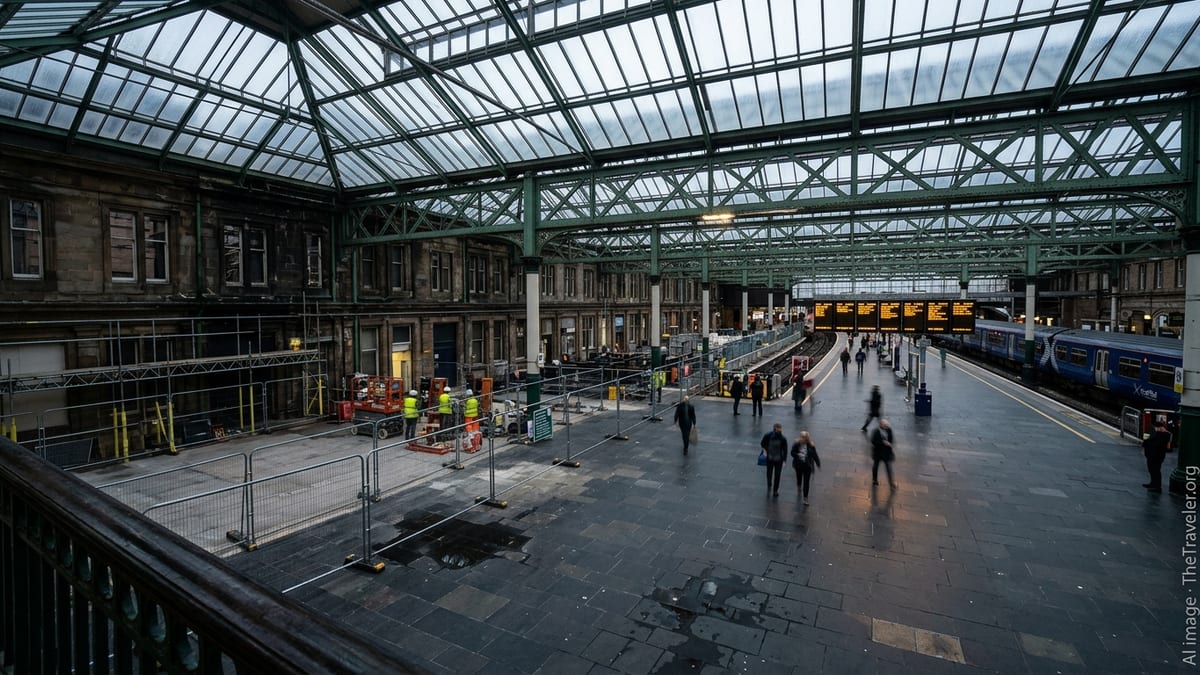
Inside the station, significant portions of the concourse near the fire damaged façade are reported to be fenced off, with temporary barriers, signage and staff presence guiding passengers along safe routes to the reopened platforms. Facilities housed in or close to the affected building, including some tenant offices and station side premises, remain unavailable while inspections, smoke damage assessments and structural decisions continue.
Passengers using the station in this transitional phase can expect a busier and more congested feel in the areas that are open. The concentration of people, temporary layouts and ongoing engineering activity around the edges of the building are contributing to longer walking routes within the station and to occasional bottlenecks, particularly at peak times when commuter and intercity flows overlap.
Nevertheless, the resumption of at least part of Glasgow Central’s normal function marks an important psychological and practical step for the city. Travellers who have spent days relying on emergency bus links, diverted trains and unfamiliar alternative stations are beginning to see a more familiar pattern of services re emerge, even if full normality is still some distance away.
What Travellers Need to Know in the Coming Days
As the partial reopening beds in, the key message for anyone passing through Glasgow Central is to plan ahead. Publicly available journey planners from rail operators and the national rail information service are being used to flag which services have returned to Central, which remain diverted, and where transfer to buses or other rail hubs is still required.
Because large sections of the station footprint remain under safety restrictions, travellers are being encouraged to allow additional time to navigate cordons, diversions and unfamiliar access points. This is particularly relevant for passengers with mobility needs or heavy luggage, as lifts and step free routes closest to the damaged structure may remain unavailable or subject to change.
More detailed engineering assessments, demolition activity on the damaged façade and long term decisions about the adjoining building will determine when Glasgow Central can move beyond partial reopening to a fuller restoration of service. Until those steps are complete, the picture for routes serving London, Edinburgh, Ayr, Gourock and other destinations will remain fluid, with gradual improvements rather than a single return to normal operations.
For now, the partial reopening signals that the immediate emergency phase has passed and that Scotland’s busiest station is once again handling trains and passengers, albeit on restricted terms. Travellers across the country will be watching closely in the days ahead as Glasgow Central edges back toward its role at the heart of the national rail network.