


More news on this day
Mounting queues, missed flights and reports of unsafe crowding at Europe’s borders have prompted the head of Greece’s regional airports network to call for an urgent rethink of new European Union border checks, as pressure builds ahead of the peak summer travel season.
Get the latest news straight to your inbox!
Greek airport operator warns of systemic flaws
Publicly available information indicates that Alexander Zinell, chief executive of Fraport Greece, has warned that the EU’s new “smart borders” regime in its current form is not working as intended and needs substantial adjustments. Fraport Greece manages 14 regional airports across the country, including key gateways to popular islands, placing the company on the front line of recent disruption.
According to recent coverage of his comments, Zinell has described the checks as both unpleasant and potentially dangerous when lines spill into terminal areas not designed for prolonged queuing. His concerns reflect growing unease within Europe’s aviation industry about how the system is affecting airport operations and passenger safety.
The remarks come after months of strained operations at Greek airports and other entry points, where the combination of new procedures and high seasonal volumes has sharply increased processing times for non EU travellers. Industry reports point to repeated instances of passengers missing flights and aircraft departing late because travellers are still stuck in border queues.
Greek travel and tourism businesses have also flagged the reputational risk for a country that relies heavily on international visitors. Extended waits on arrival or departure, particularly for British and other non EU tourists, are viewed as a threat to repeat visits and to the broader image of the Mediterranean as a convenient short haul destination.
Entry Exit System under fire as queues grow
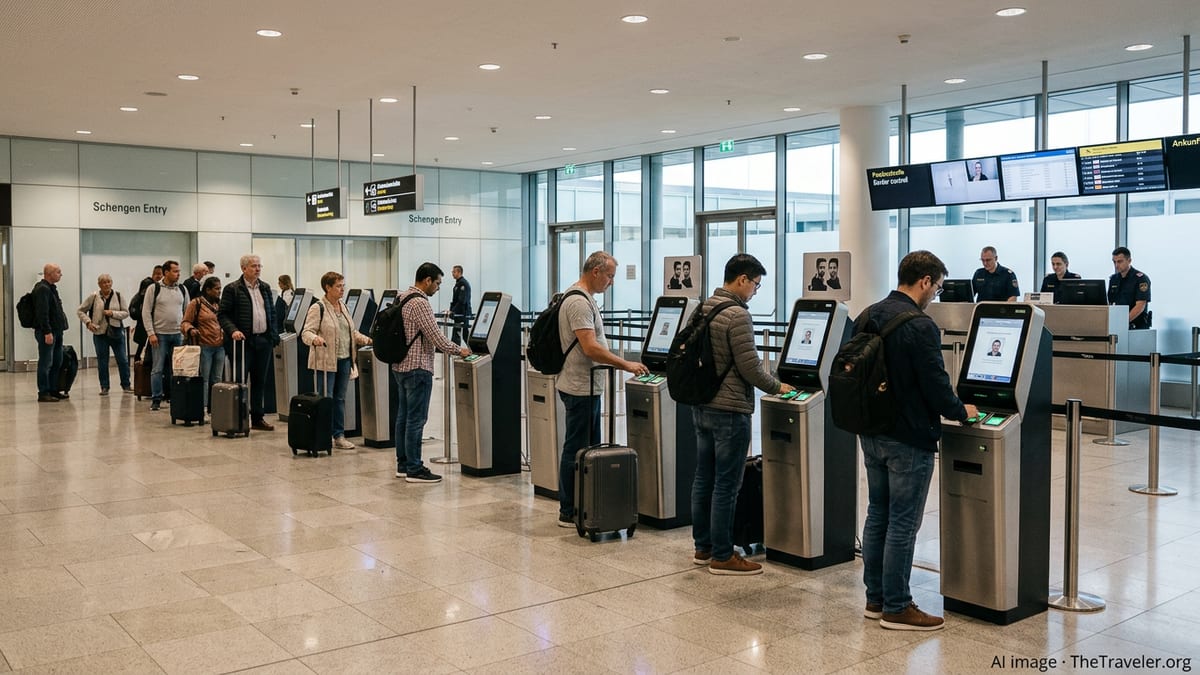
At the heart of the dispute is the EU’s Entry Exit System, a digital platform introduced to register the arrivals and departures of non EU nationals entering the Schengen area. The scheme records biometric data such as fingerprints and facial images on first entry and logs each subsequent crossing electronically, replacing the manual stamping of passports.
Since the system’s phased rollout began in October 2025, airports and border posts in several member states have experienced lengthier checks and congestion. An assessment by Airports Council International Europe earlier this year reported that border control processing times at some airports had risen by up to 70 percent, with peak time queues stretching to several hours in locations including France, Germany, Greece, Iceland, Italy, Portugal and Spain.
Travel sector coverage notes that these delays stem from a combination of factors: the time required to capture biometric data for first time registrants, technical teething problems and staffing constraints at border control points. In some instances, airports have reportedly suspended the use of biometric capture or reverted to manual workarounds when systems struggled to cope with demand.
For passengers, the impact has been immediate and visible. Accounts collected by European media describe families arriving well in advance of departure only to spend most of that time in border queues, in some cases watching their aircraft leave without them. Such experiences have fed public debate over whether the promised long term efficiency gains justify the near term disruption.
Greece takes unilateral steps to ease the pressure
Greece has already moved to blunt some of the impact of the new regime. In April, the country announced that British passport holders would be exempt from biometric registration under the Entry Exit System at Greek border crossing points, while remaining subject to standard passport checks. An advisory from Greek diplomatic services in London confirmed that this opt out took effect from 10 April 2026.
Reports indicate that the exemption followed earlier episodes of severe congestion linked to the initial use of biometric equipment at Greek airports. By removing a significant group of frequent visitors from the more time consuming part of the process, authorities aimed to reduce waiting times and protect the tourism season from the worst bottlenecks.
However, recent accounts from travellers and local outlets suggest that pressure on infrastructure has continued, particularly at regional gateways during weekend peaks. Even with simplified checks for some nationalities, a combination of high traffic volumes, limited space at older terminals and staffing shortages has left little margin when flights arrive in quick succession.
Industry observers note that Greece’s approach illustrates both the flexibility available to individual states and the difficulty of maintaining a harmonised border regime across the Schengen zone. While the suspension of some biometric requirements may ease conditions locally, it raises questions about consistency and the overall objectives of the Entry Exit System.
European aviation sector demands flexibility from Brussels
The concerns voiced in Greece are mirrored across the wider European aviation sector. At the start of July, airport groups, airlines and tourism bodies issued a joint open letter describing the situation as reaching a “critical point” and calling for rapid action from EU institutions. The signatories warned that long queues, missed connections and mounting pressure on frontline staff risk undermining confidence just as demand for air travel returns to pre pandemic levels.
The letter urged the European Commission to grant member states broad flexibility to suspend Entry Exit System checks pre emptively whenever passenger volumes exceed the capacity of border facilities, particularly during July and August. It also pressed for additional border staff, streamlined procedures and technical improvements to reduce processing times for non EU travellers.
According to that industry appeal and subsequent commentary, the sector accepts the underlying security aims of the digital border project but argues that implementation has outpaced preparation on the ground. Airports and carriers contend that operational realities, including limited terminal space and finite staffing, were not fully factored into the design.
Advocacy groups for air passengers have meanwhile warned that travellers are often left unsure of their rights when flights are missed due to bottlenecks at state run border posts. Guidance highlighted by consumer organisations indicates that airlines may classify such delays as extraordinary circumstances, limiting compensation and increasing frustration among affected passengers.
Calls grow for redesign before peak summer traffic
With schools across Europe breaking for holidays and visitor numbers climbing, Greek operators and their counterparts in other countries are pressing for immediate adjustments to avoid systemic disruption. Recent trade press reports quote senior airport executives describing the new border checks as the single biggest operational concern facing them this summer.
Sector analysts argue that the coming weeks will provide a major stress test of the Entry Exit System’s resilience. If waiting times continue to stretch into hours at major hubs and tourist gateways, there are expectations that member states will intensify demands for temporary derogations, simplified procedures for frequent travellers or even a staged rollback at the busiest locations.
For Greece, where tourism is a key economic pillar, the stakes are particularly high. Operators fear that images of holidaymakers queuing through corridors or missing flights from popular islands could discourage bookings in future seasons, even if technical fixes are eventually found. Local business associations on islands such as Zakynthos have already drawn attention to delays linked to new checks at their airports.
Against this backdrop, Zinell’s call for an overhaul of EU border checks signals a shift from managing short term disruption to questioning the design of the system itself. Whether Brussels opts to grant the flexibility requested by industry or pursues alternative remedies, the experience of Greek airports is likely to remain central to the debate over how Europe balances secure borders with a smooth travel experience.