


From whitewashed Cycladic villages to pine forests dropping into electric-blue seas, Greece’s islands have become recurring characters in film and television. For 2027, screen-inspired travel is moving beyond simple set-jetting selfies to deeper itineraries that balance locations you recognise from the cinema with real-life Greek island rhythms. This guide compares scenery, transport, typical costs and realistic routes for travellers planning a Greek island trip shaped by movies and series.
Get the latest updates straight to your inbox!
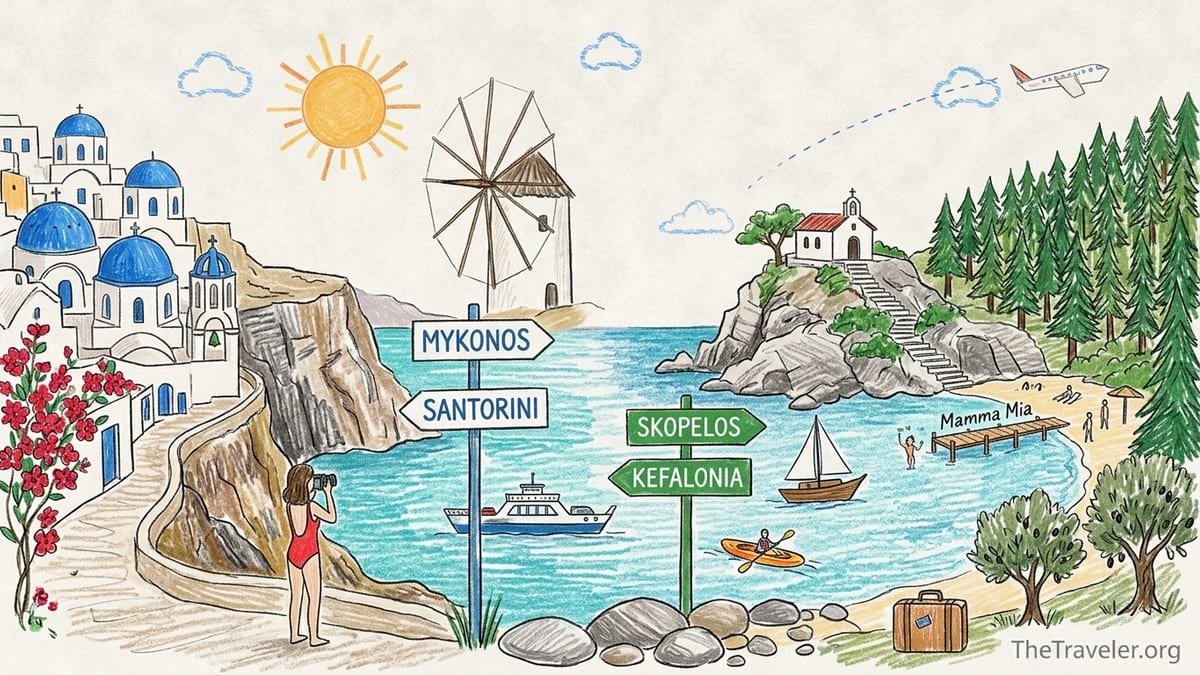
Why Screen-Inspired Greek Island Trips Are Booming
Greece’s islands have long appeared on screen, but social media has pushed specific locations directly into travel wishlists. Santorini’s caldera sunsets, Mykonos’s windmills, and the green slopes of Skopelos from the film Mamma Mia now sit alongside classic city icons like the Eiffel Tower in terms of recognisability. For 2027 planners, that visibility helps narrow down where to go, but it also raises expectations around crowds, pricing and what is realistically accessible on a one- or two-week holiday.
Streaming platforms have amplified this trend by making older films constantly discoverable. Mamma Mia, filmed largely on Skopelos and Skiathos with additional scenes in mainland Pelion, still sends visitors in search of Kastani beach and the clifftop chapel of Agios Ioannis nearly two decades after its 2008 release. Publications such as Expedia’s magazine and travel features in European newspapers continue to republish location guides, ensuring that these islands remain firmly on the radar for 2027.
Screen-inspired trips do not need to mean a rigid checklist of locations. In practice, most visitors combine one or two famous settings with nearby islands that share similar scenery but see fewer day-trippers. A traveller might spend three nights in Oia on Santorini for the iconic caldera views, then move to quieter Folegandros or Milos for beaches and hiking, or visit Skopelos on a day trip from Skiathos rather than base themselves there for a full week.
Choosing Your Backdrop: Caldera, Party Harbours or Pine Forests
Different screen productions showcase very different versions of Greece. Santorini’s image is dominated by its volcanic caldera, with clifftop towns such as Fira, Firostefani and Oia stacked in tiers of white cubic houses. This is the landscape used in countless commercials and romantic montages. The main beaches, like Perissa and Kamari, are flat and open, with black volcanic sand or pebbles. For 2027, Santorini remains the archetypal “cinematic” island, especially for first-time visitors who want the views they have seen in glossy adverts.
Mykonos, by contrast, trades on its harbourfront and nightlife. Aerial shots of its traditional windmills and the quarter known as Little Venice appear in music videos and fashion campaigns. The scenery once you leave the old town becomes more rugged, with rocky hills and relatively exposed beaches like Paradise and Super Paradise. While it offers some atmospheric Cycladic streets, its on-screen persona is more about beach clubs and late nights than tranquil village scenes.
In the Sporades, Skopelos and Skiathos look markedly different. Skopelos is heavily forested; in wide shots from Mamma Mia, pine trees tumble down to narrow coves such as Kastani beach. Skiathos, which also hosted parts of the same film, combines busy resort strips around Megali Ammos and Koukounaries with quieter bays accessible only by boat. For travellers wanting a green backdrop that matches the film’s aesthetic, these northern islands feel more intimate than the bare rock and huge cruise ships associated with the Cyclades.
Further west, Kefalonia in the Ionian Sea offers another familiar cinematic profile thanks to Captain Corelli’s Mandolin, although that film is now older and promoted less heavily. Its beaches, including Myrtos with its dramatic cliffs, and pastel harbours such as Assos, echo classic postcards more than specific scenes. For visitors planning trips in 2027, combining Kefalonia with nearby Ithaca or Zakynthos can deliver a softer, Italianate islandscape that contrasts the bright, windswept Cyclades.
Getting There in 2027: Flights, Ferries and Island Hopping
Access remains the single biggest factor in whether a screen-famous island works in a one-week 2027 itinerary. Santorini and Mykonos will continue to be among the easiest to reach, with seasonal direct flights from major European cities alongside frequent connections from Athens. As of late 2026, carriers such as easyJet operate non-stop services from London Gatwick to Mykonos and Santorini in summer, with several weekly departures, and similar seasonal flights run from other UK and German airports to both islands. Airlines typically release schedules for summer 2027 about 10 to 12 months in advance, so by mid-2026 many July and August options are already bookable.
Skiathos and Kefalonia also have international airports that receive summer charters and low-cost flights from northern Europe. For example, Kefalonia airport lists seasonal services from cities including Birmingham, Manchester and London hubs on carriers such as Jet2.com, with some routes already announced to extend through 2027. This makes Kefalonia a viable single-island holiday for travellers who prefer to avoid Athens and ferries altogether.
Reaching Skopelos, main star of Mamma Mia, still involves a boat transfer. The usual route is to fly to Skiathos, then take a ferry or smaller passenger boat to Skopelos town or Glossa on the north of the island. In high season there are typically multiple sailings per day operated by companies such as Blue Star Ferries or smaller local lines, with crossing times of around one to two hours depending on the vessel and route. Travellers should check summer 2027 timetables on operators’ official sites from early spring, when schedules are finalised.
Ferries between Piraeus, Athens’s main port, and the Cyclades also structure many screen-inspired routes. Piraeus to Santorini on a conventional ferry currently takes around seven to eight hours, with fares in the region of 45 to 70 euros per person in economy, while high-speed catamarans cut the journey to about five hours at higher prices. Services link Santorini and Mykonos directly in around two to three hours. For 2027 it is reasonable to expect similar journey times and pricing bands, though fuel costs and taxation may adjust fares upward slightly. Booking early for July and August remains sensible for anyone constraining their trip to specific filming locations.
Costs on the Ground: Santorini, Mykonos, Skopelos and Kefalonia
Prices vary sharply between the most photographed islands and those with lower global name recognition. On Santorini, current hotel data compiled by Greek accommodation aggregators indicates that in July a mid-range double in Fira or Oia often falls around 250 to 300 euros per night, with caldera-view suites in luxury properties reaching 600 euros or more. Budget options still exist, particularly in inland villages such as Pyrgos or in coastal resorts like Kamari, where simple rooms can come in around 120 to 150 euros even in peak season.
Mykonos runs similarly high, particularly close to Mykonos Town and the key beach clubs. Modest hotels and guesthouses within walking distance of the old harbour have been advertising summer rates starting near 220 to 250 euros for July 2026 dates, with full-service beach resorts higher. Meals in the old town or on the seafront frequently exceed 25 euros per person for a main course and drink, especially at venues featured regularly in lifestyle media.
Skopelos and Skiathos, despite their Mamma Mia association, remain markedly more affordable. On Skopelos, family-run pensions and small hotels in Skopelos Town list summer double rooms in the range of roughly 80 to 140 euros, depending on proximity to the waterfront and facilities such as pools. Dinner for two in a harbour taverna, including shared starters and local wine, can still come in under 50 to 60 euros. This keeps a week-long film-inspired stay within reach of mid-budget travellers who might be priced out of long stays in Oia or Mykonos Town.
Kefalonia sits somewhere in between. Resorts around Lassi and Skala show broad spreads, with simple studios sometimes advertising July rates around 100 to 150 euros per night while upscale properties with infinity pools and sea views climb to 300 euros or more. Car hire on Kefalonia and Skopelos typically starts around 40 to 60 euros per day in high season, depending on demand and booking lead time. For a 2027 trip, budgeting a modest annual increase on current prices is prudent, but the relative differences between these islands are likely to remain.
Sample Itineraries for Screen-Inspired Trips in 2027
For a first-time visitor seeking the classic cinematic Cyclades look with a manageable budget, a seven-night itinerary in June 2027 might allocate four nights to Santorini and three to a quieter island such as Milos or Naxos. Travellers could arrive directly into Santorini, spend their first day exploring Fira, then book a caldera cruise on day two, which currently costs in the region of 100 to 150 euros per person including food and drinks on reputable operators. Days three and four might take in Oia, Pyrgos and the archaeological site of Akrotiri before a short ferry ride to Milos, where accommodation and dining generally cost less than in Oia but the volcanic coastline remains film-worthy.
Those focused on nightlife and influencer-famous scenes might combine Mykonos and Santorini over 10 days, understanding this will be among the more expensive options. A realistic pattern could be three nights in Mykonos Town, two nights near one of the party beaches and five nights on Santorini. Ordering the trip with Mykonos first can help reduce costs slightly as travellers are less tempted to splurge on high-end dinners every night once the novelty of arrival has passed. Ferries between Mykonos and Santorini usually take around two to three hours, making the transfer a comfortable half-day including port travel.
For Mamma Mia fans, a Sporades-based itinerary offers a different flavour of Greece. One viable 10-day plan for July 2027 would be to fly to Skiathos, spend three nights in Skiathos Town, then move to Skopelos for six nights. From Skiathos, travellers can join organised day trips that visit Agios Ioannis chapel and Kastani beach, advertised locally with prices in the range of 40 to 70 euros per person depending on the route and inclusions. Once on Skopelos, hiring a small car for several days allows visits to less crowded beaches such as Panormos and excursions to Glossa village, which retains a traditional character despite its film exposure.
Another option for returning visitors is a two-week route pairing a Cyclades icon with a quieter, greener island. For example, travellers might fly into Santorini for four nights, then take a domestic flight via Athens to Kefalonia for nine nights. This provides a direct comparison between the bare volcanic caldera and Kefalonia’s gentler, pine-backed bays. On Kefalonia, specific locations such as Fiskardo harbour or Myrtos beach feel instantly recognisable even for those who have not seen Captain Corelli’s Mandolin, and the slower pace provides a welcome contrast to Santorini’s cruise-driven day crowds.
Managing Crowds, Seasonality and Filming Expectations
One of the most common misconceptions among screen-inspired travellers is that specific scenes can be recreated exactly as they appear on film. In practice, many sets were temporary or heavily edited. On Skopelos, for instance, the wooden jetty and beach bar seen in Mamma Mia’s Kastani beach sequences were constructed for production and removed after filming. Visitors today find an organised beach with a modern bar and sunbeds rather than the film’s precise layout, although the surrounding cliffs and pine backdrop match on-screen shots closely.
Seasonality also reshapes how familiar places feel. Santorini in late July or early August, when multiple cruise ships anchor daily, bears little resemblance to the tranquil, near-empty caldera shots used in marketing campaigns. Travellers aiming for recognisable views without extreme crowds should look to late May, early June or late September 2027, when hotels are still open but the narrow lanes of Oia can be navigated more comfortably. In these shoulder months, sunrise and late-morning photo stops at spots around the blue-domed churches often deliver clearer shots than the widely publicised sunset hour.
On Skopelos and Skiathos, shoulder-season weather is slightly less predictable but still attractive. Early June can bring cooler evenings but quieter roads around Agios Ioannis chapel, where visitors climb dozens of steps to enjoy views over the sea. By late July, daytime heat and tour boat numbers both rise, so travellers set on re-creating moments from the film often head out on morning sailings, returning before mid-afternoon when light harshens and coves fill with day-trippers.
It is also important to remember that not every building shown on screen is accessible. The fictional Villa Donna from Mamma Mia was largely a studio construction in the United Kingdom, with only exterior shots composited from various Greek locations. Likewise, some of the most photogenic terraces in Santorini, including those used in fashion shoots and commercials, belong to private hotels or villas. Respectful visitors in 2027 will focus on public paths, viewpoints and booked terraces attached to their own accommodation rather than attempting to enter restricted spaces for a photograph.
Practical Tips for Keeping a Screen-Inspired Trip Realistic
Aligning expectations with reality is essential when planning around screen locations. First, build more free time into your schedule than film montages suggest. Reaching Agios Ioannis chapel from Skopelos Town, for example, involves about a 30-kilometre drive on winding roads that can take 45 minutes or more each way, plus the climb up to the chapel itself. On Santorini, moving between Fira and Oia by bus or car can easily take 30 to 45 minutes once parking and traffic are included, especially at sunset. Designing itineraries that include no more than two major location visits per day keeps the trip enjoyable rather than rushed.
Second, factor in transport logistics when choosing where to sleep. If your priority is the Mamma Mia chapel, staying in or near Glossa in the north of Skopelos can reduce driving time. For those fixated on Oia’s dome-lined skyline, accommodation in Imerovigli or Finikia often provides similar views with slightly lower prices and easier parking, while still allowing a dedicated half-day or evening walk into central Oia for iconic shots.
Budget planning benefits from a clear-eyed view of current pricing. In 2026, a typical sit-down meal at an unpretentious taverna on Skopelos or Kefalonia might run 15 to 20 euros per person for a main dish, shared salad and soft drink or house wine. Equivalent meals in heavily photographed parts of Santorini or Mykonos often start nearer 25 to 30 euros. For 2027 trips, travellers concerned about rising costs can still manage expenses by eating main meals in less central neighbourhoods, buying picnic supplies from bakeries and supermarkets, and choosing at least a few nights in family-run guesthouses rather than exclusively high-end hotels.
Finally, remember that some of the most rewarding trip moments will not be the precise backdrops you saw on screen. A Mamma Mia enthusiast might find that a quiet evening at a waterfront café in Skopelos Town, listening to live rebetiko music, lingers longer in the memory than a crowded midday stop at a famous cove. Similarly, a visitor who first came to Santorini after seeing it in international adverts may discover that a simple early-morning walk through Pyrgos, when bakery smells fill the lanes and locals greet each other in the square, delivers a more authentic, cinematic feeling than jostling for space at a sunset viewpoint.
Conclusion: Balancing Movie Magic with Island Reality
Planning a Greek island trip around film and television locations can be a powerful way to filter the country’s huge choice of destinations. In 2027, Santorini and Mykonos will remain the most recognisable backdrops, with prices and crowds to match. Skopelos, Skiathos and Kefalonia offer greener, often more affordable alternatives that still resonate strongly with screen imagery, particularly for Mamma Mia and Captain Corelli’s Mandolin fans.
The key is to treat film locations as inspiration rather than a checklist. Use them to choose your base islands, then allow time for detours into lesser-known villages, beaches and viewpoints that share the same light and landscape but fewer tour groups. Monitor flight and ferry schedules as they are published for summer 2027, budget using current prices with some allowance for increases, and resist the urge to overpack your days.
With a realistic itinerary, thoughtful timing and a willingness to look beyond exact camera angles, travellers can enjoy both the familiarity of screen-famous spots and the surprise of discovering their own private Greek island scenes. The result is a holiday that feels cinematic without losing its sense of place.