

More news on this day
Thousands of travellers across the Middle East, Africa and Europe are facing severe disruption after Gulf Air cancelled 136 flights in a single day, compounding an already fragile regional aviation network as multiple Gulf countries restrict or close their airspace.
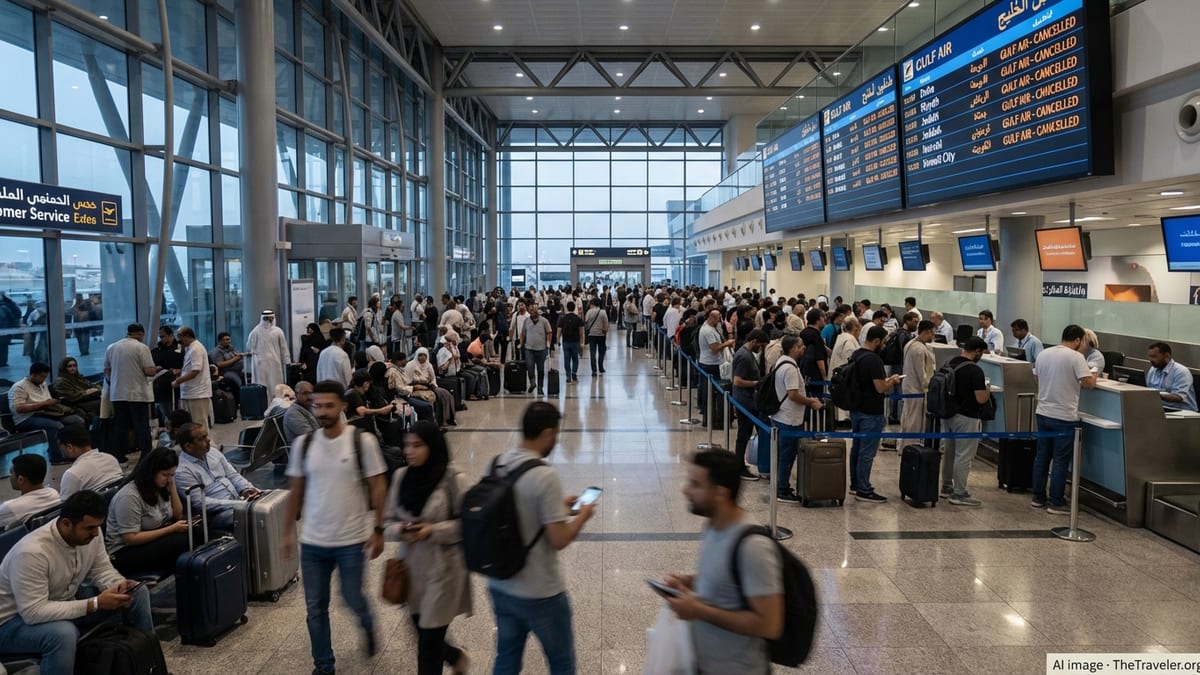
Gulf Air Pulls 136 Flights as Regional Pressures Mount
The Bahrain-based carrier’s cancellations span routes linking Bahrain International Airport with key hubs including Nairobi, Doha, Riyadh, Jeddah, Kuwait City, Dubai, Istanbul, London, Shanghai and Casablanca. Operational data show a string of services scrubbed from Monday’s schedule, including flights between Bahrain and Nairobi, Lahore, Islamabad, Doha, Riyadh, Medina, Dubai and Jeddah, as well as long-haul services to London Heathrow and Shanghai Pudong.
While Gulf Air has not issued a detailed public breakdown of the disruption, flight-tracking platforms and airport departure boards on March 3 indicate that the national airline is the primary operator behind the 136 cancelled movements, a figure that includes both outbound and inbound legs. The cancellations sit within a wider pattern of regional turbulence, with aviation analytics firms reporting that nearly a quarter of all flights bound for key Middle Eastern destinations on February 28 were cancelled in response to rapidly evolving security and airspace restrictions.
Industry analysts say the scale and suddenness of the cuts are unusual for a carrier of Gulf Air’s size and point to an environment in which airlines are struggling to maintain reliable schedules. With several Gulf states imposing temporary airspace curbs, carriers have been forced either to ground aircraft or undertake lengthy diversions that destabilise crew planning, aircraft rotations and airport capacity.
Major Hubs from Nairobi to Doha and Riyadh Squeezed
The ripple effects are being felt far beyond Bahrain. Nairobi’s Jomo Kenyatta International Airport has seen Gulf Air services to and from Bahrain scrubbed, reducing connectivity for East African passengers heading to Gulf and Asian destinations. In Doha, services between Bahrain International and Hamad International were also among those cancelled, adding to congestion and uncertainty at an airport already grappling with broader airspace closures and a temporary halt to many Qatar-bound services.
In Saudi Arabia, cancellations have hit traffic into and out of Riyadh’s King Khalid International Airport, Jeddah’s King Abdulaziz International Airport and Medina’s Prince Mohammad bin Abdulaziz Airport. These routes serve as vital links for business travellers, migrant workers and religious visitors, particularly those transiting via Bahrain to other global destinations. Ground staff at these airports have reported crowded check-in halls, extended queues at ticket desks and growing frustration among passengers seeking clarity on when normal service might resume.
Kuwait International Airport and Dubai International have also appeared on the list of affected destinations, highlighting the interconnected nature of Gulf aviation. With multiple carriers reducing or suspending operations to the region, passengers are facing a shrinking pool of alternative options, even on traditionally well-served city pairs.
Stranded Passengers Face Long Queues and Limited Alternatives
For travellers caught in the middle of the disruption, the immediate reality has been uncertainty. At Bahrain International Airport, passengers booked on short-haul flights to Gulf and regional destinations have found themselves queuing for hours at ticket counters as they attempt to secure rebookings or refunds. Similar scenes have been reported at partner airports, where travellers connecting from Europe, Africa and Asia discovered mid-journey that onward legs on Gulf Air had been cancelled.
Airlines across the region, not only Gulf Air, are advising passengers to avoid travelling to the airport unless they have received confirmation that their flight is operating. With so many services scrubbed at short notice and airspace restrictions evolving day by day, schedules published on booking platforms are no longer a reliable indicator of whether an aircraft will actually take off.
Alternative routings through less affected hubs are proving difficult to secure. Seats on flights via more distant waypoints are in high demand, and some travellers are opting to delay journeys altogether rather than commit to complex multi-stop itineraries subject to last-minute change. Travel agents say the combination of high seasonal demand and widespread cancellations has driven up prices on routes that remain open, further complicating rebooking efforts.
Airspace Restrictions and Regional Tensions Deepen the Crisis
The Gulf Air cancellations are unfolding against the backdrop of a broader air travel shock affecting the Middle East. Since February 28, several Gulf and neighbouring states have moved to close or restrict their airspace in response to escalating tensions and active military operations in the region. Aviation authorities in Qatar, the UAE, Kuwait, Bahrain, Iraq and Iran have all announced varying degrees of suspension, forcing airlines to ground aircraft or reroute around large no fly zones.
Data from aviation analytics providers indicate that on February 28 alone, nearly 23 percent of scheduled arrivals into key Middle Eastern markets were cancelled, with total cancellations including outbound traffic exceeding 1,800 flights. Bahrain and Israel recorded some of the highest cancellation ratios, while Qatar and Iraq saw around four in ten flights affected. The United Arab Emirates, including Dubai, also experienced hundreds of cancellations as airspace limitations took effect.
These measures have disrupted not just point to point travel but also the intricate web of long haul connections that rely on Gulf hubs as transfer points between Europe, Asia and Africa. Airlines that continue to operate are having to plot longer, more circuitous routings to avoid sensitive airspace, adding hours to flight times and putting additional strain on crews, fuel planning and aircraft maintenance schedules.
What Travellers Should Expect in the Coming Days
Travel industry observers say the situation remains highly fluid, with schedules for the first week of March still being adjusted on a rolling basis. While some airspace restrictions may be eased if security conditions improve, airlines are likely to proceed cautiously, restoring capacity gradually rather than rushing back to full operations. Gulf Air’s 136 cancellations may therefore represent an early wave of a longer period of disruption affecting its network and those of other regional carriers.
Passengers with upcoming bookings involving Bahrain, Doha, Riyadh, Jeddah, Kuwait City, Dubai or Nairobi are being urged to monitor their reservations closely, using airline mobile apps and direct notifications rather than relying solely on static timetables. Many carriers are offering flexible change policies, allowing customers to defer travel or reroute without standard penalties, although options may be constrained by limited seat availability.
Travel advisors recommend that those who must travel build in additional time for connections, keep accommodation plans flexible and ensure that contact details are updated with airlines to receive real time alerts. With regional aviation still adjusting to a fast changing security picture, experts caution that short notice cancellations and last minute schedule changes are likely to remain a feature of Middle East travel in the days ahead.