

More news on this day
Massive travel disruption is rippling across the Middle East, East Africa and South Asia as Gulf Air cancels at least 136 flights in response to regional airspace closures, triggering chaos at major hubs in Bahrain, Nairobi, Doha, Riyadh, Jeddah and other key transit cities.
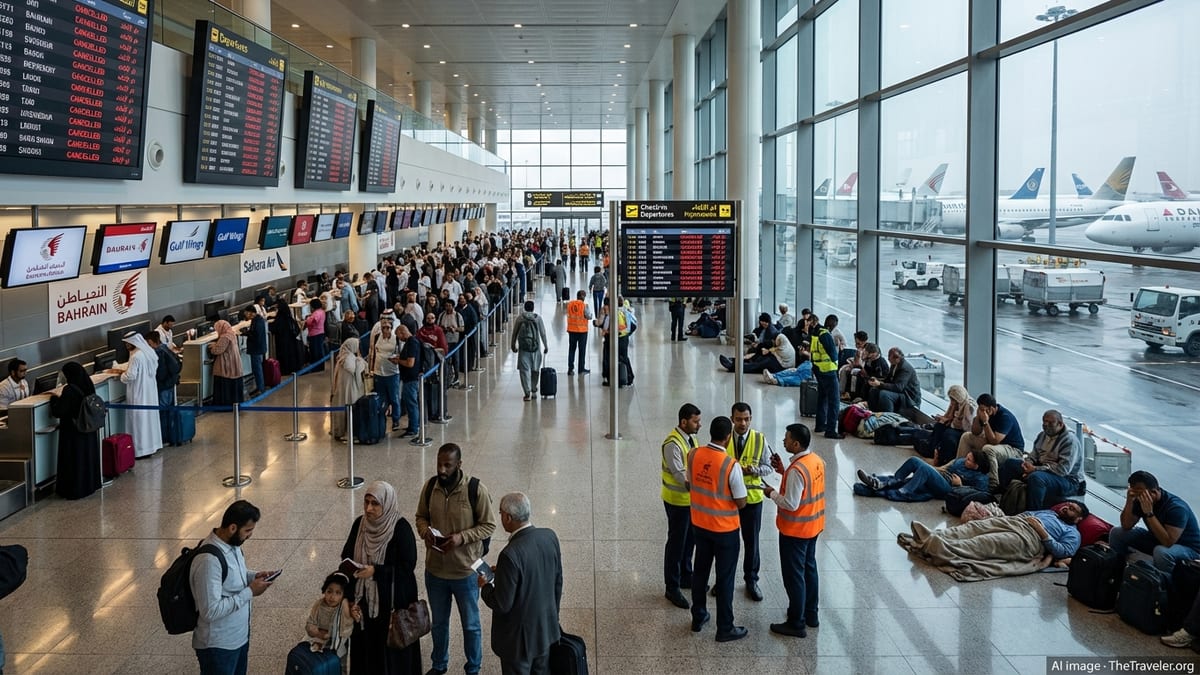
Gulf Air Cuts Deep Into Network as Regional Skies Narrow
Gulf Air, the flag carrier of Bahrain, has emerged as one of the most heavily affected airlines as airspace closures spread across the Gulf following escalating conflict involving Iran, the United States and Israel. Aviation data providers and regional aviation authorities report that the airline has cancelled about 136 services over the weekend and into Monday, disrupting connections between Bahrain and destinations across the Middle East, Africa, Europe and the Indian subcontinent.
The cancellations are concentrated on routes that rely on overflight permissions through Iran and neighbouring states, as well as services into countries that have partially or fully closed their skies. Sectors linking Bahrain to Doha, Riyadh, Jeddah, Kuwait City and Dubai have seen widespread grounding, while longer-haul flights to Nairobi and other African capitals have also been suspended or diverted as planners scramble to find safe and commercially viable routings.
While many of the grounded services are short- and medium-haul segments, the knock-on effect has been system-wide. Travellers connecting through Bahrain to Asia, Europe or Africa are reporting missed onward connections, last-minute re-routings and extended layovers as the airline attempts to consolidate remaining operations onto a reduced number of flights.
The carrier is offering free rebooking or refunds for passengers booked on affected sectors in the coming days, but customer-service channels are under heavy pressure. Phone, chat and airport desks in Bahrain and across the network remained busy on Monday as stranded travellers queued to secure alternative travel plans.
Major Hubs from Manama to Nairobi Feel the Strain
Bahrain International Airport, Gulf Air’s primary hub, has become a focal point of the disruption. Departures and arrivals boards on Sunday and Monday showed long blocks of cancelled services to regional neighbours, particularly Qatar, Saudi Arabia and Kuwait, alongside a thinning schedule to more distant destinations. Ground handlers report aircraft repositioning and the temporary parking of widebody jets that would normally be cycling through the network.
In East Africa, Nairobi’s Jomo Kenyatta International Airport has also been hit as Gulf Air’s Bahrain–Nairobi services were pulled from the schedule. The route is a popular link for Kenyan travellers heading to the Gulf and onward to Europe and Asia, and for Gulf-based expatriates visiting East Africa. Travel agents in Nairobi say passengers have been scrambling to switch to other Gulf carriers, only to find that competing airlines are themselves cutting or suspending operations as the regional airspace picture deteriorates.
Across the Arabian Peninsula, major hubs in Doha, Riyadh and Jeddah are experiencing layered disruption. Qatar’s authorities have temporarily closed the country’s airspace, and Doha’s main airport remains effectively shut to scheduled commercial traffic, forcing Gulf Air and other carriers to halt services and strand transit passengers. In Saudi Arabia, Riyadh and Jeddah continue to handle a reduced schedule but are wrestling with late-arriving aircraft, diversions and last-minute cancellations as airlines avoid conflict-affected corridors and rework flight plans around newly declared high-risk zones.
Airport hotels across the region, from Manama to Riyadh, report high occupancy as stranded travellers accept overnight accommodation while they wait for new flights to be confirmed. In some cases, passengers have been offered surface transport between Gulf cities where borders remain open and driving is still considered safe, though many are choosing to delay trips altogether.
Passengers Face Long Delays, Confusion and Limited Alternatives
For travellers, the sudden wave of cancellations has translated into long queues, limited information and difficult choices. With Dubai, Abu Dhabi and Doha all heavily restricted or fully closed to normal commercial traffic, the Middle East’s usual role as a high-frequency connecting bridge between continents has been sharply curtailed. Even when passengers can be rebooked away from Gulf Air onto other carriers, options are often circuitous, involving overnight stops in Europe or Africa and significant detours to avoid closed airspace.
Reports from passengers at Bahrain and other regional airports describe departure boards dominated by cancellations or delayed statuses with estimated departure times repeatedly pushed back. Some travellers with flexible itineraries have opted to cancel outright and seek full refunds, while others with urgent commitments are accepting multi-stop routings that can more than double normal journey times between Asia, Africa and Europe.
Travel industry analysts say the disruption is being intensified by the timing. Many of the affected flights serve labour and family traffic between the Gulf and countries such as India, Pakistan, Sri Lanka, Kenya and the Philippines. These markets rely heavily on tightly priced economy tickets and inflexible travel dates, meaning passengers have fewer affordable alternatives when regular nonstops are suddenly withdrawn.
Consumer-rights experts are advising passengers to keep all receipts for meals, hotels and alternative transport arranged during the disruption, as some carriers operating from or into jurisdictions with stronger passenger-protection rules may later be required to reimburse reasonable expenses. However, with multiple countries’ airspaces closed on security grounds, compensation rules that apply in more routine weather-related or technical cancellations may not be triggered in all cases.
Airspace Closures and Security Advisories Deepen the Crisis
The immediate cause of the cancellations lies beyond Gulf Air and other individual airlines. Following strikes on Iran and subsequent retaliatory actions, a growing list of countries across the Middle East has imposed either full or partial airspace closures, with aviation regulators and military authorities prioritising safety amid missile activity and heightened tensions. Iran, Israel, Iraq, Kuwait, Qatar and the United Arab Emirates are among the states that have sharply restricted civilian overflights, while others have issued strong advisories classifying their skies as high-risk zones.
These closures are particularly damaging to hub-and-spoke carriers like Gulf Air, which depend on overflight permissions to operate economically viable routes between Europe, Asia and Africa. Without access to key corridors across Iran and neighbouring states, many flights would have to take significant detours, adding hours of flying time, higher fuel burn and increased crew costs. For shorter regional sectors, such rerouting is often operationally or commercially impractical, leaving cancellation as the only viable option.
Air navigation service providers and regional aviation bodies are working with airlines to plot alternative routings where possible, but capacity on these safer corridors is limited. As more carriers compete to use the same slices of airspace, congestion and slot constraints are emerging as additional obstacles. Analysts note that even if some airspaces reopen in the coming days, ripple effects across schedules are likely to persist as aircraft and crews remain out of position.
Security experts caution that the situation is fluid, with risk assessments updated on an hour-by-hour basis. That uncertainty makes it difficult for airlines to publish firm schedules beyond the very short term, leading operators such as Gulf Air to issue rolling cancellations rather than committing to restoration dates that might quickly become unrealistic.
What Travellers Should Do If They Are Booked on Gulf Air
With the situation evolving by the day, travel advisers are urging passengers booked on Gulf Air to treat all near-term schedules as provisional. Those due to travel in the next 72 hours are being encouraged to monitor their booking status closely, use the airline’s official digital channels for live updates, and avoid heading to the airport until their flight is clearly confirmed as operating. For those who booked through travel agents or online travel platforms, rebooking is often handled more efficiently through those intermediaries, which may have dedicated airline contacts and bulk-change tools.
Flexible travellers whose trips are not time-sensitive are being advised to consider deferring travel by several days or more, particularly if their journeys rely on connections through Bahrain, Doha, Dubai or Abu Dhabi. In many cases, Gulf Air and other affected carriers are waiving change fees and offering fare differences at reduced or no cost for rebookings beyond the immediate disruption window, although exact policies vary by ticket type and route.
Travellers already in transit face tougher choices. Some may find it quicker to accept rebooking through alternative hubs in Europe, North Africa or South Asia rather than waiting for direct Gulf flights to resume. Others may decide to terminate journeys partway and arrange ground transport or regional flights once local conditions stabilise. Embassies and consulates in the region have begun issuing advisories reminding citizens to stay in close contact with their airlines and maintain flexible contingency plans.
For now, industry observers say the key variables will be how long core Gulf airspaces remain restricted and whether the current security crisis escalates or eases. Until that picture becomes clearer, Gulf Air’s 136 cancellations are likely to represent only an early phase of a wider and longer-running reshaping of travel patterns across Bahrain, Kenya, Qatar, Saudi Arabia, Kuwait and a broad swathe of neighbouring air corridors.