

More news on this day
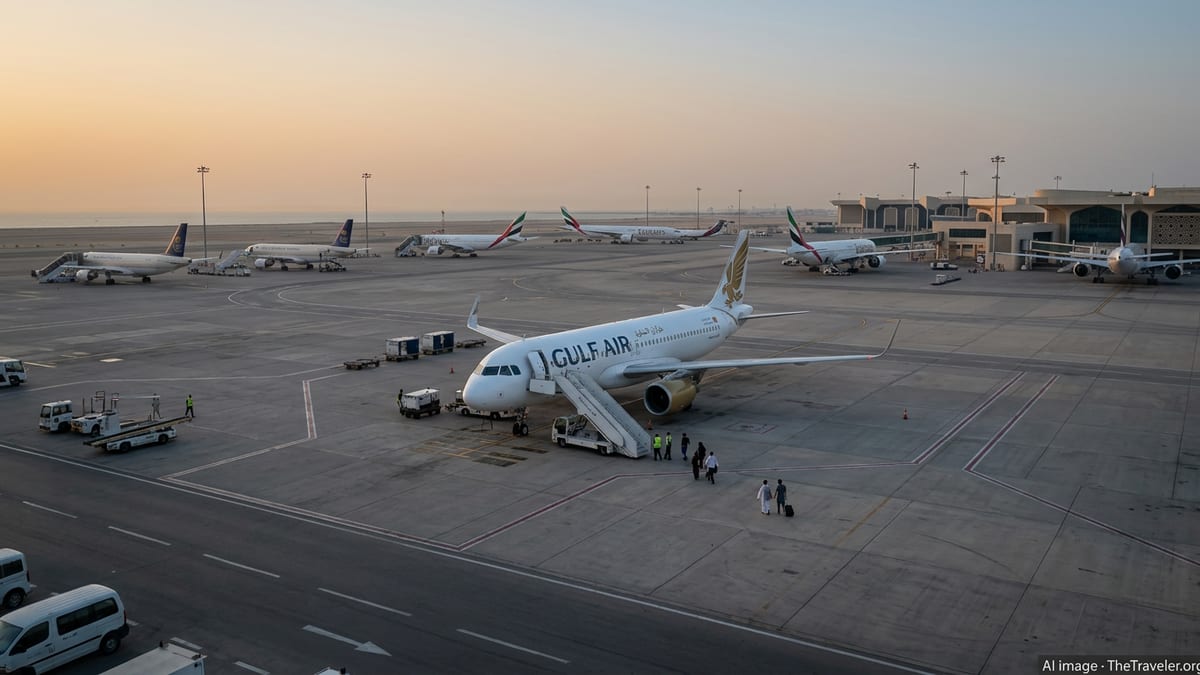
Gulf Air is extending the use of Saudi Arabia’s Dammam airport as an interim base for select passenger services, as Bahrain’s airspace remains closed amid the wider Middle East conflict and prolonged regional flight disruptions in March 2026.
Get the latest news straight to your inbox!
Ongoing Closure of Bahrain Airspace Reshapes Gulf Travel
Bahrain’s airspace and Bahrain International Airport remain closed in mid‑March 2026 following Iranian missile and drone strikes across the Gulf and subsequent US and Israeli military action, according to multiple operational briefings and aviation advisories. The shutdown, in place since February 28, has removed a key hub from regional networks and left Bahrain’s flag carrier Gulf Air without access to its home base.
Published aviation safety notices and industry customer advisories indicate that the Bahrain flight information region is still restricted to civilian traffic, with the closure extended until further notice. Commercial traffic over the kingdom largely disappeared in the days after the initial attacks, and tracking data continues to show a near‑complete absence of scheduled passenger movements.
The loss of Bahrain as a functioning hub is contributing to what several operational assessments describe as “compressed” airspace over remaining corridors in the wider Middle East. Neighboring states, including Kuwait, Qatar, and the United Arab Emirates, have imposed varying degrees of restrictions or capacity limits, further amplifying delays, diversions, and cancellations for travelers moving between Europe, Asia, and Africa.
Publicly available economic and security analyses of the 2026 Gulf crisis highlight Bahrain among the states experiencing sustained aviation disruption, with thousands of daily flights across the region curtailed since late February. The closure of Bahrain’s skies and the continued suspension of normal operations at Bahrain International Airport are now entering a third week, with no clear reopening timeline published.
Gulf Air Turns to Dammam as Contingency Gateway
With its Manama hub unavailable, Gulf Air has turned to King Fahd International Airport in Dammam, in Saudi Arabia’s Eastern Province, as a practical substitute for limited operations. Regional travel advisories, freight circulars, and passenger updates shared via social media indicate that the airline has been staging selected flights out of Dammam, using ground transfers from Bahrain to connect stranded passengers to onward services.
Comments from aviation workers and travelers on public forums, along with unofficial repatriation notices circulating online, describe Gulf Air organizing special services from Dammam to long‑haul destinations such as London and Karachi. In several instances, passengers were reported to have been moved by road from Bahrain to Dammam before boarding outbound flights, illustrating how the operator is using the Saudi airport as a temporary lifeline route.
These contingency flights appear to be operating alongside the broader Saudi airport network, which remains open with some Gulf‑facing airspace restrictions. Industry situation reports from early March list Riyadh, Jeddah, and Dammam among Saudi airports that have continued to handle commercial movements, even as nearby countries have enacted full or partial closures of their own airspace.
While precise schedules for Gulf Air’s Dammam services are not consolidated in a single public timetable, widely shared passenger guidance stresses that travelers should treat them as limited and subject to rapid change. The arrangement is framed as a temporary response to the Bahrain shutdown rather than a formal hub shift, with the carrier adapting services as security and regulatory conditions evolve.
Extended Disruptions and Uncertain Timelines for Reopening
Across the wider region, flight data aggregators and aviation news outlets continue to track thousands of cancellations since the start of the crisis. Reports indicate that airspace closures affecting Bahrain, Kuwait, Qatar, Iran, Iraq, Israel, and parts of the United Arab Emirates have at times formed a near‑continuous band of restricted skies, forcing airlines to adopt longer routings or suspend services entirely.
For travelers linked to Bahrain, the disruption has been especially acute. Coverage focused on the kingdom notes that Gulf Air’s regular schedule remains suspended and that the national carrier has offered rebooking options and extended travel validity into late March for tickets originally booked during the closure window. However, the continued extension of airspace restrictions, and references in industry circulars to validity “until further notice,” underline the lack of a firm horizon for normalization.
Security risk assessments published in early and mid‑March emphasize that missile and drone activity, as well as the prospect of further escalation, continues to influence government and regulator decisions on airspace status. Regional and international aviation guidance advises operators to avoid large parts of the Gulf and surrounding states, citing the risk of misidentification, interception activity, or debris from air defense engagements.
The net effect for Gulf Air passengers is a planning environment defined by short‑notice changes and limited alternatives. Even where contingency flights via Dammam operate, travelers are often required to adjust ground transport, accept extended total journey times, and remain prepared for last‑minute revisions if the security picture shifts.
What Travelers Using Gulf Air Need to Know Now
For passengers who were due to fly to or from Bahrain, publicly available guidance from travel management companies, consular advisories, and airport notices suggests several practical implications. First, standard departures and arrivals at Bahrain International Airport remain unavailable, meaning that any confirmed Gulf Air itinerary routed through Manama is likely to require rebooking or rerouting.
Second, travelers whose journeys are being shifted to Dammam should factor in the additional leg overland from Bahrain to Saudi Arabia. Reports from recent repatriation operations describe organized bus transfers and controlled group movements between the two points, but these arrangements depend on current border procedures and may be adjusted with little advance warning.
Third, capacity on the limited Dammam flights linked to Gulf Air appears constrained. Accounts shared by affected passengers point to short booking windows and rapid sell‑outs when special services are announced. Prospective travelers are being encouraged, in publicly visible communications, to monitor the airline’s official channels and those of Bahrain International Airport closely, rather than relying on static third‑party schedule information.
Finally, broader government travel advisories for the Middle East remain fluid, with several Western states updating guidance to urge heightened caution or voluntary departure from the region. While these notices are not specific to Gulf Air, they frame the wider environment in which the airline is operating and may influence insurance coverage, corporate travel policies, and personal risk decisions for passengers considering near‑term trips involving Bahrain or Dammam.
Regional Aviation Outlook as the Crisis Continues
Aviation analysts following the 2026 Gulf crisis note that the region’s air network has shifted into an extended period of reduced capacity and fragmented connectivity. With major hubs such as Dubai, Doha, and Bahrain experiencing partial or full disruptions at different points, the usual model of seamless long‑haul connections through the Gulf has been replaced by patchwork routings and dependency on secondary gateways.
Against this backdrop, Gulf Air’s limited extension of operations via Dammam stands out as an attempt to preserve some level of connectivity for Bahrain‑linked travelers, even while the airline’s core hub remains offline. Industry commentary suggests that similar measures, including temporary bases and wet‑lease arrangements, may be used by other affected carriers as the situation evolves.
Looking ahead, the pace at which Bahrain’s airspace can safely reopen will likely depend on both the regional security trajectory and the assessment of aviation regulators and defense planners monitoring missile and drone threats. Even after a formal reopening, observers expect a phased restoration of flights, with initial emphasis on essential routes, followed by a gradual ramp‑up as confidence returns.
For now, travelers considering Gulf itineraries in March 2026 are navigating an environment where flexibility is essential. The continued closure of Bahrain’s skies, the concentration of Gulf Air’s limited activity through Dammam, and the broader uncertainties of the regional conflict together define a new, more fragile map of air travel across one of the world’s key transit corridors.