

More news on this day
Gulf Air is preparing a phased return to its Bahrain International Airport hub after weeks of disruption linked to the Iran conflict, signaling a cautious restart for one of the Gulf’s most affected national carriers.
Get the latest news straight to your inbox!
From Grounded Hub to Temporary Saudi Base
The closure of Bahraini airspace in early March, following Iranian strikes and wider regional hostilities, forced Gulf Air to halt scheduled operations at its Bahrain base. Publicly available aviation advisories show that Bahrain’s flight information region was effectively shut to routine commercial traffic, leaving the carrier with limited options for maintaining connectivity.
According to industry coverage, Gulf Air responded by relocating core operations across the King Fahd Causeway to King Fahd International Airport in Dammam, Saudi Arabia, roughly 85 kilometers from Manama. The move allowed the airline to preserve a truncated network using Saudi airspace while Bahrain’s skies remained restricted.
Travel trade reports indicate that the Dammam workaround involved re-timing services and adjusting crew and fleet rotations so that aircraft and staff were based temporarily in Saudi Arabia. Passengers originating in Bahrain were advised to reach Dammam by road, adding several hours and new logistical steps to journeys that previously began at Bahrain’s compact island hub.
While the Dammam solution maintained a minimal presence on key routes, it also underscored how dependent Gulf Air’s hub-and-spoke model is on uninterrupted access to Bahrain International Airport and the surrounding Gulf airspace corridors.
Phased Resumption of Bahrain Departures
Scheduling data compiled by route-tracking services shows that Gulf Air has now set 9 April 2026 as the start date for a limited resumption of departures from Bahrain. One specialist network analysis notes that the airline initially plans to operate 13 routes with 26 weekly departures from its home hub, a fraction of its pre-crisis schedule but a significant symbolic step toward normalization.
The early pattern of restored flights appears focused on regional and short-haul markets that can be operated within available risk corridors and crew duty windows. Observers expect frequencies and destinations to be adjusted frequently in line with security assessments, regulatory guidance and demand.
Gulf Air’s decision to restart from Bahrain comes as some regional airspace restrictions begin to ease following a ceasefire, even as portions of the Gulf remain under conflict-zone advisories. Data from multiple flight-tracking platforms on 9 April shows a modest uptick in movements to and from Bahrain compared with the previous weeks of complete shutdown.
Aviation analysts caution that the initial schedule is likely to remain conservative. Capacity will depend not only on Bahrain’s own risk assessments but also on the status of neighboring flight information regions, which determine whether efficient routings to Europe, Asia and Africa are viable.
Regional Airspace Still Under Tight Constraints
The broader operating environment for Gulf Air’s return remains challenging. Updated notices and safety advisories for airlines continue to highlight large swathes of airspace across the Gulf, Iran and parts of the Levant as conflict-affected, with recommended avoidance at most flight levels or strict risk-mitigation procedures.
Recent assessments from aviation safety bodies indicate that carriers are being urged to avoid or severely limit operations in several key corridors, including those covering Bahrain, Iran, Iraq, Israel, Jordan, Kuwait, Oman, Qatar and parts of Saudi Arabia. That patchwork of advisories constrains routings and can lengthen flight times, increase fuel burn and complicate scheduling.
Industry analysis of network patterns during the conflict shows hub airports in the United Arab Emirates and Qatar operating at reduced capacity, while Bahrain experienced a near-total halt to civilian traffic for several weeks. In that context, Gulf Air’s resumption at its home base is emerging as one of the first significant tests of how quickly a smaller Gulf hub can re-establish its transfer role after a full closure.
Even as some airspace corridors reopen, operators remain on high alert for further volatility. Any renewed escalation could prompt swift re-closures or new altitude restrictions, forcing airlines such as Gulf Air to toggle back to contingency routings through alternative hubs.
Passenger Disruption and Demand Recovery
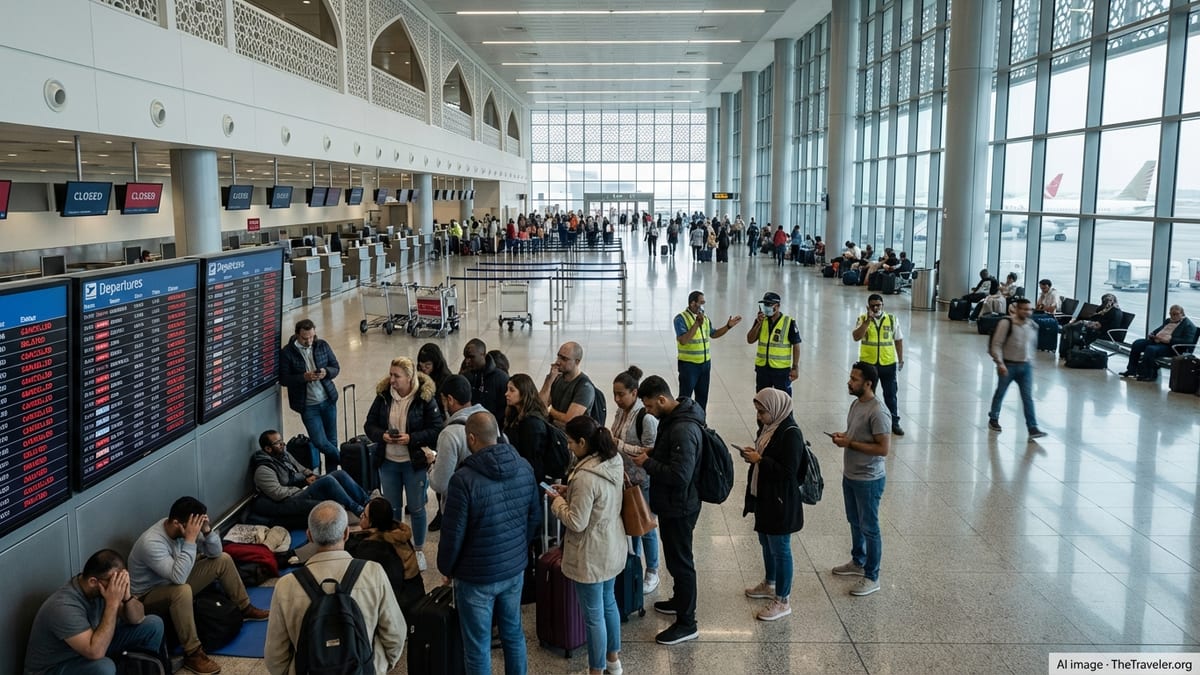
For travelers, the conflict-induced shutdown of Bahrain’s airspace produced widespread disruption, with thousands of passengers facing cancellations, diversions or unplanned overnight stays across the region. Online passenger forums, airline advisories and airport notices describe a patchwork experience, with some travelers rerouted via Saudi hubs and others encouraged to postpone trips altogether.
As Gulf Air prepares to move flights back to Bahrain, demand is expected to recover unevenly. Business and expatriate traffic on essential regional routes typically rebounds first, while discretionary leisure travel often takes longer to return, especially when security perceptions remain fragile.
Travel-industry commentary suggests that flexible booking policies, clear communication on schedule changes and coordination with Bahrain International Airport’s ground operations will be critical to rebuilding confidence. Passengers are being urged to monitor airline channels closely for updates, as timetables remain subject to rapid adjustment.
Airfares on certain Gulf routes have already reflected the imbalance between constrained capacity and sustained demand. Analysts note that as more seats return to the market from Bahrain and neighboring hubs, pricing may begin to stabilize, although uncertainty around fuel costs and insurance premiums could limit how quickly fares retreat.
Strategic Stakes for Bahrain as a Hub
The resumption of Gulf Air services from Bahrain carries strategic implications that reach beyond one airline’s schedule. Bahrain has positioned itself as a nimble, boutique hub, competing with larger neighbors by emphasizing ease of transfer and targeted connectivity rather than sheer scale.
The extended airspace closure tested that value proposition. With much of its hub function effectively transferred to Dammam, Bahrain risked losing some connecting flows to larger airports in Saudi Arabia and the United Arab Emirates, where carriers could offer a wider selection of onward services even amid disruption.
A gradual ramp-up from 9 April gives Bahrain and Gulf Air an opportunity to reclaim lost traffic and demonstrate operational resilience. The extent and speed of the recovery will shape perceptions among global airlines, code-share partners and corporate travel buyers weighing the reliability of different Gulf gateways.
For now, the planned return to the Bahrain hub illustrates how regional carriers are trying to navigate the fine line between restoring normalcy and managing ongoing security risks. Gulf Air’s experience is likely to serve as a case study in crisis response and recovery for smaller hub-based airlines operating in politically sensitive regions.