

More news on this day
Hundreds of thousands of travelers across the Middle East are stranded or scrambling for alternative routes after Qatar, Bahrain and Kuwait closed their airspace, while Dubai International and Riyadh’s King Khalid International airports operate only a handful of tightly controlled flights amid the rapidly escalating Gulf crisis.
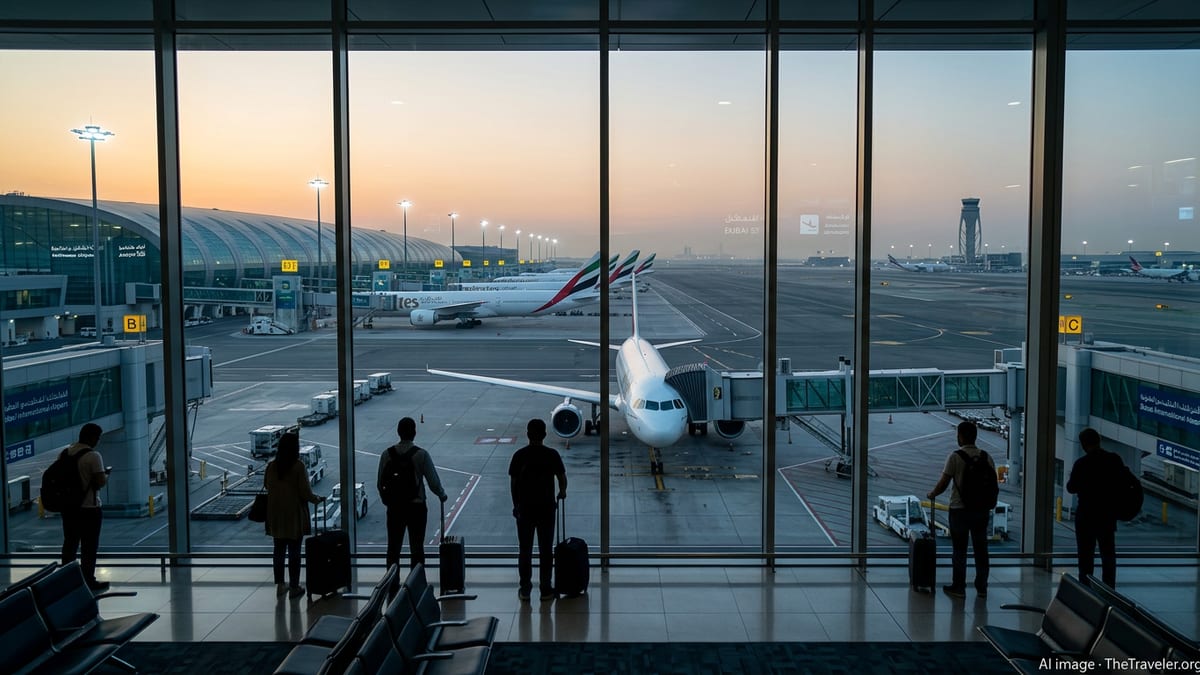
Airspace Closures Ripple Across the Gulf
The current wave of airspace shutdowns began after coordinated United States and Israeli strikes on Iran triggered retaliatory missile and drone attacks across the Gulf late last week. In response, aviation authorities in Qatar, Bahrain and Kuwait ordered full closures of their airspace to commercial traffic, forcing airlines to ground or divert aircraft on some of the world’s busiest east–west corridors.
Qatar’s Hamad International Airport in Doha, a critical hub linking Europe and the Americas with Asia and Africa, has suspended all flight operations after Qatari airspace was shut. Bahrain and Kuwait have taken similar steps, halting movements at Bahrain International Airport and Kuwait International Airport as authorities assess damage risks and monitor the evolving security picture.
Regional flight-tracking data over recent days has shown vast stretches of normally crowded skies over Iran, Iraq, Kuwait, Bahrain and Qatar nearly empty, with long-haul services forced into lengthy detours or cancellations. Aviation analysts estimate that several thousand flights have already been canceled or rerouted since the first strikes, with the knock-on effects expected to last well beyond the initial crisis window.
Industry observers note that this is one of the most severe simultaneous airspace disruptions the Gulf has seen in decades, eclipsing even previous diplomatic rifts and localized conflicts in its geographic scope and impact on global connectivity.
Dubai and Riyadh Test Narrow Corridors
While several Gulf states have opted for full closures, the United Arab Emirates and Saudi Arabia are experimenting with limited, tightly controlled corridors to keep at least some commercial traffic moving. Dubai International Airport, ordinarily one of the world’s busiest passenger hubs, halted most operations after reported strikes and nearby interceptions, but has since allowed a small number of flights to operate under strict routing and timing constraints.
Carriers based in the UAE are focusing primarily on evacuation and essential connectivity. Emirates has suspended the majority of its regular schedule from Dubai, supplementing a small program of repatriation and cargo services, while low-cost airline Flydubai has begun operating a restricted list of departures from specific terminals. Flights that do depart must follow designated air corridors that skirt higher-risk zones and are subject to tight air traffic control flow limits.
In Saudi Arabia, Riyadh’s King Khalid International Airport has emerged as one of the few major Gulf gateways still handling limited commercial operations. Officials there are prioritizing flights that support government-organized evacuations and essential international links, particularly to Europe and Asia via safer northern or southern routes. Even so, many international carriers have temporarily suspended services to Riyadh and other Saudi cities out of caution and in line with conflict-zone safety guidance.
Aviation safety bulletins from European and international regulators now advise airlines to avoid the airspace of Iran, Iraq, Israel and several Gulf states wherever possible, further constraining the number of routes that can realistically operate to and from Dubai and Riyadh in the short term.
Stranded Passengers Face Mounting Uncertainty
For travelers caught in the middle of these fast-moving restrictions, confusion and uncertainty have quickly become the norm. Passengers in Doha, Manama, Kuwait City, Dubai and Abu Dhabi describe hours-long queues at customer-service desks, repeated cancellation notices and scarce information on when regular flights might resume.
Tourists and business travelers are competing for the same dwindling pool of seats as governments rush to organize evacuation flights for their citizens. Some foreign ministries have publicly urged nationals in affected countries, including the United Arab Emirates, Qatar, Bahrain and Kuwait, to depart via any available commercial option while warning that choices may shrink further if the security situation deteriorates.
In Dubai, where hotels were full of transfer passengers suddenly unable to continue their journeys, demand for alternative transport has surged. Travel agents report a spike in bookings for overland journeys to Muscat in Oman or to Saudi cities such as Riyadh, where limited flights still depart. Others are paying eye-watering sums for private jet charters routed through remaining open airports on the fringes of the crisis zone.
Travel rights organizations say passengers should preserve boarding passes, booking confirmations and any written communication from airlines, as many may later qualify for refunds, rebookings or compensation depending on the carrier’s policies and applicable regulations. For now, however, the priority for most is simply finding a way out.
Global Airlines Redraw Routes Overnight
The closures and restrictions in the Gulf have forced global airlines to redraw their route networks almost overnight. Major European and Asian carriers have canceled or rerouted flights not only to Doha, Bahrain, Kuwait, Dubai and Abu Dhabi, but also to destinations further afield that normally rely on overflying the region as a shortcut between continents.
Some airlines are diverting services via the eastern Mediterranean and the Caucasus or pushing flights farther south over the Arabian Sea and Indian Ocean, adding hours of flying time and significant fuel costs. Others have temporarily suspended services to multiple Middle Eastern destinations altogether rather than attempt complex detours through a patchwork of open and partially open airspaces.
Industry groups warn that the disruption will ripple through global schedules for days or weeks. Aircraft and crew stranded at closed airports must be repositioned, while new routing plans need regulatory approvals and updated crew duty rosters. Airlines already managing tight capacity at the end of the busy winter travel season are now faced with large-scale rebooking operations and heavy call-center backlogs.
Aviation analysts say that if airspace closures in Qatar, Bahrain and Kuwait persist and corridor operations in the UAE and Saudi Arabia remain constrained, the wider industry could see a prolonged period of instability on key routes linking Europe, Asia, Africa and Australasia, with the Gulf’s usual role as a seamless connecting hub sharply diminished.
What Travelers Should Do Now
With the situation evolving by the hour, travel experts urge passengers to stay in close contact with their airlines and avoid heading to airports in affected countries without a confirmed, operating flight. Several carriers serving Dubai, Doha, Bahrain and Kuwait have explicitly asked customers not to travel to the airport unless they have received up-to-date confirmation that their flight will depart.
Travelers are also advised to monitor official advisories from their home governments, which increasingly include warnings about potential further strikes, airspace changes and the possibility of additional evacuations. Where possible, passengers who have flexible tickets or comprehensive travel insurance may wish to postpone nonessential trips to the region or reroute via alternative hubs outside the conflict-affected zone.
For those already on the ground, embassy hotlines and consular services can provide guidance on available evacuation flights or safe overland options. Some governments are beginning to negotiate dedicated charter services using the limited air corridors into and out of Dubai and Riyadh, though demand is expected to far outstrip supply in the near term.
While aviation authorities in the Gulf emphasize that the current closures and restrictions are temporary and driven by safety considerations, there is still no clear timetable for the full reopening of airspace over Qatar, Bahrain and Kuwait, or for a return to normal operations at Dubai International and Riyadh. Until that picture becomes clearer, travelers are likely to face one of the most challenging periods for air travel through the Gulf in recent memory.