

More news on this day
Overnight airspace closures across the United Arab Emirates, Qatar and Bahrain have plunged Gulf aviation into an unprecedented standstill, forcing major airports to halt commercial flights and triggering a cascade of global travel warnings as governments rush to assess fast‑moving security risks.
Key Gulf Hubs Go Quiet as Airspace Closes
What began as rolling airspace restrictions over Iran and Iraq has rapidly widened into a near-total shutdown around the Gulf, silencing some of the world’s busiest transit hubs. Dubai International, Abu Dhabi’s Zayed International and Doha’s Hamad International have all suspended regular commercial operations, while Bahrain International is operating only at sharply reduced capacity after confirmed drone and missile interceptions in its airspace.
Data from flight-tracking services shows skies over the UAE, Qatar and Bahrain largely empty after authorities ordered overnight closures or severe curbs on civilian traffic. Aviation analytics firms report that hundreds of flights into and out of these three states have been cancelled since Saturday, with Sunday and Monday schedules gutted as airlines scramble to replan or ground services.
Emirates, Etihad Airways, Qatar Airways and Gulf Air have each announced blanket suspensions of flights at their hubs, with limited exceptions for ferry and emergency rotations. Dubai’s flagship carrier Emirates has halted all flights to and from Dubai International until at least Monday afternoon local time, while Etihad has suspended operations from Abu Dhabi over a similar window. Qatar Airways remains effectively grounded in Doha as Qatari airspace stays closed.
Bahrain’s Civil Aviation Authority activated rapid-response protocols after a drone attack on Bahrain International Airport, confirming only minor physical damage but ordering a halt to normal movements while air defences intercept incoming threats. Authorities in all three states stress that passenger and crew safety is the overriding consideration and that services will resume only once airspace is confirmed secure.
Regional Conflict Drives a Global Aviation Disruption
The aviation shutdown is the most visible consequence yet of the escalating conflict involving the United States, Israel and Iran, which has spilled across the wider Middle East in recent days. Missile and drone strikes, including attacks close to major civilian hubs, have pushed regulators and airlines to adopt an ultra-cautious posture, cutting off key east–west corridors that link Europe, Africa and the Americas with Asia and Australasia.
Flight data shows that airspace over Iran, Iraq, Kuwait, Israel, Bahrain, Qatar and the UAE is now heavily restricted or fully closed to commercial traffic, forcing carriers to avoid an entire swath of the region. The result is a patchwork of diversions, extended routings and abrupt cancellations as long-haul airlines weigh security bulletins against operational limits such as crew duty times and fuel planning.
Industry analysts say the scale and coordination of the Gulf halt rivals the early days of the Covid-19 pandemic, but with a fundamentally different driver. This time, the risk is not demand collapse but the potential for aircraft to be caught near active military operations. Europe’s aviation safety regulator has highlighted a high risk to civil aviation across several conflict-zone airspaces, advising against overflights where hostilities or military bases could make airlines potential collateral targets.
Knock-on effects are rippling far beyond the Gulf. Carriers from Europe, North America and Asia have cancelled or rerouted services that normally rely on Gulf hubs for connectivity. Routes that would typically cross Iran and the Gulf are being pushed north over Turkey and the Caucasus or south over the Arabian Sea, adding hours to some journeys and straining fleet and crew resources.
Travelers Stranded as Airlines Race to Respond
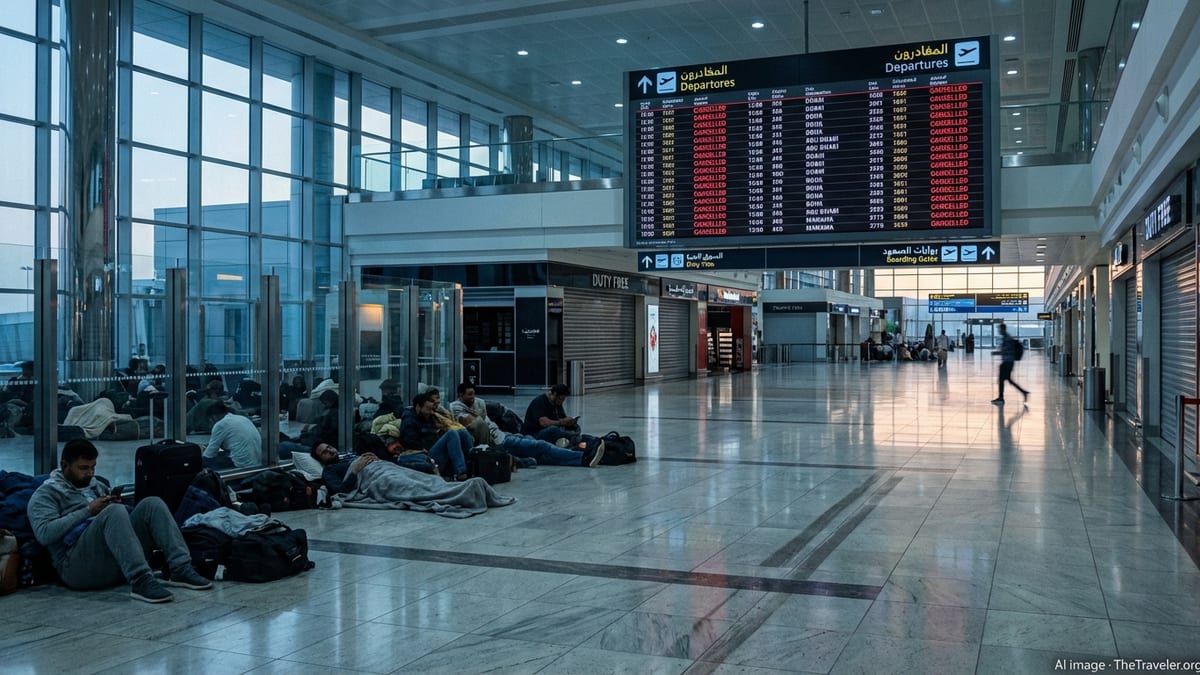
At terminal buildings from Dubai and Abu Dhabi to Doha and Manama, departure boards have turned into walls of red as “cancelled” notices stack up. Tens of thousands of passengers have been stranded overnight, many unable to leave the airport due to visa restrictions or concerned about venturing into cities amid evolving security advisories.
Gulf carriers have deployed additional staff to manage queues at ticket counters and transfer desks, but the rapid nature of the shutdown has left many travelers with limited options. Some airlines are arranging special services or evacuation-style flights once brief operating windows open, prioritizing those with onward long-haul connections or vulnerable passengers. Others are rebooking customers via remaining hubs in Saudi Arabia, Oman or Europe, where airspace remains open but increasingly congested.
Outside the region, the disruption is complicating travel plans for tourists, business travelers and migrant workers who rely heavily on Gulf megahubs for connections between continents. Tour operators report a wave of itinerary changes as clients seek to avoid transit through the Middle East altogether, while corporate travel managers are moving urgent trips onto alternative routings or delaying them outright.
Meanwhile, airlines’ customer service channels are under intense strain. Websites and call centers are handling unprecedented volumes of refund and rebooking requests from passengers whose itineraries touch the Gulf over the coming week. Several carriers have introduced flexible waivers, allowing free date changes or full refunds for travel involving the affected airports, but warn that processing times will be longer than usual.
Governments Issue Stronger Warnings and Advisories
The aviation freeze has been mirrored by a sharp escalation in official travel advisories. A growing list of governments in Europe, Asia and North America now urges citizens to avoid non-essential travel to the broader Middle East, with specific do-not-travel warnings for areas near active conflict and around key military installations.
Foreign ministries have updated guidance to reflect the closures in the UAE, Qatar and Bahrain, advising travelers already in the region to remain in close contact with their airlines and to register with consular services. Some states are preparing contingency plans for government-assisted departures once safe air corridors are identified, particularly for citizens currently transiting through Gulf airports who may find themselves stuck for several days.
Security agencies are also closely monitoring the risk of further missile or drone activity targeting aviation infrastructure. Authorities in Bahrain report that dozens of incoming projectiles have already been intercepted, and similar statements from Gulf neighbours stress that air defences are on high alert. While officials insist that there is no immediate threat to civilian populations beyond the risk of isolated strikes, they acknowledge that the fluid military situation limits their ability to provide firm timelines for reopening.
Insurance providers have begun to respond as well, with some underwriters revising their risk assessments for airlines and shipping companies operating in the Gulf. Higher war-risk premiums and operating costs are expected to feed through to carriers and eventually passengers, particularly if airspace closures persist beyond the initial suspension periods.
What Travelers Should Do Now
For travelers with upcoming itineraries involving the UAE, Qatar or Bahrain, the most urgent step is to avoid heading to the airport without confirmed flight information. Airlines and airports are urging passengers to monitor official channels and mobile alerts, as schedules are changing hour by hour and many flights still visible in booking systems may not operate.
Those already stranded in Gulf airports are being advised to stay within secure terminal areas, follow instructions from airport authorities and keep essential documents and medications easily accessible. While some hotels and airlines are providing accommodation and meal vouchers, availability is limited by the sheer number of affected passengers, and local curfews or security advisories may restrict movement in and out of airport zones.
Travel planners recommend that passengers with non-urgent trips through the region consider postponing or rerouting journeys via alternative hubs until more clarity emerges about airspace safety. Travelers whose tickets were booked through agents or tour operators should work through those intermediaries to manage changes, as they may have access to consolidated rebooking options across multiple airlines.
With aviation authorities in the Gulf set to review conditions over the next 24 to 48 hours, industry observers caution that even a partial reopening of airspace will not immediately restore normal service. Backlogs of aircraft, crew and displaced passengers will take days, if not weeks, to unwind, meaning that the reverberations of this overnight shutdown are likely to reshape global travel patterns well beyond the Gulf for the foreseeable future.