

More news on this day
Hapag-Lloyd Cruises is expanding its expedition program on the world’s largest river, unveiling a 2026 Amazon itinerary that carries guests from Brazil’s Atlantic coast deep into the Peruvian rainforest on a small, ice-class expedition ship.
Get the latest news straight to your inbox!
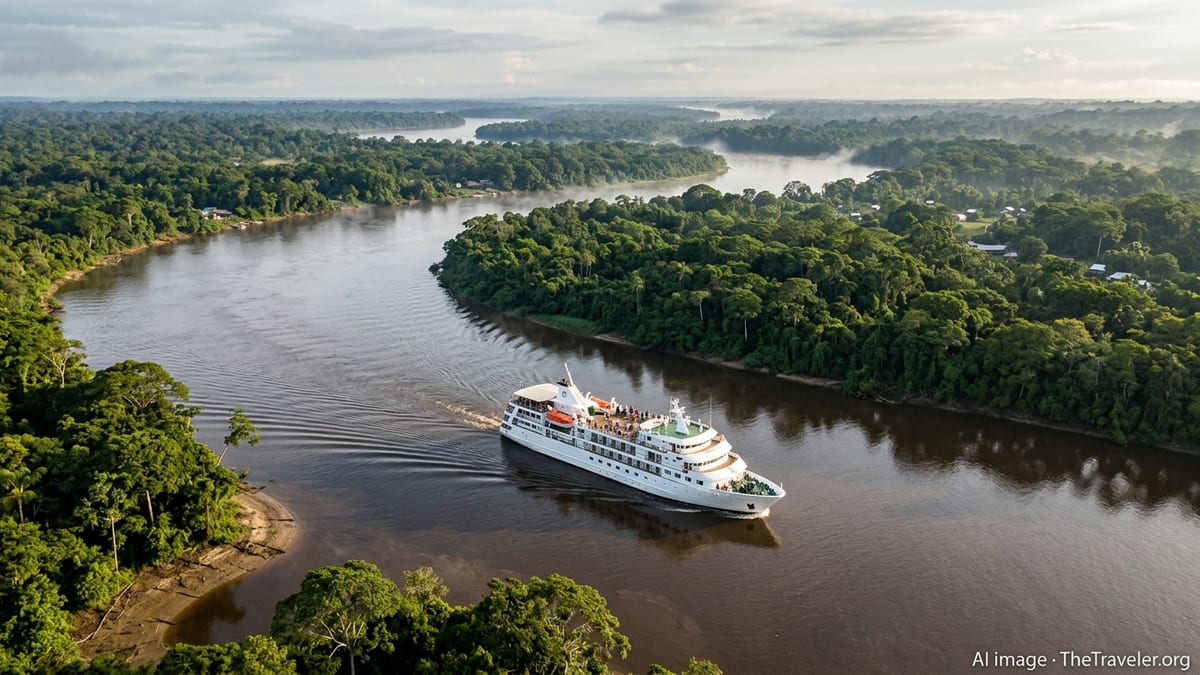
New 2026 Route Links Belém and Iquitos
The newly promoted 2026 program centers on a Brazil to Peru itinerary that follows the Amazon upstream from Belém on Brazil’s Atlantic coast to Iquitos in Peru. Operating in March 2026, the voyage is designed as an 18-day expedition, giving travelers nearly three weeks on the river and its tributaries at one of the region’s wetter, high-water periods.
According to publicly available information from the line and trade coverage, the route uses the expedition ship HANSEATIC spirit, a small, maneuverable vessel built for remote cruising. The voyage is marketed as an “Expedition Amazon” journey and is scheduled to run from 11 March to 29 March 2026, with Belém as the starting point and Iquitos as the final port, reversing a companion downstream itinerary offered later in the month from Peru back to Brazil.
Booking details indicate that the 2026 sailing is positioned at the premium end of the expedition market, with fares listed in European markets from roughly the high five-figure euro range per person including certain charter flight arrangements. The line continues to emphasize limited capacity and an “exclusive circle of explorers” as part of its positioning, reflecting its long history in the region.
The 2026 upstream voyage builds on recent Amazon seasons for Hapag-Lloyd’s HANSEATIC-class ships, which have already completed trial programs reaching Iquitos and calling at ports in Brazil, Peru and Colombia. Industry reports indicate that the company is currently one of the few international cruise operators to run deep Amazon itineraries all the way to Iquitos rather than turning around at Manaus.
Itinerary Highlights Along the Amazon and Rio Negro
The 2026 expedition is structured to showcase both the broad, silt-laden main stem of the Amazon and darker tributaries such as the Rio Negro. The route from Belém passes through the maze of channels at the Amazon delta before continuing inland via the so-called Breves canals, a network of waterways that cut through islands and flooded forest and are considered a classic introduction to the river’s scale.
Further inland, schedules released for the 2026 program indicate calls along the Brazilian Amazon and time on the Rio Negro, a blackwater tributary known for its striking color contrast with the sandy-brown Solimões section of the Amazon. Near Manaus, the meeting of these waters creates a sharply defined boundary that can extend for many kilometers, a visual highlight commonly referenced in promotional material for the voyage.
After Manaus, the ship is slated to continue toward the tri-border area shared by Brazil, Peru and Colombia, an important crossroads for river commerce and a gateway to the upper Amazon. Sample itineraries list visits to communities such as Leticia and Pevas, along with days dedicated to Zodiac exploration in more remote stretches where there are no large ports.
The final segment of the journey takes guests into Peru, concluding at Iquitos, a river port that cannot be reached by road from the rest of the country. The city serves as a hub for onward flights to Lima and points beyond, and its position in the upper Amazon basin allows the line to market the voyage as a full-length river crossing from the Atlantic fringe to the Andean foothills.
Expedition Experience on Board HANSEATIC spirit
The HANSEATIC spirit, introduced as part of Hapag-Lloyd Cruises’ modern expedition trio, is central to how the 2026 Amazon expedition is framed. Public specifications describe a relatively small passenger capacity compared with mainstream ocean ships, along with a shallow draft intended to allow navigation far upriver where water levels and sandbanks can be challenging.
The ship’s design emphasizes outdoor viewing and close engagement with the surrounding landscape. Observation decks, bow access and expansive windows are promoted as key features, enabling guests to watch for wildlife, river traffic and village life as the vessel moves through narrow channels and broad reaches alike. Cabins across categories typically include large windows or balconies, and interior spaces are designed in a contemporary, understated style consistent with the line’s expedition branding.
Operational details released for Amazon seasons note that a fleet of Zodiacs is carried on board to support landings at remote sites, skiff-style wildlife viewing and exploratory cruises into flooded forest and side channels. Daily programs generally combine Zodiac outings, guided walks where conditions allow, and onboard presentations in a lecture theater, all of which are promoted as core components of the Amazon expedition experience.
Service features such as multilingual expedition commentary, a focus on regional cuisine and a relatively high crew-to-guest ratio are also highlighted in marketing materials. The line positions the 2026 itinerary as suitable for experienced cruise travelers seeking a deeper, nature-focused journey rather than a traditional resort-style vacation, with the ship functioning as a comfortable base in an otherwise remote environment.
Wildlife, Seasonality and Environmental Emphasis
The March 2026 timing places the voyage in the high-water season for much of the central Amazon, when floodplains and varzea forest are typically inundated and accessible by small craft. Public information about previous seasons suggests that this period allows Zodiacs to penetrate deep into side channels and forest interiors, increasing the chances of close-up wildlife viewing without long treks over muddy ground.
Marketing and independent coverage of Hapag-Lloyd’s Amazon expeditions point to a wide range of potential wildlife sightings, from pink river dolphins and caimans to macaws, toucans and various monkey species. The company underscores that specific encounters can never be guaranteed, but emphasizes the density of life along quieter stretches of the river and its tributaries, particularly at dawn and dusk.
The line also places strong emphasis on environmental interpretation and conservation messaging. Expedition teams typically include naturalists and regional specialists who deliver talks on topics such as rainforest ecology, hydrology and the pressures facing local communities. Publicly available descriptions of past voyages highlight discussions around deforestation, climate change and river management, positioning the cruise as both an adventure and an educational journey.
Hapag-Lloyd Cruises has stated in previous materials that its Amazon operations are conducted with strict attention to local regulations, pilotage requirements and seasonal depth variations. For the 2026 sailing, itinerary notes again stress that routing and landings remain subject to official approvals and river conditions, signaling to guests that flexibility is a built-in aspect of the trip.
Growing Interest in Deep Amazon Expedition Cruising
The expansion of Hapag-Lloyd’s Amazon program into 2026 reflects broader momentum in the expedition-cruise segment, where travelers are increasingly looking beyond coastal routes to inland waterways. Trade and consumer travel outlets report sustained interest in itineraries that access hard-to-reach environments, with the Amazon frequently cited alongside polar regions and the Galápagos as a marquee destination.
For the German-speaking core market and a growing international audience, the 2026 Brazil-to-Peru voyage offers a rare chance to traverse nearly the full navigable length of the Amazon on a single ship, without the rough conditions associated with some other expedition regions. The line’s decision to continue offering both upstream and downstream versions of the route in the same year suggests that demand has been strong enough to support multiple extended departures.
At the same time, the product remains a niche within the larger cruise industry, shaped by river depth constraints, complex cross-border logistics and a limited number of ships built to handle the Amazon’s challenges. As more travelers look to 2026 and beyond for long-haul adventures, the Hapag-Lloyd program is likely to be one of the most detailed and far-reaching cruise-based options for experiencing the rainforest from Brazil to Peru.
Travel advisers and specialist agencies following the segment note that cabins on such itineraries often book well ahead, particularly in higher-category accommodations. For prospective guests considering the 2026 expedition, that pattern suggests that early planning will be key for securing preferred dates and cabin types on what is emerging as one of the Amazon’s defining river voyages.