

More news on this day
Power outages and dangerous crosswinds are disrupting daily life across Virginia, Maryland, Washington DC and the broader Northeast, where an early-spring wind event has left an estimated 450,000 customers without electricity and placed millions under high wind warnings.
Get the latest news straight to your inbox!
High Wind Warnings Stretch From Mid-Atlantic Into Northeast
Weather alerts from federal forecasters show a corridor of high wind warnings and advisories extending from Virginia and the District of Columbia through Maryland and into portions of Pennsylvania, New Jersey, New York and New England. Publicly available forecast discussions describe a tightly wound low-pressure system racing along the East Coast, squeezing a steep pressure gradient over the Mid-Atlantic and Northeast and generating widespread damaging gusts.
Gusts topping 50 to 60 miles per hour have been reported at multiple airports and coastal observation sites in recent days, according to published coverage of the broader storm pattern affecting the eastern United States. In some interior and higher-elevation locations, peak gusts have surged even higher, matching speeds more often associated with tropical systems or intense winter storms.
The high wind warnings indicate an elevated risk of downed trees, snapped branches and falling debris, particularly in heavily forested suburbs where older canopy trees overhang streets and power lines. Travel advisories emphasize the danger for high-profile vehicles on bridges and open stretches of interstate, where sudden crosswinds can cause drivers to lose control.
As the storm center tracks northeastward, the zone of strongest winds is forecast to pivot from the central Appalachians and Mid-Atlantic toward coastal New England. Forecast graphics available from national meteorological agencies show the worst of the conditions concentrating along the Interstate 95 corridor and exposed coastal areas, but blustery conditions are expected to linger well behind the departing low.
Virginia and the Capital Region Grapple With Outages
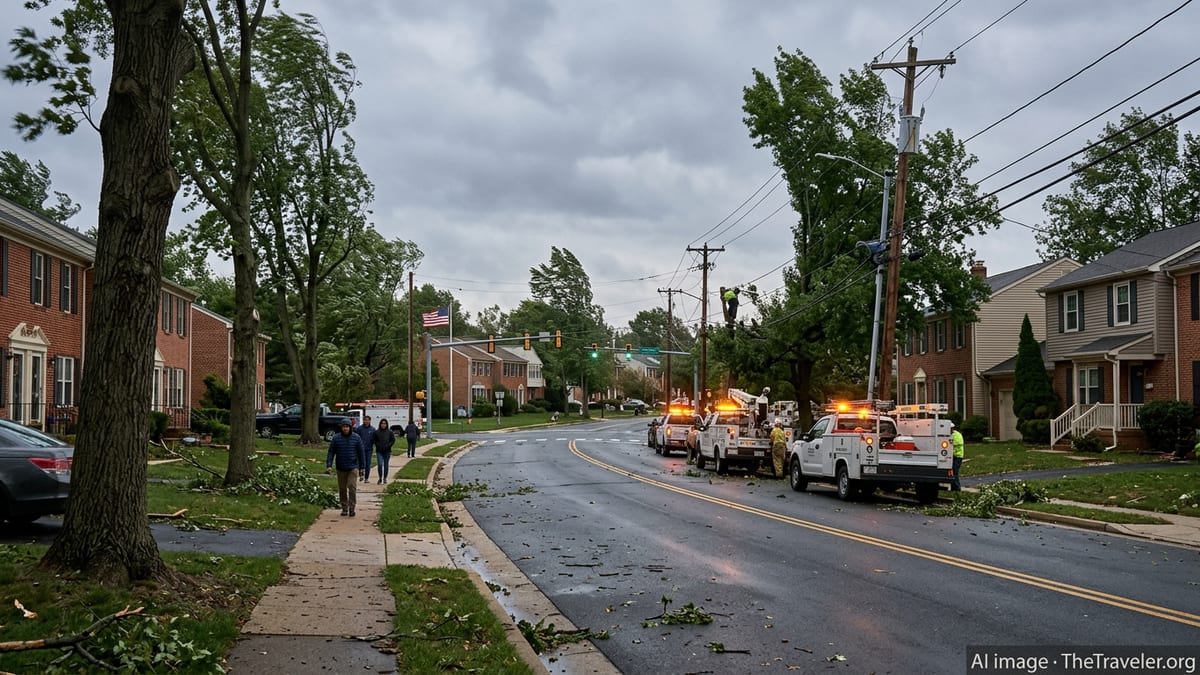
In Virginia, outage maps published by major utilities indicate hundreds of scattered outage clusters stretching from the outer suburbs of Washington DC through central and eastern parts of the state. Northern Virginia communities have reported pockets of neighborhood-scale blackouts, with customers describing abrupt power cuts following sudden wind bursts that toppled limbs onto distribution lines.
Publicly available outage dashboards for the region show tens of thousands of customers offline at various points since the strongest winds arrived, with numbers fluctuating as repair crews complete restorations and new incidents occur. The pattern reflects a classic wind-driven event in which line damage is highly localized but widespread, complicating restoration logistics.
Across the Potomac in Washington DC and suburban Maryland, reports indicate a similar patchwork of outages, particularly in tree-lined residential neighborhoods where overhead lines remain the norm. Transit agencies in the capital region have warned of potential delays linked to debris on tracks, signal problems and congestion on alternate routes as drivers navigate around downed trees and closed lanes.
Local emergency managers have used public channels to remind residents to avoid downed lines, treat all wires as energized and limit travel where possible during periods of peak gusts. In areas with prolonged outages, community centers and public buildings equipped with generators have been highlighted as potential warming or device-charging locations.
Northeast Corridor Sees Widespread Disruption
Farther north, the same storm system and its associated pressure gradient have lashed the Northeast corridor, where outage-tracking services report that the total number of affected customers across multiple states has climbed into the hundreds of thousands. The combined impact reaches roughly 450,000 customers without power at the height of the event, based on aggregated totals from utilities and independent monitoring platforms.
In states such as Pennsylvania, New York, New Jersey and parts of New England, the strongest winds have coincided with saturated ground and, in some locations, leftover snowpack from earlier winter storms. This combination has made mature trees more vulnerable to uprooting and has increased the likelihood that falling trunks would bring down spans of distribution lines, causing extended outages along residential streets and rural roads.
Rail services along sections of the Northeast Corridor have reported weather-related slowdowns as dispatchers temporarily reduce speeds through especially exposed segments and crews respond to reports of debris near the right-of-way. Airport arrival and departure boards in several major hubs have shown scattered delays linked to crosswind concerns and the need for additional spacing between aircraft in turbulent conditions.
Reports from port authorities and coastal agencies in the Northeast also describe hazardous marine conditions, with gale-force winds producing steep waves and rough seas just offshore. Ferry operators in some metropolitan areas have announced schedule changes or temporary suspensions, adding to the broader transportation disruption felt across the region.
Grid Vulnerabilities and Tree Damage Drive Outages
Energy system analyses and recent storm case studies for the eastern United States indicate that the majority of weather-related electric outages during high wind events are caused by tree and branch impacts on overhead lines. Fact sheets prepared by regional energy and environmental organizations have estimated that as much as 90 percent of storm outages in some Northeast and Mid-Atlantic service territories can be traced to vegetation contact with power infrastructure.
Many of the hardest-hit communities in this latest event are characterized by mature tree canopies, older housing stock and above-ground distribution networks that thread through densely built neighborhoods. When strong gusts arrive after a wet period, root systems can loosen and large trees may topple, ripping down feeders and transformers and sometimes blocking access roads needed for repair vehicles.
Utilities in Virginia, Maryland and neighboring states have in recent years highlighted grid-hardening investments that include targeted undergrounding of select lines, installation of stronger poles and expansion of vegetation management programs. However, published coverage and public regulatory filings show that fully burying distribution networks in older communities remains prohibitively expensive, leaving vast stretches of the network exposed to wind damage.
High wind events like the current system also interact with broader regional energy dynamics. Market analyses of recent winter storms in the eastern United States have described how periods of intense wind can simultaneously boost wind power generation and increase the risk of localized distribution failures, a dual effect that complicates planning for both grid operators and emergency planners.
Travel and Safety Considerations for Residents and Visitors
For travelers moving through the Mid-Atlantic and Northeast during this wind event, transportation agencies and travel advisories emphasize flexibility and caution. Drivers are urged to watch for sudden lane closures due to downed trees or power lines and to exercise particular care on elevated roadways where gusts can be strongest. Those operating high-profile vehicles such as vans, trucks and recreational vehicles face elevated risk in exposed locations.
Rail and air passengers are encouraged to monitor carrier alerts for schedule changes, as even minor wind shifts can require adjustments to departure times, runway use and train speeds. According to publicly available travel guidance, passengers should allow extra connection time and prepare for potential gate or platform changes as operations are adjusted in response to evolving conditions.
For residents and visitors staying in affected areas, safety information distributed through public channels stresses the importance of having flashlights, battery-powered radios and charged devices on hand in case of outages. Guidance also typically warns against using generators indoors or operating gas stoves for space heating, due to the risk of carbon monoxide buildup.
As winds gradually subside from southwest to northeast, utilities across Virginia, Maryland, Washington DC and the broader Northeast are expected to shift from emergency response to systematic restoration, prioritizing critical facilities before moving through neighborhood-scale repairs. Publicly available restoration estimates suggest that while many customers should see power return within hours of the strongest gusts passing, some in heavily damaged corridors may face outages lasting into the coming days.