

More news on this day
As the Department of Homeland Security shutdown stretches into its second month, travel industry observers warn that existing Transportation Security Administration staffing shortages could turn routine airport screenings into a growing chokepoint for U.S. air travel.
Get the latest news straight to your inbox!
Partial Shutdown Targets Homeland Security, Not the Entire Government
The current disruption is classified as a partial federal shutdown, focused on the Department of Homeland Security after Congress failed to agree on full-year funding before a February deadline. Most other federal agencies are operating under approved budgets, but Homeland Security and its component agencies, including the Transportation Security Administration, remain caught in a funding lapse.
Publicly available budget documents and congressional summaries indicate that the department has been relying on a contingency plan that designates the majority of TSA screeners as essential personnel. That status keeps airport checkpoints open but requires many officers to continue working without timely pay, a dynamic that has historically increased financial strain and burnout among front-line staff.
Analysts note that the current impasse comes on the heels of the broader 2025 federal shutdown, which disrupted operations across multiple agencies for more than a month. That earlier episode highlighted how even short-term lapses in funding can ripple through aviation security and staffing, with lingering morale and retention challenges that are still being felt.
Travel groups and policy experts caution that, because this shutdown is focused on Homeland Security, its effects on aviation security could prove more concentrated than in previous government funding crises. The result, they warn, is an elevated risk that any staffing instability at TSA will be felt quickly and visibly at airport checkpoints.
Mounting Staffing Gaps Put Pressure on Airport Checkpoints
Even before the latest shutdown, TSA had been grappling with chronic staffing issues linked to pay levels, high turnover and intense competition for workers in a tight labor market. Workforce data released over the past year pointed to sustained resignations among screening officers, particularly in high-cost metropolitan areas where starting federal pay often lags behind local private-sector jobs.
Recent reporting on federal workforce trends suggests that attrition has persisted into 2026, with several hundred officers leaving TSA since the current funding lapse began. Travel forums and employee discussions have highlighted concerns that missed paychecks could accelerate decisions by experienced screeners to exit the agency, further eroding an already stretched workforce.
At the same time, demand for air travel has remained robust, with domestic passenger volumes near or above pre-pandemic levels on many routes. Aviation researchers studying delay patterns note that, in the post-pandemic era, security checkpoints at large hubs have become a more visible contributor to total journey time, especially when staffing is insufficient to handle peak waves of early morning and late afternoon flights.
Industry analysts warn that the combination of strong passenger traffic, elevated resignation rates and a prolonged funding lapse at Homeland Security is creating a fragile equilibrium at security checkpoints. Any localized spike in sick calls or unfilled positions, they argue, can quickly translate into long queues, missed flights and mounting frustration among travelers.
Early Signs of Longer Lines at Major U.S. Airports
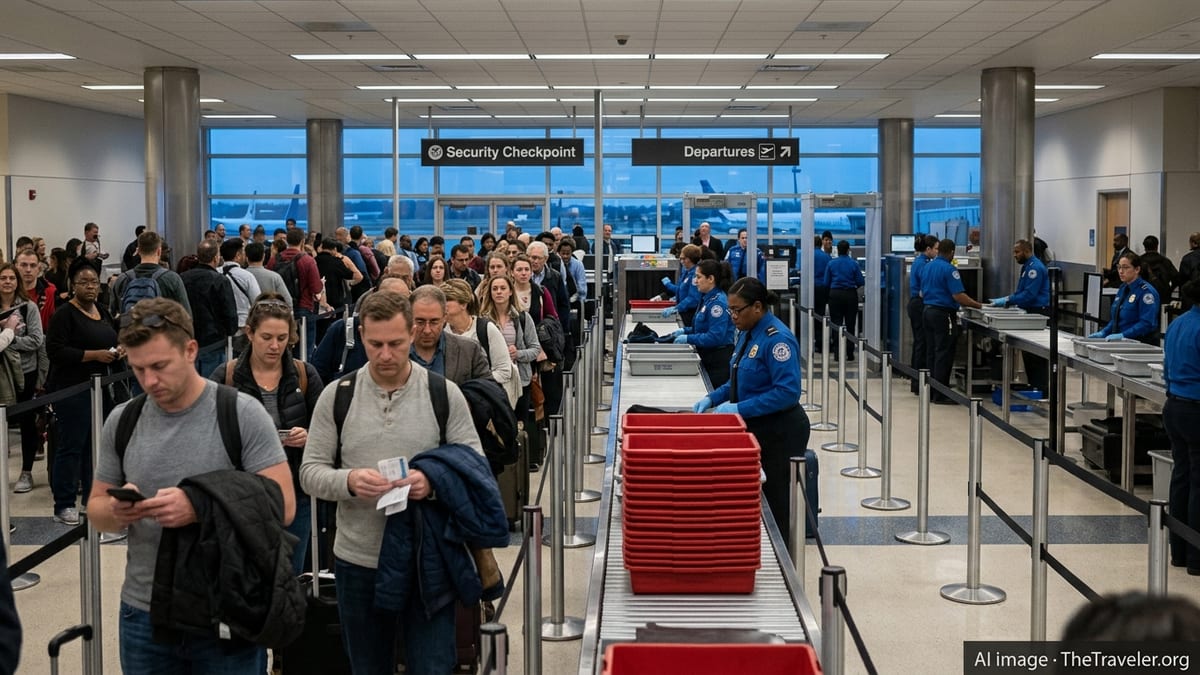
In recent days, travelers have begun describing longer-than-usual waits at security checkpoints in several major U.S. markets, including large hub airports in the South and along the coasts. Social media posts and traveler forums reference early morning lines snaking through terminal lobbies, with some passengers reporting waits approaching or exceeding two hours during peak periods.
Local news coverage in multiple cities has echoed these reports, citing airport officials who attribute the congestion in part to staffing constraints among federal screeners. While not all airports are experiencing severe delays, the uneven pattern has created uncertainty for passengers trying to gauge how early to arrive before a flight.
Some medium-sized airports, particularly those with fewer checkpoints and limited ability to reassign staff between terminals, appear especially vulnerable to disruption. Travel experts note that these facilities can be more exposed to spikes in absenteeism because they lack the staffing depth of the largest hubs, making it harder to absorb the loss of even a few officers on a given shift.
So far, major aviation tracking services have not reported a nationwide collapse in security throughput, and flights themselves continue to depart and arrive largely on schedule. However, aviation analysts emphasize that security bottlenecks can be highly localized, creating severe delays for travelers at certain airports even when the broader system appears to be functioning normally.
Lessons From Past Shutdowns Shape Today’s Concerns
Concerns about the current Homeland Security shutdown are shaped in part by memories of previous funding lapses that disrupted airports. During the 2018 to 2019 partial shutdown, a rising wave of unpaid absences among screeners contributed to terminal closures and extended waits at several major airports, including in New York and Miami, according to contemporaneous coverage by national news outlets.
More recently, the 2025 government shutdown offered another illustration of how quickly staffing issues can move from behind-the-scenes stress to visible operational strain. Reports from that period documented multi-hour security waits at airports including Houston, Chicago and Orlando, as well as scattered terminal closures driven by staffing shortfalls.
Aviation researchers who study delay propagation note that security queues can have knock-on effects throughout the system, as missed connections and rebooked passengers ripple through already full flights. Their analyses of prior shutdowns suggest that once a critical threshold of absenteeism is reached at a given airport, recovery can be slow, especially at facilities with limited physical space to add new screening lanes.
These historical patterns underlie many of the warnings being raised about the current DHS funding lapse. While each shutdown has its own political and budgetary context, aviation specialists say the operational risks are consistent: when unpaid security officers face prolonged uncertainty, the likelihood of staffing gaps and traveler disruption rises.
What Travelers Can Expect and How the Industry Is Adapting
For now, air travelers are being advised by airlines, airports and travel organizations to allow additional time for security screening, particularly at large hubs and during early morning and late afternoon peaks. Many carriers have begun updating their pre-trip guidance to emphasize earlier arrivals and the importance of monitoring airport conditions on the day of travel.
Some airports are responding by adjusting terminal staffing patterns, consolidating security lanes during off-peak hours and increasing communication with passengers through terminal displays and announcements. Concession operators and local volunteer groups in a few cities have revived support efforts seen in earlier shutdowns, such as providing snacks or small relief measures to federal workers and impacted travelers.
Technology and process changes are also being scrutinized as potential buffers against staffing shortfalls. Wider deployment of computed tomography scanners, expanded use of identity-verification kiosks and incremental expansions of trusted traveler programs such as TSA PreCheck and Global Entry are frequently cited as ways to increase throughput when staffing is tight, though many of these measures depend on sustained funding and long-term planning.
As the Homeland Security shutdown continues without a clear end date, the travel industry remains focused on how long TSA officers will be expected to work without full pay and whether resignations will accelerate. Observers warn that, if the impasse extends deeper into the busy spring and summer travel seasons, the intersection of funding uncertainty and chronic staffing gaps could turn today’s sporadic long lines into a persistent feature of the U.S. airport experience.