

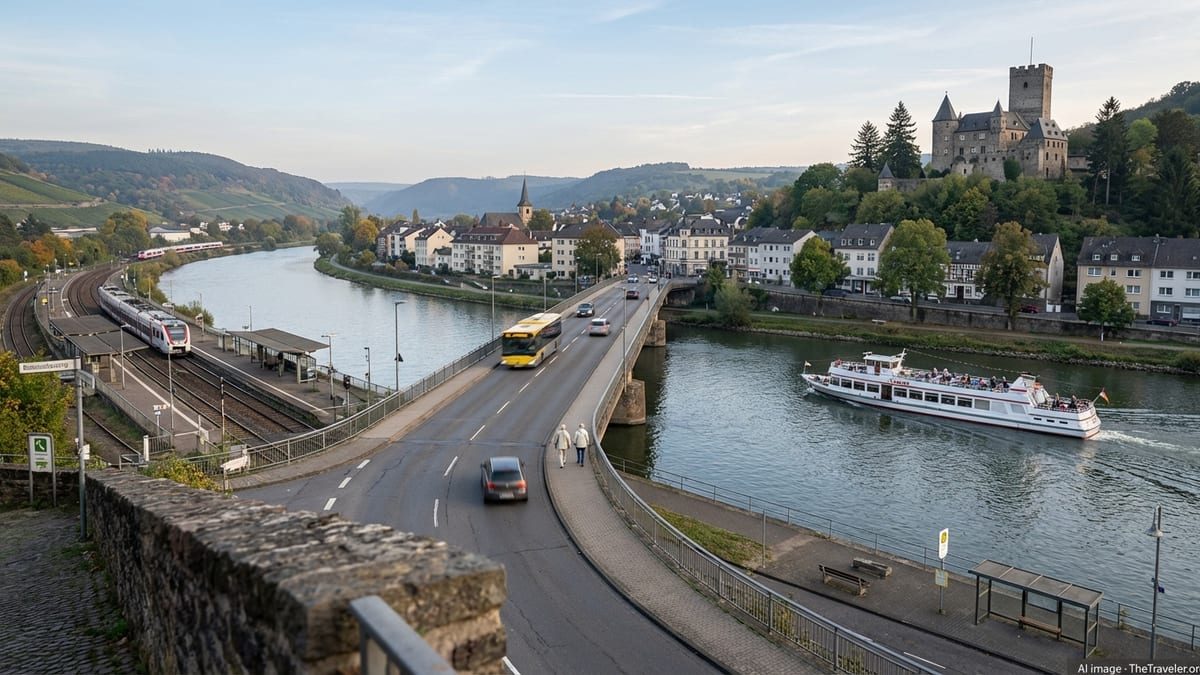
At the meeting point of the Lahn and Rhine rivers, Lahnstein looks, at first glance, like a quiet riverside town best explored on foot. But once you arrive, you discover a surprisingly rich transport network: two active railway stations with direct regional links, regular buses into neighboring Koblenz and along the valleys, signposted long-distance trails for walkers, and seasonal riverboats that open up the UNESCO-listed Upper Middle Rhine Valley. Knowing how these pieces fit together is the key to moving smoothly between castle viewpoints, riverside promenades, and vineyard slopes.
Understanding Lahnstein’s Layout and Transport Hubs
Easy mobility makes it more enjoyable to cover the main things to do in Lahnstein. Lahnstein is essentially a town of two historic halves. Niederlahnstein sits on the northeast side of the Lahn where it meets the Rhine, a low-lying quarter with its station, river promenade, and easy access toward Koblenz.
Oberlahnstein rises to the southwest, slightly higher and closer to Burg Lahneck and several important hiking trail junctions. The confluence and the bridges between the two shape how you move: you will constantly cross from one side to the other, whether by train, on foot, or by boat along the Rhine.
The town’s rail backbone is formed by the East Rhine Railway and the Lahn Valley Railway. Niederlahnstein station is the key junction where these lines meet, making it the practical transport hub for most visitors arriving by train. Oberlahnstein station, a few minutes’ walk from the Rhine bank, also serves regular regional trains, especially along the right bank of the Rhine. A third stop, Friedrichssegen, lies further up the Lahn and is mainly of interest to hikers and day trippers heading into the valley. Together, the three stations give Lahnstein unusually dense rail access for its size.
On top of the trains, regional buses connect the town’s neighborhoods and nearby communities, while riverboats on the Rhine call at the Lahnstein landing stages in season. Roads B42 and B260 run along either river, but many visitors choose to leave their car behind once they arrive. Distances within town are short, gradients are manageable, and much of the charm lies in following footpaths that thread past chapels, castle towers, and wooded ravines, with public transport handling the longer hops.
For trip planning, it helps to think of Lahnstein transport in layers: interregional trains that bring you in from Koblenz, Frankfurt, or Limburg; local trains and buses that bridge short distances along the valleys; and your own two feet or a bicycle for the final, scenic approach to viewpoints and riverfronts. These transport options also open up popular day trips from Lahnstein.
Arriving and Getting Around by Train
Most visitors to Lahnstein arrive by rail, and for good reason. Niederlahnstein station, opened in the 19th century and rebuilt several times, today serves as a separation station for the Lahn Valley and East Rhine lines. It is well integrated into the regional network and functions as a compact, user-friendly hub. Modern regional trains stop here at least hourly on key routes, with additional services at peak times, giving you direct connections toward Koblenz, Wiesbaden, Frankfurt, and into the Lahn valley toward Limburg and Gießen.
On the right bank of the Rhine, the service commonly branded as the Rheingau line links Neuwied, Koblenz, Niederlahnstein, Wiesbaden, and Frankfurt. This route typically runs at 60-minute intervals, increasing to roughly half-hourly frequencies between Koblenz and Frankfurt at busy times. Parallel to this, the Lahn-Eifel services use the Lahntal railway, running from Koblenz via Niederlahnstein along the Lahn to Limburg, with extensions onward to Weilburg, Wetzlar, and Gießen, and a branch via Mayen Ost and Andernach that also passes through Niederlahnstein. For travelers, the practical takeaway is that Niederlahnstein gives you frequent, direct regional access both along the Rhine corridor and deep into the Lahn valley.
Oberlahnstein station, slightly older in origin, lies on the East Rhine Railway as well and is particularly convenient if you are staying near Burg Lahneck, in the old Oberlahnstein center, or close to the Rhine promenade there. It is a through station with several platform tracks, used primarily by regional trains. Though it lost its former role as a junction decades ago, it still sees regular traffic and often appears in local journey planners as a stop for trains moving along the right bank of the Rhine between Koblenz and Rüdesheim or beyond.
Both main stations are integrated into the Verkehrsverbund Rhein-Mosel fare system, which simplifies ticketing across trains and buses in the wider region. Niederlahnstein offers step-free access to platforms, lifts, and a redeveloped station forecourt that includes bicycle stands and short-term parking. Oberlahnstein is more modest but still practical, with its platform 1 accessible to passengers with reduced mobility. For day-to-day movement within Lahnstein and short excursions to Koblenz or up the Lahn, you can rely heavily on these regional trains, using bus or footpaths for the “last mile.”
Local Buses, Taxis, and Everyday Mobility
While the railway handles longer stretches along the valleys, local buses knit together the different corners of Lahnstein and connect into the wider Rhein-Lahn district. Services are coordinated under the same regional transport association as the trains, so tickets and passes are generally valid across modes within the appropriate zones. Buses tend to radiate from nodes near the stations and central squares, stopping at town-center points such as Salhofplatz in Oberlahnstein or stops close to Niederlahnstein’s station and riverfront.
A handful of bus routes are particularly useful for visitors. Lines running along the Rhine connect Lahnstein with neighboring communities and Koblenz, complementing the rail service and offering alternative options in case of disruptions or for reaching intermediate stops that lack stations. Other routes head up into residential areas in the hills above town, which can be handy if you are staying in guesthouses away from the immediate riverfront and prefer not to climb steep streets at the end of a long day of sightseeing.
Taxi services are available around the stations and can be ordered by phone from most accommodations or restaurants. They are practical if you arrive late when bus frequencies have dropped or if you are carrying luggage and staying in a more remote holiday apartment, perhaps up one of the side valleys or closer to forest edges. For short intra-town journeys in daylight hours, however, most travelers find that walking or using the bus network is sufficient.
Car travel is possible along B42 and B260, and there are parking areas both near the riverfronts and by some trailheads, but many visitors choose to treat Lahnstein as a partially car-free base. Distances are modest, public transport is reliable by European standards, and the town’s scenic appeal is strongest when you are on foot, moving slowly enough to notice stone walls, vineyard terraces, and the changing light on the river. A practical pattern many travelers adopt is to park once at their accommodation or a designated car park and then switch to trains, buses, and boats for daily excursions.
Walking Lahnstein: Promenades, Trails, and Scenic Routes
Lahnstein rewards walkers on every scale, from ten-minute riverside strolls to full-day hikes along well-known long-distance routes. Within the town itself, you can easily piece together a network of short walks: from Niederlahnstein’s station down to the Rhine bank, along the promenade past the church of St. John and riverside lawns, across the Lahn bridge to Oberlahnstein, and then onward toward Burg Lahneck or into residential streets with views across the confluence. Pavements are generally good, and wayfinding is helped by clear local signage.
Just beyond the built-up area, Lahnstein becomes a gateway to several marquee trails. The Rheinsteig, a long-distance path running along the right bank of the Rhine from Bonn to Wiesbaden, passes directly through the municipality. In the Lahnstein area it traces the ridges above the river, linking viewpoints over the Rhine gorge with forested stretches and the dramatic Ruppertsklamm ravine. Access points to the trail are reachable from town on foot, although some hikers choose to take a short bus or taxi ride to skip initial road sections and begin walking in the woods.
Other classic routes include the Rheinhöhenweg, which also passes over Burg Lahneck and the Lahn bridge, and the Lahnhöhenweg, a trail that begins in Oberlahnstein and follows the Lahn valley into the countryside. Pilgrims and long-distance walkers may encounter the Lahn-Camino, a branch of the Camino de Santiago that ends at Oberlahnstein’s hospital chapel before continuing as the Rhine-Camino toward Kaub. For all these routes, Lahnstein serves as a natural overnight stop or staging point, with the added advantage that you can let trains carry you back if you choose to hike one-way sections.
For gentler outings, the riverside paths along both the Rhine and the Lahn are worth exploring at different times of day. Early morning brings mist over the water and quiet quays; evenings may offer long sunsets reflected in the current and opportunities to watch river traffic. Families with children often appreciate these flat promenades, which combine open play spaces, benches, and occasional cafés. The moderate local climate means walking is possible year-round, though trails in ravines like Ruppertsklamm can be slippery after rain, so footwear with good grip is advisable.
Exploring by Boat: River Cruises and Ferries
The meeting of Rhine and Lahn defines Lahnstein’s character, and at some point most visitors are tempted to swap land transport for a boat. Regular scheduled cruises along the Rhine, operated by long-established companies, stop at Oberlahnstein’s landing stage and at other points along the Middle Rhine corridor between Koblenz and Mainz. These liner services usually run from early April into mid or late October, with multiple departures each day in high season. They function as both sightseeing cruises and point-to-point transport, allowing you to hop between towns like Boppard, St. Goar, or Rüdesheim.
The Oberlahnstein landing stage sits just a few minutes’ walk from the local station, making boat trips easy to combine with rail travel. Accessibility information indicates that the landing stage can accommodate passengers with reduced mobility, although tidal variations and gangway angles may affect conditions on a given day. Travellers are generally advised to arrive a short time before departure to purchase tickets or confirm reservations at the local ticket office. Payment is typically possible by cash and major bank or credit cards.
Once on board, the river itself becomes your transport corridor. Loudspeaker commentary in multiple languages highlights castles, cliffs, wine villages, and historical sites as you glide by. From a practical standpoint, the cruises let you cover long stretches of the valley without road traffic or railway tunnels, and you can disembark at various intermediate landing stages to explore on foot before continuing by train. In peak season you can often structure a loop: sailing downriver in one direction, then returning to Lahnstein by regional train from another riverside town.
On the Lahn, navigation is more limited and seasonal, but in good conditions small excursion boats and paddlers share the quiet waters upstream of Lahnstein. Even without formal scheduled services, river culture is visible everywhere: in marinas, rowing clubs, and small piers. If you plan to combine hiking with boating, a common pattern is to take a morning train from Lahnstein up the Lahn valley, hike a section of the Lahnhöhenweg or local loops, and then return by train or, where available, a short boat trip closer to Koblenz and the Rhine.
Day Trips Using Trains, Trails, and Boats
Lahnstein’s layered transport options make it an ideal base for day trips that mix modes. A classic itinerary begins with a short regional train ride up the Rhine to towns such as Boppard or St. Goar, both of which offer hillside chairlifts or steep paths to panoramic viewpoints. After exploring in the morning, you might board a mid-afternoon river cruise back toward Lahnstein, watching the Lorelei cliffs and castle-studded slopes float by from the deck before disembarking near your accommodation.
Another popular pattern is to dedicate a day to the Lahn valley. From Niederlahnstein you can ride one of the Lahn-Eifel trains upstream to Bad Ems, Nassau, or even as far as Limburg. Each of these towns offers its own set of walking routes, historic centers, and spa or riverfront promenades. You can hike sections of the Lahnhöhenweg between towns, using the train to close the loop at the end of the day. Because the Lahntal railway was built to follow the contours of the valley, station stops are often close to trail access points, making spontaneous route changes easy.
For those focused on hiking, using Lahnstein as a multi-night base works well. One day you might follow a stretch of the Rheinsteig, starting directly in town and heading either north toward Koblenz or south toward Braubach, known for Marksburg Castle. Another day could see you exploring Ruppertsklamm, a rocky ravine that offers a short but dramatic scramble alongside a mountain stream. Public transport and signed connectors bring you back from the trail end to your starting point without the need for a car shuttle.
Families and more relaxed travelers can structure softer itineraries: a mid-morning walk over the Lahn bridge and up to Burg Lahneck, lunch in town, and an afternoon river cruise segment. Public transport allows you to adjust plans on the fly in response to weather, energy levels, or spontaneous discoveries. Because many regional train and boat services operate on predictable hourly or multi-hourly timetables, it is straightforward to plan your movements around them with a combination of printed schedules and electronic journey planners.
Seasonal and Practical Considerations
Although Lahnstein’s rail links operate year-round, other transport options are strongly seasonal. The main Rhine cruising season generally runs from early April to mid-October, with the densest schedules in summer and on weekends. Outside this window, there may still be occasional special sailings or holiday services, but you should not count on liner boats for routine mobility. Similarly, some bus routes may run reduced timetables on weekends, public holidays, and during school vacations, so it is wise to check current schedules rather than relying on out-of-date printed timetables.
Weather is another factor in choosing your mode of transport. The region’s climate is moderate, with the lowest rainfall typically in late winter and peak rainfall in early summer. In practice, this means that walking is viable in most months, but trails through ravines or steep forested slopes can become muddy and slippery after heavy rain. In winter, shortened daylight hours and the possibility of ice on shaded paths call for extra caution. Trains and buses generally keep running in all but the most extreme conditions, making them a safe fallback when outdoor plans must be adjusted.
Accessibility varies by mode and route. Niederlahnstein station offers step-free access, redesigned platforms, and lifts, making it comparatively easy for travelers with mobility challenges. Oberlahnstein’s main platform is accessible, but moving between tracks may involve underpasses or stairs. Riverside promenades tend to be level and paved, while hiking trails quickly become uneven, narrow, or steep once they leave urban areas. Riverboats equipped for passengers with reduced mobility often note this in their information materials and at the pier, but boarding can still depend on water levels and ramp gradients.
From a budget perspective, regional day tickets and network passes often provide the best value for travelers who expect to ride multiple trains and buses in a single day. Some Rhine cruise operators also offer hop-on, hop-off style passes valid for unlimited rides along specified stretches of the river during a calendar day. Combining such passes with walking segments allows you to see much of the Middle Rhine and Lahn valleys in a short stay, without renting a car. For more extended visits, weekly or longer-term transport passes within the regional association may be worth considering.
The Takeaway
Lahnstein’s compact size and layered transport network make getting around both straightforward and rewarding. Trains bring you efficiently along the Rhine and the Lahn, buses fill in local gaps, and taxis handle late-night or luggage-heavy transfers. Once you are in town, most everyday routes are comfortably walkable, whether you are wandering between Oberlahnstein and Niederlahnstein across the Lahn bridges or climbing gradually toward castle viewpoints and forest trails.
The town’s real strength lies in how these modes complement one another. You can hike a stretch of the Rheinsteig or Lahnhöhenweg without worrying about retracing your steps, because trains and buses stand ready to return you to your starting point. You can spend a leisurely afternoon cruising the Rhine, then step off at Oberlahnstein and be back at your hotel or a local restaurant within minutes on foot or by train. For visitors who value flexibility, this interlocking network is as much a part of Lahnstein’s appeal as its castles and river views.
With some basic planning around seasonal timetables and trail conditions, you can tailor your movements to your interests: a rail-based explorer hopping between valley towns, a walker stringing together panoramic stages, or a river traveler letting boats set the pace. In every case, Lahnstein’s geography at the confluence of two rivers, anchored by reliable regional transport, makes it a particularly easy town to navigate thoughtfully and without haste.
FAQ
Q1: Which train station should I use when visiting Lahnstein for the first time?
Niederlahnstein station is usually the most practical choice, as it is the main junction for both the East Rhine Railway and the Lahn Valley Railway and offers frequent regional connections to Koblenz, Wiesbaden, Frankfurt, and the Lahn valley.
Q2: How often do trains run through Lahnstein?
Regional trains typically run at least once an hour on the main routes through Niederlahnstein, with more frequent service at peak times, especially on the corridor between Koblenz and Frankfurt.
Q3: Can I rely on buses to get around Lahnstein without a car?
Yes, local and regional buses link residential districts, central squares, and neighboring towns, and they integrate with the same regional ticket system as the trains, making car-free travel feasible for most visitors.
Q4: Is Lahnstein a walkable town?
Lahnstein is very walkable, with short distances between key sights, riverside promenades on both the Rhine and the Lahn, and signed paths leading toward Burg Lahneck and nearby trailheads.
Q5: When do the Rhine riverboats operate to and from Lahnstein?
Regular liner cruises on the Rhine that stop at Oberlahnstein generally operate from early April to mid or late October, with the highest frequency in summer and on weekends.
Q6: Are the landing stages and stations accessible for travelers with reduced mobility?
Niederlahnstein station offers step-free access and lifts, and the Oberlahnstein landing stage is designed with passengers with reduced mobility in mind, though actual ease of boarding may vary with water levels and ramp angles.
Q7: What is the best way to combine hiking with public transport in Lahnstein?
Many hikers use Lahnstein as a base, walking sections of the Rheinsteig, Lahnhöhenweg, or Lahn-Camino and then returning by regional train or bus from another town, which allows one-way hikes without needing a car shuttle.
Q8: Do I need a car to explore the Middle Rhine and Lahn valleys from Lahnstein?
No, you can comfortably explore the region by combining regional trains, buses, and seasonal riverboats, using walking paths for local exploration and viewpoints.
Q9: Are there discounted tickets for using trains and buses around Lahnstein?
Regional day tickets and network passes are commonly available and can offer good value if you plan to take multiple train and bus journeys in a single day or over several days.
Q10: How should I plan for seasonal changes in transport around Lahnstein?
Train services run year-round, but riverboats and some bus routes follow seasonal or reduced timetables, so it is advisable to check current schedules for your travel dates, especially outside the main April to October cruising season.