


For travelers who fly Spirit Airlines a few times a year, the Free Spirit Travel More World Elite Mastercard can quietly turn everyday spending into free or heavily discounted trips. It is not a card for everyone, but in the right hands it can cover bag fees, unlock priority perks and shave hundreds of dollars off flights to places like Orlando, Las Vegas or the Caribbean. The key is understanding exactly how the points system works, what the card really offers, and how to use those benefits in the real world without overpaying in fees or interest.
Get the latest updates straight to your inbox!
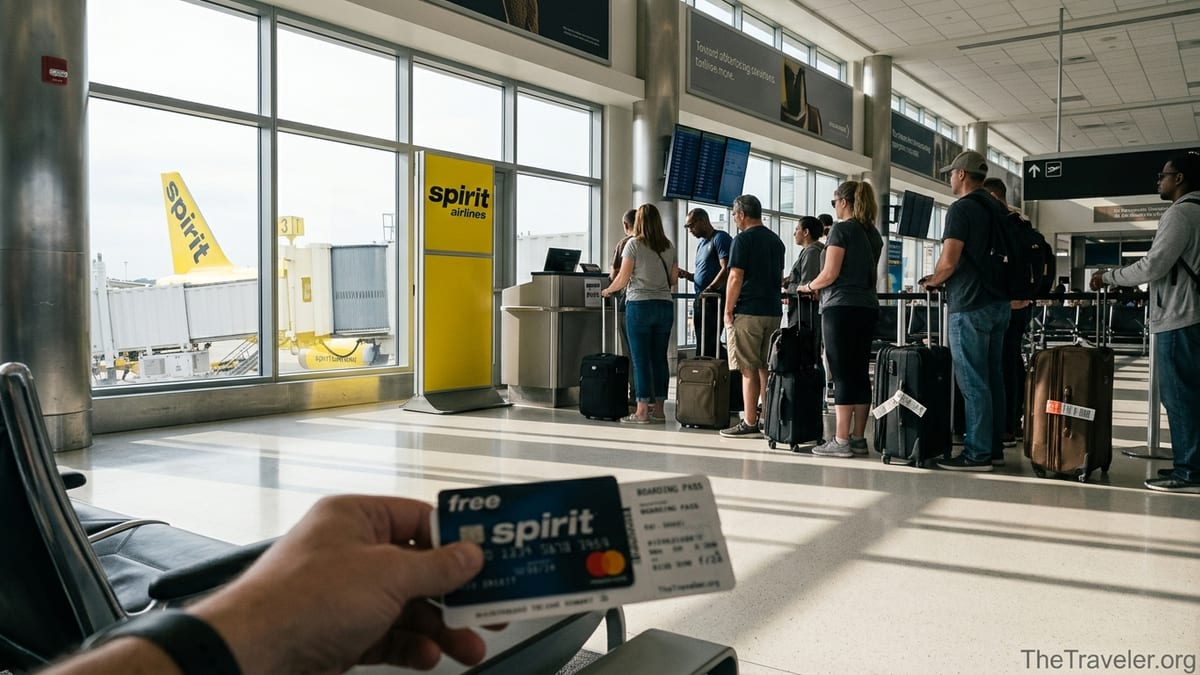
Free Spirit in a Nutshell: What the Card Is Built Around
The Free Spirit Travel More World Elite Mastercard is issued by Bank of America and is tied directly to Spirit Airlines’ Free Spirit loyalty program. Every dollar you spend on the card earns points that can be used only within Spirit’s ecosystem, mainly for award flights and Points + Cash redemptions. Unlike flexible cards that transfer to multiple airlines, this one is very focused: it is best suited to travelers who are reasonably sure they will fly Spirit at least a couple of times per year.
Spirit runs an ultra low cost model. You often see base fares like 39 dollars from Fort Lauderdale to Atlanta or 49 dollars from Dallas to Las Vegas, but almost everything extra costs money: carry on bags, checked bags, seat selection, even printing a boarding pass at the airport. Free Spirit and its co branded credit cards are designed to soften some of that sting for regular customers by returning value in the form of points, fee waivers and status like free checked bags and early boarding.
The Travel More Mastercard is Spirit’s higher tier consumer card, separate from the no annual fee Free Spirit Travel Mastercard. It usually requires an annual fee around the cost of a typical one way Spirit ticket, but in exchange you get faster point earning, a larger welcome bonus and more onboard and baggage perks. For a traveler who might do two or three round trips per year, that trade can quickly turn positive if the benefits are used strategically.
How You Earn Points With the Free Spirit Travel More Mastercard
The core of the card is its earning structure. Recent public offers have awarded 3 points per dollar on eligible Spirit purchases, 2 points per dollar on dining and grocery store purchases, and 1 point per dollar on everything else. That means charging a 400 dollar family booking from Chicago to Orlando on Spirit could earn roughly 1,200 points from the fare itself, before you even count the extra points you earn as a Free Spirit member for buying the ticket.
Because everyday categories like dining and grocery stores earn double points, the card can build balances surprisingly quickly for households that put routine spending on it and pay the statement in full. For example, a couple that spends 800 dollars per month at supermarkets and another 400 dollars per month at restaurants could collect around 2,400 Free Spirit points every month just from those purchases. Over a year, that is roughly 28,000 points, enough to cover at least one off peak domestic round trip if you are flexible with dates and routes.
One important concept for frequent Spirit flyers is Status Qualifying Points, or SQPs. With this card, you earn SQPs on spending, typically 1 SQP for every 10 dollars in net purchases. SQPs are separate from redeemable points and are used to unlock Silver or Gold elite status, which in turn unlocks heavier perks like priority boarding, free snacks and complimentary bags. For instance, if you already earn 1,700 SQPs in a year by flying, putting an additional 3,000 dollars of purchases on the Travel More card could push you over the 2,000 SQP threshold for Silver status, which changes the economics of every future flight.
Welcome Bonus, Annual Fee and What They Mean in Practice
Spirit and Bank of America frequently promote sign up offers for the Free Spirit Travel More Mastercard that include a large chunk of bonus points once you meet a minimum spending requirement in the first few months. Publicly advertised offers have often hovered around the 60,000 point range plus a flight voucher after a few thousand dollars of qualifying purchases. Occasionally, targeted in flight or airport offers have dangled even higher bonuses for those willing to apply on the spot.
To put a typical 60,000 point bonus in context, many analysts value Free Spirit points at roughly 1 cent each, give or take, depending on the route and timing. That makes the welcome bonus worth in the neighborhood of 600 dollars in flights if redeemed for cheaper Spirit routes. In real terms, that might look like three or four round trips between Detroit and Myrtle Beach when bought on sale, or two peak season returns to Orlando during school holidays when cash fares spike.
The tradeoff is the annual fee, which generally falls under 100 dollars. For someone who barely flies Spirit and lets the card sit in a drawer, that fee is hard to justify. But for a traveler who will realistically use the card’s free bags benefit a couple of times per year, or who can redeem the bonus points at good value, the first year can easily be a strong net positive. The key is to calculate: will the welcome bonus plus baggage savings clearly exceed the annual fee and any opportunity cost versus using a more flexible travel card.
Checked Bags, Boarding and Onboard: The Flight Perks That Matter
Where the Travel More Mastercard starts to stand out for frequent Spirit flyers is on baggage and onboard perks. Spirit historically charged for every bag, including carry ons, and those fees can easily run 40 to 70 dollars per segment if you wait until check in. With the Travel More card, Spirit introduced an eye catching benefit: up to two free checked bags for the primary cardholder on eligible itineraries, provided the card is properly linked to your Free Spirit account and the name on the card matches the traveler.
In practical terms, consider a round trip from New York LaGuardia to Fort Lauderdale for a beach vacation. If you check one 40 pound suitcase each way, Spirit might normally charge around 60 dollars each way when bought in advance, for a total of roughly 120 dollars. With the Travel More Mastercard benefit applying correctly, that single round trip could recoup more than the card’s annual fee just in bag savings. Add a second checked bag for a long trip or a ski vacation and the math tilts even further in your favor.
Beyond bags, cardholders can see softer perks that still matter on day of travel. Spirit’s elite tiers include priority boarding, shortcut security at select airports and complimentary inflight snacks and drinks at higher levels, and spending on the Travel More card can help you reach those tiers through SQP earnings. If you fly routes prone to long overhead bin battles, like peak season flights from Newark to Orlando, being able to board earlier can mean the difference between overhead space above your seat and having to gate check a bag.
Redeeming Free Spirit Points: What Trips They Can Actually Buy
Redeeming Free Spirit points is most compelling on routes where Spirit’s cash fares are already low and competitive. Many analyses peg the average redemption value at around 1 cent per point, but that number moves. A 5,000 point one way award from Fort Lauderdale to Atlanta when the cash fare is 50 dollars is a clean 1 cent per point return. On the other hand, if a peak school holiday return from Baltimore to Cancun is pricing at 20,000 points when cash fares are 180 dollars, you are getting under 1 cent per point, and it may be better to save your points for another trip.
Because Spirit uses dynamic pricing, award rates can swing widely based on date, demand and how far in advance you book. Savvy cardholders treat points almost like a separate currency. Before confirming a booking, they compare the cash fare to the points cost and choose whichever offers better value. For a traveler with flexible dates, it is common to find off peak one way domestic awards in the 2,500 to 7,500 point range on short routes such as Houston to New Orleans or Las Vegas to San Diego, especially midweek.
Another practical feature for cardholders is Points + Cash. Instead of needing enough points to cover an entire ticket, you can part pay in points and cover the rest in cash. This is useful when you have, say, 8,000 points banked and want to book a 12,000 point flight from Chicago to Los Angeles. Rather than waiting to earn the extra 4,000 points, you can use what you have and pay the remainder in dollars. It is not always the most mathematically optimal redemption, but for real travelers balancing school breaks, limited vacation time and shifting prices, it adds welcome flexibility.
Pooling Points and Keeping Them From Expiring
One benefit of holding a Free Spirit credit card that often gets overlooked is points pooling. Cardholders can start a pool with up to eight friends or family members and combine their points into a shared balance. That is especially powerful for households or groups that take occasional trips together but book tickets separately. For example, a family of four flying once a year from Minneapolis to Orlando might each earn 2,000 or 3,000 points per trip, not enough individually for a free ticket. In a pool, those same points could reach 10,000 or more and become a usable award.
Pooling is also helpful for travelers who live in smaller cities where Spirit operates only a few routes. A cousin in Detroit and a friend in Houston, both flying Spirit sporadically, can funnel their points into a single pool led by a cardholder. Over a couple of years, that pool might accumulate enough points for a group getaway to Las Vegas or a spontaneous long weekend in Los Angeles without anyone feeling like their smaller balances are going to waste.
Equally important is that holding a Free Spirit credit card protects your points from expiring as long as your account remains open and in good standing. Spirit normally requires qualifying earning or redemption activity within a set period to keep points alive. For infrequent flyers, that can mean juggling small transactions just to reset the clock. When you have the Travel More Mastercard, ongoing card activity and the cardholder protection on expiration can make it much easier to let points build up over time for a bigger trip.
Comparing the Travel More Card to Alternatives
Before applying, it is worth comparing the Free Spirit Travel More Mastercard with both the no annual fee Free Spirit card and broader travel rewards cards. The entry level Free Spirit Travel Mastercard typically earns fewer points on Spirit purchases and offers a smaller welcome bonus, but it avoids an annual fee. That can be a reasonable option for someone who flies Spirit once every year or two, mainly wants protection against point expiration and might appreciate the ability to pool points without paying for a premium card.
On the other side are flexible travel cards from banks and airline cards tied to larger carriers. A traveler who splits time between Spirit and a major airline from a hub like Dallas Fort Worth or Atlanta may get better all around value from a general travel card that earns transferable points, redeemable with multiple airlines and hotels. For example, if you regularly fly American, Delta or United in addition to Spirit, a flexible card can cover trips when Spirit’s schedules or routes do not suit your needs, while the Spirit card is only useful when you are on a Spirit metal flight.
The Travel More Mastercard makes the most sense when your home airport has strong Spirit service and you genuinely prefer or accept flying Spirit for price sensitive trips. A traveler based in Fort Lauderdale, Orlando or Las Vegas, where Spirit has many nonstop routes, can realistically plan most vacation flights on the airline and turn the card into a workhorse. Someone based in an airport where Spirit only flies one or two routes per week is usually better served by a broader travel rewards card, using Spirit selectively when the fare difference is overwhelming.
How to Use the Card Safely and Get Real Value
Like any airline card, the Free Spirit Travel More Mastercard only works in your favor if you avoid interest charges and late fees. Those costs quickly erase the value of points and travel perks. The travelers who benefit most set up automatic full balance payments from a checking account each month and treat the card as a safer, perk loaded version of a debit card. That way, the 3x points on Spirit, 2x on groceries and dining, and 1x everywhere else truly become rewards, not expensive financing.
There is also a learning curve on making the bag benefit and perks work smoothly. You need to ensure your Free Spirit number is correctly attached to your reservations and that the card is linked to your loyalty profile, not just used at checkout. Real world reports show that when the systems sync, the discounted or free bags automatically show up as options during booking and in manage my trip screens. If they do not, calling Spirit to verify your account linkage before showing up at the airport is advisable to avoid surprise bag fees at the counter.
Finally, be deliberate about how you use the welcome bonus. Rather than blowing 60,000 points on a single expensive holiday weekend flight where the value per point is mediocre, consider stretching them across multiple trips. Four or five midweek flights from Chicago to New Orleans or Los Angeles to Portland in the 10,000 to 15,000 point range can extend the sense of getting free travel far longer than one high season redemption, and they give you more chances to pair free checked bags and elite like perks with actual trips.
The Takeaway
The Free Spirit Travel More World Elite Mastercard is a focused tool for a specific kind of traveler. If Spirit is your go to airline for budget friendly runs to Florida, Vegas or sun destinations, this card can turn routine grocery and dining spending into flights, erase much of what you would normally pay in baggage fees and help you climb into elite tiers that make the Spirit experience more comfortable.
On the other hand, if you rarely fly Spirit, prefer legacy carriers or value flexibility above all else, a general travel rewards card that spans multiple airlines will almost certainly serve you better. As with any co branded airline card, the Travel More Mastercard works best when you walk into it with clear eyes about your flying patterns, keep your balance paid in full and put the perks to work on trips you would have taken anyway.
FAQ
Q1. Do I have to book my flight with the Free Spirit Travel More Mastercard to get the free checked bags?
The free checked bags benefit is tied to your Free Spirit account and cardholder status, not strictly to the payment method, but in practice you should both link the card to your Spirit profile and use it to pay for the ticket whenever possible. That reduces the chance of system errors and makes it much more likely your bag benefit is recognized automatically during booking.
Q2. How many Free Spirit points do I need for a typical domestic round trip?
There is no fixed award chart, but many short haul domestic routes can be found for roughly 10,000 to 20,000 points round trip when booked off peak. For example, midweek flights between Fort Lauderdale and Atlanta or between Las Vegas and San Diego sometimes price at the lower end of that range, while peak holiday or school vacation dates on popular routes can require significantly more.
Q3. Can Free Spirit points from the card be used on other airlines or transferred to partners?
No. Free Spirit points are designed to be used within Spirit’s own program, primarily for Spirit operated flights and Points + Cash bookings. Spirit is not part of a major airline alliance and does not offer the kind of broad transfer partnerships you see with some larger carriers.
Q4. Do Free Spirit points expire if I have the Travel More card?
Holding a Free Spirit credit card helps protect your points from expiration as long as your card account remains open and in good standing. Without the card, you would need periodic qualifying earning or redemption activity to keep points alive, which can be harder for infrequent travelers.
Q5. How quickly do welcome bonus points post after I meet the minimum spend?
Timing can vary by promotion and processing cycles, but many travelers report that bonus points appear within one or two statement cycles after meeting the spending requirement. It is wise to allow several weeks of buffer when planning a trip around a new card bonus rather than assuming the points will be usable immediately.
Q6. Is the Free Spirit Travel More Mastercard a good first travel card?
It can be a reasonable first travel card if you live near a Spirit focus city and already fly the airline often, but for most beginners a more flexible travel rewards card is better. Cards that earn transferable bank points or that are not tied to a single airline usually provide more options while you figure out your travel habits.
Q7. What credit score do I generally need to qualify for the Travel More card?
Specific approval criteria are not published, but this World Elite Mastercard is typically aimed at applicants with good to excellent credit profiles. In practice, that often means a solid history of on time payments, relatively low balances compared with your limits and a track record with other cards before applying.
Q8. Can I pool points with family members who do not have the card?
Yes. As the cardholding Pool Pilot, you can invite up to eight friends or family members to join your points pool even if they do not hold a Free Spirit credit card themselves. Their earned points will flow into the shared balance that you, as the pool leader, can use to book award travel.
Q9. Is it worth keeping the card after the first year once I have used the welcome bonus?
It can be, if you continue to get strong value from free checked bags, elevated earning on Spirit tickets and everyday categories, and the ability to prevent point expiration. If your Spirit flying tapers off or you move away from a Spirit served airport, those benefits may no longer justify paying the annual fee and you may want to reevaluate.
Q10. What happens to my points if I close the card?
Closing the card does not instantly erase your Free Spirit points, but you lose the protections and earning tied to the credit card. Once the account is closed, your points will again be subject to the standard expiration rules of the Free Spirit program, so it is smart to redeem or plan to use them within a reasonable window before canceling.