

More news on this day
What began as a regional crisis has rapidly morphed into a worldwide travel emergency, as the expanding US–Israel war with Iran shuts key air corridors, strands passengers and forces airlines and governments to redraw the global map of where it is safe to fly.
From War Zone to No-Go Zone: Advisories Redraw the Tourist Map
For years, Israel and its neighbors marketed themselves as bucket-list destinations for history, food and sun. That image has been eclipsed almost overnight by hard security warnings. In late February and early March 2026, the US State Department escalated its advisories across the region, maintaining Level 4 “Do Not Travel” guidance for Israel, the West Bank and Gaza while raising Jordan, Saudi Arabia, Oman and the United Arab Emirates to Level 3, urging Americans to reconsider travel. The shift reflects not just localized clashes, but the reality that the US–Israel confrontation with Iran now affects the entire Middle East.
American officials have gone further than routine caution. A broad advisory issued this week urges US citizens to depart much of the region “immediately” using any remaining commercial options, citing serious safety risks tied to retaliatory strikes and the potential for further escalation. That message has rippled through embassies, social media and airline apps, prompting a wave of cancellations not only to the hottest conflict zones but to countries once marketed as safe stopovers.
For travelers, advisory changes matter as much as missile strikes. A Level 3 or 4 warning can void travel insurance, invalidate corporate duty-of-care policies and trigger automatic itinerary bans for multinational companies and universities. Tour operators are quietly stripping Jerusalem, Petra, Amman and Gulf city breaks from 2026 brochures, replacing them with itineraries in Southern Europe, East Africa and Southeast Asia. The result is a sudden, uneven reshaping of global tourism flows that is only beginning to be felt.
19,000 Flights Canceled: When Hubs Go Dark
The Middle East is not just a destination; it is one of the world’s most important crossroads. Within days of the first joint US–Israeli strikes on Iran in late February, at least 19,000 flights were canceled as Iran, Israel and key Gulf states shut or restricted their airspace. Hub airports in Dubai, Abu Dhabi and Doha, which normally funnel millions of passengers between Europe, Asia, Africa and Australasia, were hit by temporary closures and heavy disruption.
Schedules that seemed confirmed just hours earlier vanished from departure boards. According to data cited by major news agencies and aviation analytics firms, hundreds of thousands of travelers have been stranded or forced into last-minute rebookings since February 28. Airlines from Europe, Asia and North America have either suspended services to cities such as Tel Aviv, Beirut, Amman, Riyadh and Dubai or rerouted aircraft on longer, fuel-hungry paths skirting conflict zones.
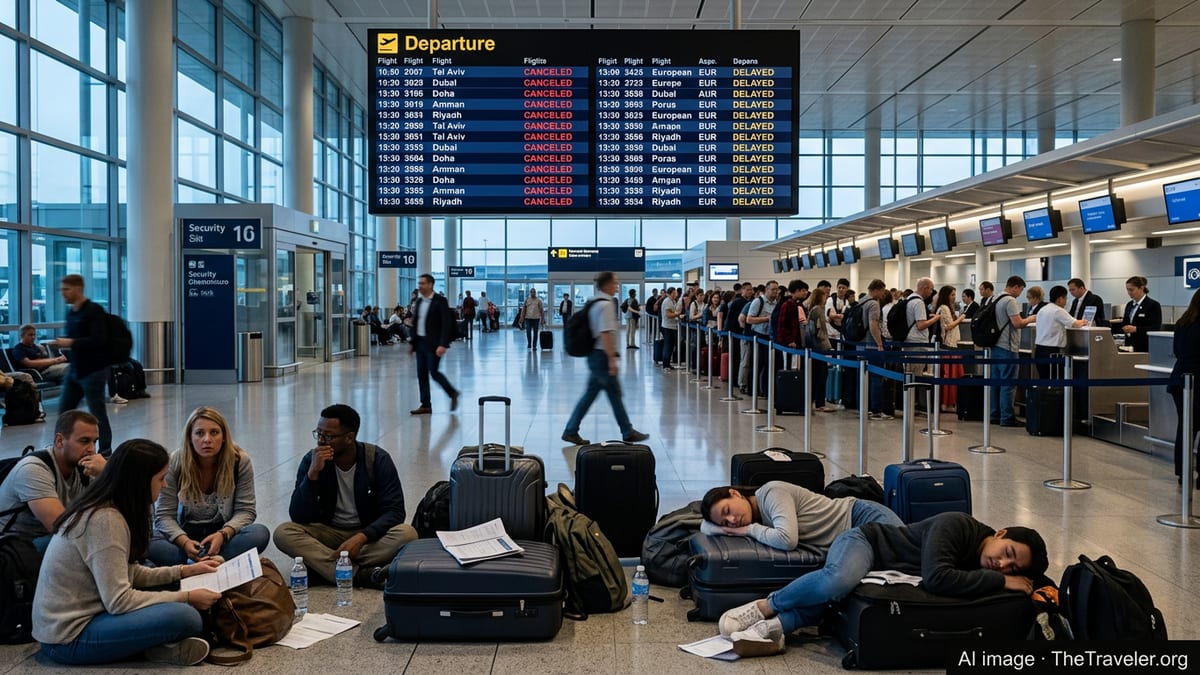
The immediate result is chaos for ordinary travelers: long queues at rebooking desks, nights on airport floors, and itineraries stretched by 10 or more additional hours in the air. But the secondary effects may prove more enduring. As carriers absorb higher fuel and insurance costs, analysts warn that fares on long-haul routes touching Europe, Africa and Asia are likely to remain elevated, even if hostilities cool quickly. For travelers planning trips months ahead, the uncertainty is chilling.
Stranded Tourists and One-Way Evacuation Flights
Across the region, the human side of these disruptions is playing out in hotel lobbies and makeshift airport camps. Families on holiday in Dubai or Abu Dhabi, backpackers in Jordan and business travelers changing planes in Doha woke up to find their return flights canceled and outbound options dwindling. With many airspaces closed and commercial schedules gutted, governments have begun organizing limited evacuation flights to pull citizens out of the Gulf and neighboring states.
These one-way services are a lifeline, but they are not a guarantee. Seats are scarce, priorities vary by country and eligibility rules shift by the day. Travel agencies report clients willing to pay any price simply to get a confirmed booking out of the region, while others face the opposite problem: nonrefundable hotel reservations and tours for trips that can no longer safely happen. Cruise passengers whose itineraries included Gulf ports or Suez Canal transits are also affected, as ships divert or suspend sailings entirely.
For many stranded travelers, the hardest part is the information gap. Airline apps can lag behind real-time airspace closures, call centers are overwhelmed, and official advice changes as military events unfold. The volatility is pushing more people to book through full-service travel advisors or corporate travel managers who can interpret advisories, chase refunds and piece together complex alternate routes when direct flights disappear.
Red Sea, Suez and the Hidden Cost of Rerouting
The shock to passenger travel sits on top of a maritime crisis that has been building for more than two years. Houthi attacks on shipping in the Red Sea since late 2023, combined with subsequent strikes and blockades linked to the Gaza war and now the US–Israel conflict with Iran, have diverted thousands of cargo vessels away from the Suez Canal. Container lines and tanker operators have rerouted around the Cape of Good Hope, adding up to ten days and roughly a million dollars in fuel to each voyage.
While these detours are largely invisible to leisure travelers, they have profound knock-on effects. Higher shipping and insurance costs feed into air cargo rates and, ultimately, the prices consumers pay for everything from luggage and outdoor gear to hotel furniture and aviation fuel. The International Monetary Fund has previously estimated that Red Sea disruptions cut Suez Canal trade volumes by around half in early 2024; more recent regional studies suggest that capacity losses and schedule volatility remain significant.
For the travel sector, this means rising operating expenses on multiple fronts. Airlines must choose between longer flight paths that avoid risky airspace and higher jet fuel bills already inflated by disrupted oil flows. Cruise lines that had started to tiptoe back into Red Sea itineraries have once again shifted ships away, canceling repositioning voyages between the Gulf, East Africa and the Mediterranean. Even destinations far from the conflict zone feel the strain when supply chains for aircraft parts, hotel food imports or tour vehicles are delayed or made more expensive.
Will Global Travel Ever Feel Stable Again?
For travelers who endured the pandemic shutdowns, the current crisis can feel like a bitter déjà vu: once again, plans are being upended by forces far beyond individual control. Yet industry experts caution against assuming that the age of carefree, frictionless global travel will simply snap back when ceasefires are signed. The war has exposed just how dependent the modern travel network is on a handful of geopolitical chokepoints in the Middle East, from air corridors over Iran and Iraq to maritime lanes in the Red Sea.
Insurers, airlines and governments are responding in ways that could permanently reshape how and where people move. Underwriters are reassessing war-risk premiums on both aviation and shipping, making some routes more expensive to operate even in peacetime. Carriers are exploring more resilient network designs that reduce reliance on a small number of mega-hubs, opening opportunities for secondary airports in Europe, Central Asia and East Africa to attract connecting traffic.
For individual travelers, the new normal is likely to involve more homework and less spontaneity. Checking government advisories before booking, understanding airline waiver policies, and considering flexible tickets or robust travel insurance may become as routine as comparing hotel reviews. Regions that can credibly market political stability and diversified access routes, such as parts of Latin America and the Pacific, may gain share as skittish tourists seek destinations less exposed to Middle East flashpoints.
What is clear already is that the US–Israel conflict has accelerated a trend toward a more fragmented, risk-aware travel landscape. The era when a single hub in the Gulf could plug almost any two cities together overnight may be giving way to a patchwork of shifting corridors, contingent on politics as much as price. For now, anyone planning a major trip in 2026 will need not only a passport and a ticket, but a close eye on the headlines.