


More news on this day
Europe’s new biometric Entry/Exit System is reshaping the airport experience for millions of non-European travelers, and the early results include long queues, missed connections and a flurry of schedule warnings from airports and airlines.
Get the latest news straight to your inbox!
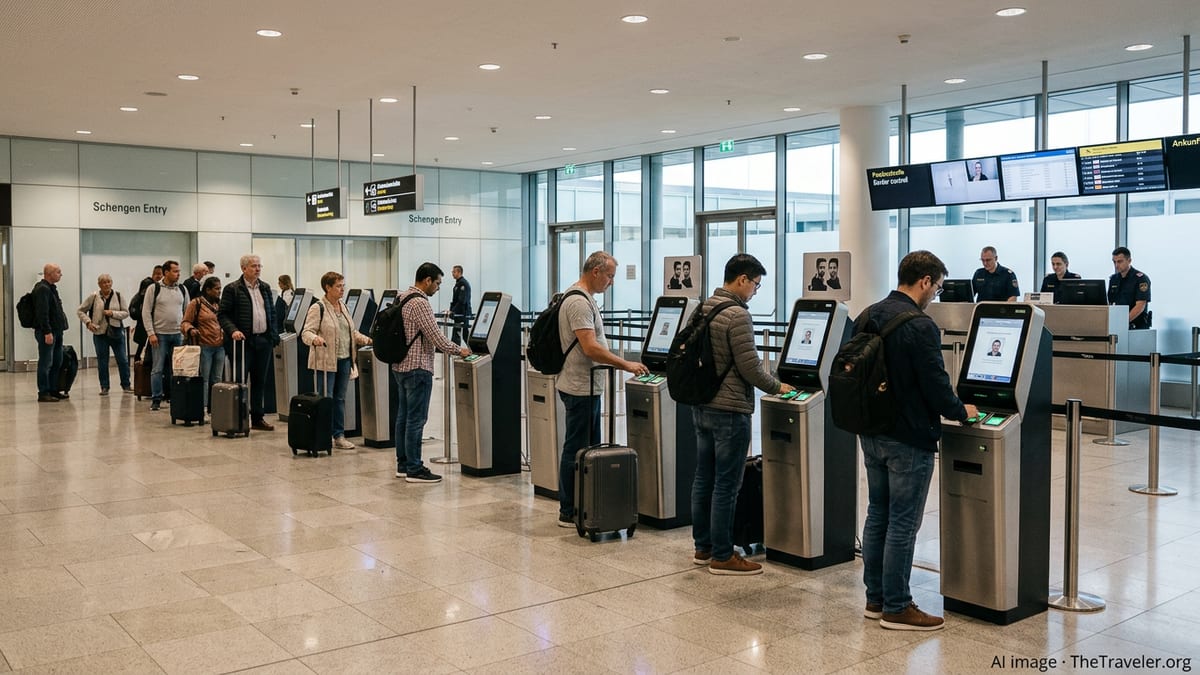
What EES Is And Why It Is Disrupting Airports
The European Union’s Entry/Exit System, or EES, is a continent-wide database that replaces traditional passport stamping for most non-EU nationals entering the Schengen Area. Instead of a quick ink stamp, travelers now undergo digital registration that captures their personal details, travel document information and biometric data such as fingerprints and a facial image at the first entry point.
Publicly available information from EU institutions describes EES as a security and border-management upgrade intended to track overstays more accurately and automate parts of the screening process over time. The system became operational in October 2025 and moved to full deployment across Schengen external borders in April 2026. It currently applies to travelers from visa-exempt and visa-required third countries, but not to citizens of EU and Schengen states or to nationals of Iceland, Liechtenstein, Norway and Switzerland.
The challenge is that the first EES enrollment is considerably slower than a standard passport check. Airport and airline groups have reported that during peak waves, border-control processing times have increased by up to 70 percent at some terminals, with queues occasionally stretching to two or three hours. A combination of technical glitches, unfamiliarity among travelers and limited physical space at older border-control areas has amplified the impact during holiday peaks.
Reports from several hubs, including Lisbon, Madrid and popular leisure gateways in Spain and Portugal, describe periods in late 2025 and early 2026 when local authorities temporarily reduced or paused EES processing at certain checkpoints after bottlenecks built up. As full deployment has taken hold, travel-industry associations are warning that delays may persist unless infrastructure and staffing are scaled up or the rules are fine-tuned.
Know When EES Applies To Your Trip
One of the most important ways to avoid surprises is to understand when you will actually face an EES border check. The system is triggered when a non-EU traveler crosses an external Schengen border. That means passengers arriving from the United States, Canada, the United Kingdom or most long-haul origins into a Schengen country will encounter EES on arrival, and again when leaving the zone at the final external exit point.
By contrast, passengers making only domestic or intra-Schengen journeys after they have already been cleared at an external border are unlikely to see additional EES checks. For example, a traveler flying New York to Paris and then connecting onward to Rome will normally complete EES processing in Paris when entering Schengen, but not again in Rome. Meanwhile, someone traveling from London to Paris for a weekend breakwill pass through EES at the Channel crossing or airport because the United Kingdom is outside Schengen.
Travelers on open-jaw itineraries or complex multi-country trips need to look closely at where they first enter and finally leave the Schengen zone. Long-distance rail segments that cross the external border, such as services between Switzerland or Italy and neighboring non-Schengen territories, may also involve EES checks at specific stations or land crossings. Ferry ports are gradually joining the rollout, which means summer island-hopping itineraries can be affected as implementation expands.
These distinctions matter because the longest delays tend to arise at major external gateways where many first-time EES registrations are taking place simultaneously. Planning your route so that you enter Schengen at an airport with a strong track record for automated border control, or at a less congested time of day, can significantly reduce the risk of an extended wait regardless of your final destination.
Build More Time Into Every Airport Touchpoint
Airports and airlines across Europe are urging passengers from non-EU countries to arrive earlier than usual, especially during the busy summer season. Some facilities are recommending that long-haul travelers allow at least three hours before departure and that those with tight connections involving an EES border check reconsider their plans in favor of longer layovers.
The risk is particularly acute for self-connecting passengers who book separate tickets on different airlines. In those cases, if a traveler is delayed in an EES queue and misses a follow-on flight purchased independently, consumer-protection rules that govern airline-caused delays may not apply. Even on a through-ticket, immigration delays are often treated differently from operational disruptions, leaving travelers with fewer automatic rebooking and compensation options.
Building in additional buffer time is especially important at airports that have reported heavy congestion since EES went live. Travel media and aviation analytics firms have pointed to periods of severe strain in southern European leisure hubs, where surging seasonal demand collides with constrained border infrastructure. Smaller regional airports that previously offered quick, low-stress arrivals may now experience disproportionate pressure if their passport-control zones were not designed for biometric kiosks and new queuing layouts.
Passengers should factor in extra time not just for the formal EES enrollment, but for upstream pinch points such as check-in, document checks and security screening. Airlines are increasingly performing pre-departure verifications to ensure that travelers have the right documents for EES processing and, once it is introduced, for the separate ETIAS travel authorization system expected to become mandatory in late 2026 or 2027 for many visa-exempt visitors.
Use Smart Routing, Timing And Airport Facilities
Beyond simply arriving earlier, travelers can use routing and timing strategies to stay ahead of EES bottlenecks. Choosing flights that land in Europe during mid-morning or early afternoon, rather than the dense early-morning bank when many transatlantic services arrive at once, can reduce strain at passport control. Similarly, departing in the late evening may mean shorter exit queues compared with late-afternoon peaks that coincide with holiday shuttle flights.
On multi-stop trips, it may be worth entering Schengen at a secondary hub with a reputation for efficient border control instead of the largest gateways. Some smaller airports advertise shorter queues and have invested heavily in self-service biometric kiosks, while a few major hubs have opened dedicated EES processing areas for families or travelers needing extra assistance. Public advice from airports indicates that using automated gates whenever eligible, keeping passports ready and following signage to the correct EES line can shorten the process.
Airport services can also help mitigate the impact of the new system. In several cities, fee-based meet-and-assist providers and fast-track arrangements are being marketed specifically as a way to navigate EES queues more smoothly, particularly for tight connections or high-value business trips. While these options add cost, they may be attractive for travelers passing through heavily affected hubs at peak times, or for those coordinating group movements where a missed flight would be especially disruptive.
Even relatively simple measures, such as avoiding itineraries that require changing airports within the same metropolitan area, can reduce exposure to multiple border crossings and associated delays. Within Europe, travelers might also choose rail or intra-Schengen flights that do not cross an external border once they are already inside the zone, which can sidestep EES checks on intermediate segments.
Prepare Documents And Expectations Before You Fly
A recurring theme in early EES reports is that many travelers arrive at border control uncertain about what the system is or why they are being asked for fingerprints and a facial image. That confusion can slow the line for everyone. Reviewing official guidance before departure and understanding that first-time enrollment involves biometrics, a short interview and potential verification questions can make the experience smoother.
Passengers should ensure that their passports have sufficient validity for Schengen rules, are machine-readable and undamaged, and are easily accessible as they approach border control. Where available, travelers can pre-complete digital forms or scan their passports at self-service kiosks before reaching an officer. Families should decide in advance how they will present at the checkpoint, particularly if children are being registered for the first time under EES.
Looking ahead, the introduction of ETIAS, the separate pre-travel authorization that will apply to many visa-exempt visitors, is expected to add another layer of preparation rather than new airport processing. Travelers who familiarize themselves with the distinction between EES, which is a border-entry database, and ETIAS, which functions more like an online travel permit, will be better positioned to comply with changing rules and avoid last-minute surprises at check-in.
For now, the most effective strategy is a mix of realistic expectations and proactive planning. EES represents a major shift in how Europe manages its borders, and the adjustment period is producing uneven experiences from one airport to another. Travelers who know when and where the system applies, who allow generous buffers and who plan their routes carefully are more likely to move through Europe’s airports with minimal disruption, regardless of where they are flying.