

Access to a local bank account is a practical necessity for most foreigners planning to reside or conduct regular financial activity in Thailand. Recent tightening of banking compliance and fraud-prevention rules has changed what is realistically possible for non-residents, particularly for those on short-stay visas. Understanding current requirements, account types and bank practices is essential before relying on Thai banking for salary, investments or long-term living expenses.
Regulatory Context for Foreigners Opening Thai Bank Accounts
Thailand’s commercial banks operate under regulations issued by the Bank of Thailand and anti-money-laundering legislation that require stringent customer identification and verification. Banks must understand a customer’s legal status in the country, expected transaction profile and source of funds, which has led to progressively tighter standards for foreign applicants over the last several years.
In practice, Thai banks distinguish between residents and non-residents and must comply with measures designed to limit Thai baht speculation and cross-border money laundering. Non-resident baht accounts and foreign currency deposit accounts are subject to specific conditions on usage, interest and transfer reporting. This regulatory framework influences not only which products are offered to foreigners but also the documentation and face-to-face checks required at account opening.
From 2024 into 2025, banks have also responded to high-profile fraud cases by re-assessing risk on foreign retail accounts. Reports indicate that accounts opened on short-term visas are now closely scrutinized, and some banks have moved to freeze or close accounts where the visa status no longer meets internal criteria or where re-verification attempts fail. Foreigners considering relocation should therefore treat account opening requirements as strict, not discretionary.
Foreign applicants should assume that account opening decisions are driven by a combination of national regulation, internal risk policies and branch-level risk appetite. Even where regulations theoretically allow non-resident accounts, individual banks may impose more conservative rules for foreigners than the legal minimum.
Eligibility and Visa Status: What Is Realistically Possible in 2025
Officially, Thai regulations allow foreigners to open bank accounts if they can be properly identified and if the bank is comfortable with the purpose and funding profile of the account. However, by early 2025 the practical reality is that most major banks will no longer open standard retail accounts for people on tourist visas or visa-exempt entries, regardless of earlier anecdotal experiences. Tourist-based account opening, once possible at selected branches, has largely been curtailed.
Foreigners with the best prospects of opening personal accounts are those holding long-term or non-immigrant visas, such as work, business, retirement, or family categories. Banks typically expect that the remaining permission to stay is measured in months rather than days and that the visa condition is consistent with regular financial activity inside Thailand, such as employment, residence or study. Many banks treat a valid work permit, or official confirmation of residence from Thai authorities, as a strong positive factor even if not always explicitly required for basic savings accounts.
Some banks will consider applicants on education or specialist visas, but acceptance is inconsistent and often depends on the perceived credibility of the institution sponsoring the visa. Branch managers retain considerable discretion, and similar applications may be accepted in a major city branch and rejected in a smaller provincial branch. Foreigners without a long-stay visa should not rely on being able to open an account and should have a contingency plan for international banking and card usage.
Existing foreign customers who opened accounts under older, more relaxed policies may now be required to show updated visa evidence, proof of address and additional identification. Failure to provide acceptable documentation can lead to frozen accounts or restricted transaction limits. This ongoing eligibility monitoring is an important consideration for foreigners who intend to maintain Thai accounts while changing visa type or leaving the country for extended periods.
Main Account Types Available to Foreigners
Thai banks offer several categories of deposit account that may be accessible to foreigners, subject to individual bank policies. The most commonly used for day-to-day purposes is the standard savings account with an ATM or debit card. This account type allows domestic withdrawals, card payments and local transfers, and in many cases gives online or mobile banking access. Minimum opening deposits are typically modest by international standards, often the equivalent of a few hundred US dollars or less, although policies vary.
Current or checking accounts are generally aimed at residents with regular income flows, and some banks reserve them for customers with work permits, business connections or higher average balances. These accounts may require higher minimum deposits and more stringent screening. They can be useful for individuals expecting to receive local salary payments or to write cheques, but foreigners should not assume automatic eligibility.
Non-resident baht accounts are specific products governed by Bank of Thailand rules for individuals or entities that are legally non-resident. They are usually intended for investment-related flows, such as property transactions or securities investments. These accounts may carry restrictions on interest payments or on the type of transactions allowed, and banks often require detailed documentation about the source and intended use of funds. They are more likely to be relevant for investors rather than everyday residents.
Foreign currency deposit accounts allow eligible customers to hold balances in major foreign currencies inside the Thai banking system. These accounts are widely used by residents and non-residents who earn or invest abroad and wish to manage exchange rate timing. For foreigners, such accounts can provide a way to bring in foreign currency and convert to baht later, but they often require higher minimum balances and stricter onboarding procedures than ordinary savings accounts.
Documentation and Compliance Requirements
Foreigners opening accounts in Thailand should expect a comprehensive know-your-customer and anti-money-laundering process. At minimum, banks typically require a valid passport, evidence of legal entry and stay in Thailand, and contact information. Many banks now insist on seeing a visa consistent with the intended account use, such as a non-immigrant visa for long-term residence, work or retirement. Short-stay tourist stamps are increasingly rejected for new accounts.
Proof of local address is a frequent stumbling block. Banks may ask for a lease agreement, utility bill, hotel confirmation with duration, or a residence certificate issued by immigration or the local municipality. For foreigners who are newly arrived and not yet formally registered at an address, it may be necessary to obtain an official residence certificate or a letter from an employer, school or embassy. Some banks accept a combination of these documents or an endorsement from a trusted institutional customer.
In addition to identity and address verification, banks will usually request information about the customer’s occupation, employer or business activities, and expected transaction patterns. Foreigners may be asked to complete tax self-certification forms for international tax reporting regimes. Those who are tax-resident in certain jurisdictions can expect additional questions and possible documentation, particularly where foreign tax identification numbers are involved.
Evidence of source of funds, such as recent bank statements from abroad, employment contracts or pension documents, is increasingly important for foreigners planning significant transfers or large cash deposits. Banks are under pressure to detect unusual transaction patterns and may limit services or request further proof if early activity does not match the stated profile. Applicants who can present a clear, well-documented financial picture at the outset generally face fewer issues later.
Bank-to-Bank Variations and Branch-Level Practice
While Thai banks operate under the same national regulations, policy implementation differs notably between institutions and even between branches of the same bank. Some large banks have a long history of working with foreign residents and have published guidelines for account opening by foreigners, including for non-residents bringing investment or pension income. Others focus primarily on domestic customers and may offer only limited support for foreigner onboarding.
Branches in major cities and areas with substantial expatriate or investor communities are usually more familiar with foreigner documentation and speak more English. They may be better equipped to process complex cases, such as non-resident baht accounts or foreign currency deposits linked to cross-border investments. By contrast, smaller branches in less international locations sometimes apply blanket refusals for foreigners without work permits, even when head-office rules allow some flexibility.
It is common for foreign applicants to experience different outcomes at different branches. A set of documents rejected in one location may be accepted elsewhere, particularly if supported by additional evidence such as a residence certificate, employer letter or large prospective balance. From a relocation-planning perspective, this inconsistency means that time needs to be allocated for potentially visiting multiple branches or banks, especially in the first weeks in the country.
Foreigners should also be aware that internal policies are evolving. Banks may change their onboarding rules quickly in response to regulatory inspections, high-profile fraud cases or internal risk reviews. A practice reported as possible six months ago may no longer be accepted. For this reason, relying on recent, locally gathered information and treating any success stories as time-sensitive rather than permanent rules is advisable.
Practical Opening Process and Typical Timelines
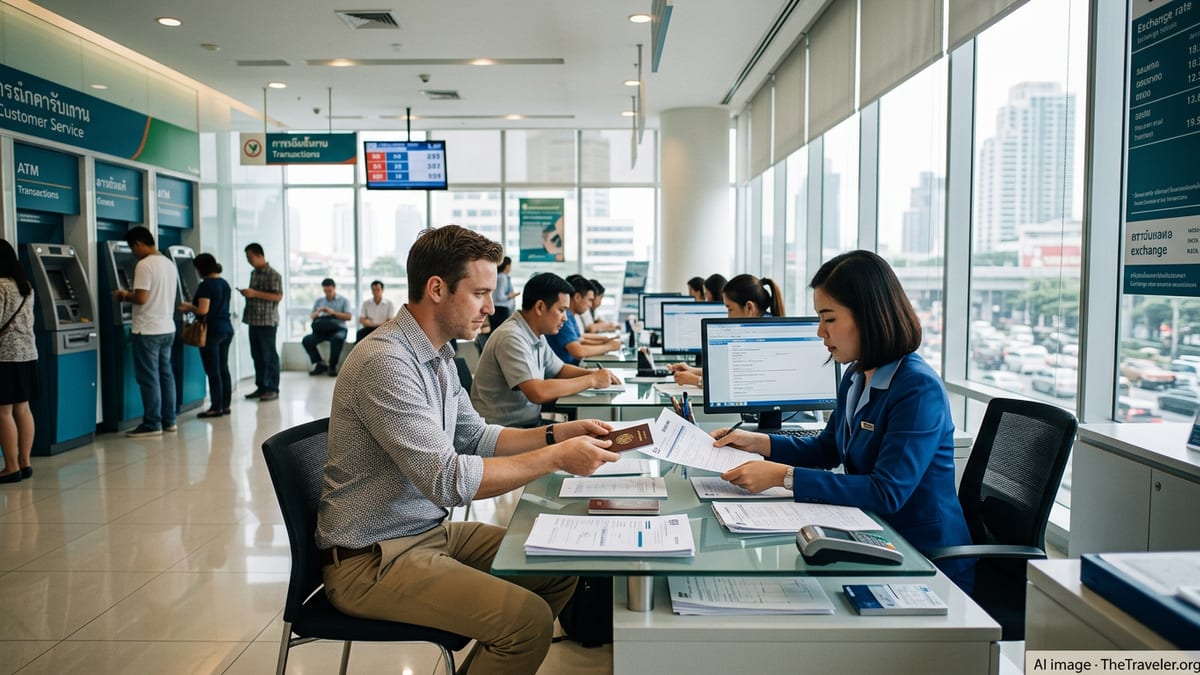
For foreigners who satisfy a bank’s eligibility criteria, the process of opening a basic savings account generally takes between 30 minutes and 2 hours in-branch, depending on queue length, documentation completeness and the need for translation. Most banks require that applications are made in person, with original documents presented. Online-only onboarding for foreigners is limited and may be restricted to existing customers upgrading or opening additional accounts.
The typical sequence involves an initial review of passport and visa, followed by completion of an account opening form and various consent documents. Bank staff then input data into internal systems, make copies of documents and may ask additional questions about occupation, purpose of account and anticipated transaction volumes. In some cases, a supervisor must approve the application, especially for non-standard visa categories or foreign currency accounts.
Once the account is approved, the customer usually receives an account passbook or account number immediately, and in many cases an ATM or debit card printed on site. Card activation may be possible at an ATM or via phone service, and online banking credentials are often set up on the same day. Foreigners should verify any minimum balance requirements, monthly fees and limitations on international transfers at the outset to avoid later surprises.
More complex products, such as non-resident baht accounts, foreign currency deposits or investment-linked accounts, can require additional approvals and longer timelines. Banks may ask for extra documentation, including contracts, property purchase agreements or investment statements, before allowing large inbound transfers. Relocating individuals who expect to move significant funds should not assume that full transfer capacity will be available immediately after opening the account.
Risk Controls, Freezes and Ongoing Obligations
Foreigners using Thai bank accounts must adapt to a risk environment characterized by strict fraud controls and frequent transaction monitoring. Banks have been criticized in recent years for account misuse linked to online scams, and have responded by imposing more aggressive freezes and transaction holds when risk indicators are triggered. Foreign accounts, particularly those opened on weaker documentation or short-stay visas, are often treated as higher risk.
Typical risk triggers include large inbound transfers inconsistent with the customer’s stated profile, frequent cross-border remittances without clear economic purpose, or unusual patterns such as multiple third-party deposits. In such cases, banks may temporarily block transfers or withdrawals and request documentary proof of source of funds. Foreigners should expect to produce contracts, invoices, payslips or external bank statements on short notice to avoid prolonged account restrictions.
Changes in visa status, lapses in permission to stay or failure to update contact details can also lead to problems. Some banks require foreign customers to present updated visa evidence periodically, and if they cannot do so, accounts may be restricted or closed. This is particularly important for those who change from work to retirement visas, or who exit and re-enter the country on different statuses while expecting uninterrupted account access.
From an ongoing compliance perspective, foreigners should keep copies of all documents used for account opening, maintain a clear record of large transfers, and proactively update the bank about changes in immigration status or local address. Those who depend on their Thai accounts to meet other obligations, such as balance requirements linked to immigration rules or local payroll, should have contingency arrangements in case of temporary freezes or system issues.
The Takeaway
Opening a bank account in Thailand as a foreigner in 2025 remains possible but is materially more constrained than in earlier years, especially for tourists and short-stay visitors. Long-term visa holders, employees, retirees and documented family dependants have the best prospects of securing stable access to local banking services. Even in these categories, requirements vary between banks and branches, and documentation expectations have risen.
For relocation planning, a Thai bank account should be treated as a critical infrastructure element that demands early attention. Prospective movers should assess their likely visa status, identify candidate banks in advance, and assemble a robust documentation file covering identity, residence and source of funds. They should also be prepared for ongoing compliance checks and the possibility of policy shifts over time.
Foreigners who successfully open accounts benefit from easier local payments, potential cost savings on currency conversion and a smoother interface with Thai employers, landlords and service providers. However, they must operate within a regulatory environment that prioritizes financial integrity and fraud prevention. Clear communication with banks, conservative transaction patterns and meticulous record-keeping are essential to maintaining uninterrupted access.
Ultimately, the feasibility of opening and maintaining a Thai bank account depends less on nationality and more on demonstrable ties to Thailand, transparency of financial activity and adherence to evolving bank policies. Those who plan around these realities can integrate Thai banking into their relocation strategy with fewer disruptions.
FAQ
Q1. Can I open a Thai bank account on a tourist visa?
In 2025, most major banks no longer open standard retail accounts for foreigners on tourist visas or visa-exempt entries, and applicants should not rely on this route.
Q2. Do I need a work permit to open a bank account?
A work permit is not always legally required, but many banks strongly prefer or effectively require it for certain account types, especially current accounts and higher-risk profiles.
Q3. Which visa type gives the best chance of account approval?
Non-immigrant visas for work, business, retirement or family purposes generally provide the best basis for account approval, particularly when accompanied by proof of local residence.
Q4. What basic documents should I prepare before visiting a bank?
At minimum, prepare a valid passport, current visa, proof of local address, and evidence of income or funds such as employment contracts, pension letters or foreign bank statements.
Q5. How long does it usually take to open an account?
For straightforward cases, in-branch account opening typically takes between 30 minutes and 2 hours, assuming documents are complete and no additional approvals are required.
Q6. Can I open a non-resident baht account as an investor?
Yes, some banks offer non-resident baht accounts for investment-related purposes, but they often require detailed documentation of investment activity and may apply usage restrictions.
Q7. Will I get online and mobile banking access as a foreigner?
Most banks provide online and mobile banking to foreign customers with standard savings accounts, although functionality and language support can vary between institutions.
Q8. What happens if my visa type or status changes?
Banks may request updated documentation when your visa changes, and failure to demonstrate valid status can result in restrictions, frozen accounts or eventual closure.
Q9. Are large international transfers into my Thai account a problem?
Large or unusual international transfers can trigger compliance reviews; banks may temporarily hold funds and request documents proving the legal source and purpose of the money.
Q10. Is it possible to hold foreign currency in a Thai bank?
Yes, many banks offer foreign currency deposit accounts, but access for foreigners typically involves higher minimum balances and stricter onboarding compared with basic savings accounts.