

More news on this day
With Taiwan’s 2026 Tomb‑Sweeping long weekend stretching from Friday 3 April to Monday 6 April, rail operators are preparing expanded services as travelers fan out to ancestral hometowns, scenic areas and major cities all at once.
Get the latest news straight to your inbox!
Understanding the 2026 Tomb‑Sweeping Travel Window
Tomb‑Sweeping Day, also known as Qingming Festival, falls on Sunday 5 April in 2026, with a make‑up public holiday on Monday 6 April. Publicly available holiday calendars show that the period from 3 to 6 April is expected to function as a four‑day travel window, with many residents taking advantage of the adjacent weekend to travel.
Transport and tourism advisories indicate that rail demand typically surges in the days immediately before and after Qingming, as families return to hometowns to tend graves, while others use the long weekend for coastal and mountain getaways. Online discussions from residents and visitors planning 2026 trips already point to packed trains on main north–south corridors and limited same‑day ticket options.
For visitors, this means that the pressure on both the Taiwan Railways Corporation’s conventional network and on the high‑speed rail will not be confined to a single day. Crowding is likely from Thursday 2 April through Tuesday 7 April, with the heaviest flows centered on departures from Taipei, Taoyuan and Taichung toward southern and eastern Taiwan, and return flows in the final two days of the break.
What to Expect from Rail Expansion in 2026
Based on patterns from recent Tomb‑Sweeping weekends, including expanded timetables and extra trains announced in previous years, publicly available information suggests that Taiwan’s 2026 plan will again focus on boosting capacity on core intercity routes. Taiwan Railways has typically added late‑night and early‑morning services on the West Coast main line, extra limited‑express services to Hualien and Taitung, and more stopping trains to intermediate towns.
Reports on earlier holiday operations describe a layered approach: additional long‑distance trains for major city pairs, plus strengthened local services to connect passengers with hometown stations and tourist regions. In coastal and scenic areas, regional lines often see more frequent departures or longer consists to handle day‑trippers heading for hot springs, national scenic areas and coastal trails during the long weekend.
For 2026, observers expect a similar expansion between Taipei and Kaohsiung, as well as a focus on the Yilan and Hualien corridors, where road congestion is severe and rail is often the fastest way through mountain tunnels and along the Pacific coast. High‑speed rail, which is overseen by a different operator, is also scheduled to run special holiday timetables around Tomb‑Sweeping, with specific dates published for added services from Thursday 2 April.
Travelers can therefore anticipate denser timetables, more standing‑room tickets on conventional trains, and strong competition for reserved seats on both systems. The trade‑off is that while more trains run, stations and platforms become significantly more crowded, particularly at peak morning and evening departure banks.
Booking Strategies for Taiwan Railways and High‑Speed Rail
Holiday booking rules and published ticketing calendars indicate that seats for Taiwan Railways Corporation intercity trains typically open well in advance of major holidays, with popular departures selling out quickly. Experience from previous Qingming periods suggests that high‑demand trains between Taipei, Taichung, Tainan and Kaohsiung can fill within hours of release, especially on the outward rush days.
To navigate this, travelers are advised to secure reservations as soon as ticket sales open for the 3 to 6 April period and to remain flexible on departure times. Early‑morning and late‑evening trains are often less competitive than mid‑morning and late‑afternoon departures, even when additional services are added. Conventional rail passengers who miss out on seats may still be able to purchase non‑reserved or standing tickets, but should be prepared for crowded coaches over several hours.
On the high‑speed rail, publicly available timetables show that a mix of reserved and non‑reserved cars operates on most trains, with extra services layered into peak periods. During Qingming, online booking platforms and station ticket counters typically show sharply reduced seat availability several weeks before the holiday. Some travelers monitor cancellations or lightly used mid‑day trains, but those options can be limited for groups or travelers with strict schedules.
Visitors arriving from overseas should consider arranging rail tickets alongside flights and hotels, particularly if they plan to travel on Friday 3 April or Monday 6 April, when pressure on both northbound and southbound services is expected to be most intense.
On‑the‑Ground Tips for Navigating Holiday Crowds
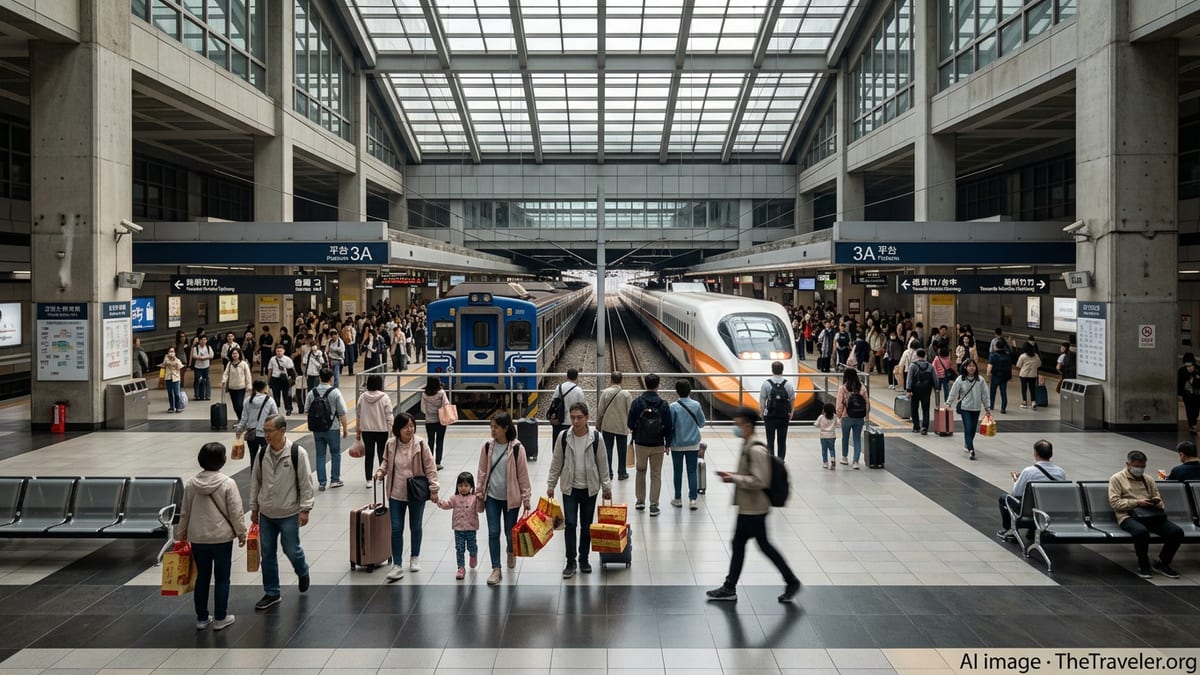
Reports from recent Tomb‑Sweeping holidays in Taiwan highlight that station congestion can be as challenging as the train journeys themselves. Major hubs such as Taipei Main Station, Banqiao, Taichung and Zuoying tend to see long queues at ticket machines, busy concourses and heavy use of escalators and platforms during the morning and late‑afternoon peaks.
Allowing extra time for transfers between metro, conventional rail and high‑speed rail is essential, especially when moving with luggage or children. Travelers are encouraged by local advisories to arrive well ahead of departure to locate the correct platform, purchase or collect tickets, and pass through any dedicated entry gates calmly. Carry‑on baggage kept compact and easy to handle makes boarding and alighting faster in dense crowds.
For those unable to secure ideal train times, publicly available travel guidance points to off‑peak journeys as a workable alternative. Mid‑day departures, very early morning services, or late‑night trains added for the holiday often provide slightly more space, even though they may require adjustments to check‑in times at accommodations. On some routes, intercity buses and tourist shuttles can supplement rail, but these options are also affected by highway congestion during Tomb‑Sweeping.
Within cities, metro systems and local buses generally remain frequent, although some routes operate on holiday schedules. Visitors who plan to use rail for day trips during the Qingming weekend may find it easier to base themselves in one city for several nights and fan out regionally, rather than changing hotels in step with the nationwide travel wave.
Planning Side Trips and Scenic Rail Journeys
Tomb‑Sweeping coincides with early spring conditions in Taiwan, a period when published tourism material highlights milder temperatures, fresh greenery and, in some regions, lingering cherry blossoms. This combination makes 2026’s long weekend particularly attractive for coastal walks, hot spring visits and mountain rail excursions that rely on Taiwan’s dense rail network.
Some national scenic areas and regional tourism boards promote integrated itineraries linking high‑speed rail stations, conventional trains and shuttle buses, allowing travelers to reach hot spring towns, cultural parks and coastal viewpoints without renting cars. Past announcements around Tomb‑Sweeping weekends have spotlighted adjusted shuttle routes from high‑speed rail stations to hot spring districts and heritage sites, reflecting efforts to channel increased holiday traffic onto public transport.
Given the likely crowding, travelers aiming for these scenic side trips may wish to avoid the most intense outbound and return days, using Saturday 4 April or Tuesday 7 April for longer excursions if schedules permit. Choosing less publicized destinations or traveling outside midday peaks can also make rail journeys more comfortable, even when trains are formally operating under expanded holiday timetables.
Overall, publicly available information on Taiwan’s 2026 holiday schedule and past Tomb‑Sweeping rail operations suggests that a combination of early booking, schedule flexibility and realistic expectations about crowd levels will be key for anyone planning to rely on trains during this important cultural period.