


Landing in Doha can feel surprisingly relaxed for a major Gulf hub, and that calm extends to getting between Hamad International Airport and the city. Locals mix the metro, Karwa taxis, ride-hailing apps and even public buses depending on time of day, budget and luggage. With a bit of planning, you can do exactly the same and avoid overpaying for transfers or getting stuck in the wrong queue.
Get the latest updates straight to your inbox!
Understanding Your Options: How Locals Really Move Between Airport and City
Most Doha residents do not treat airport transfers as a special, complicated trip. For many, Hamad International Airport is simply another stop on the Red Line of the Doha Metro or a short Karwa taxi ride away from home. If you are staying anywhere near a metro station or one of the main business districts such as West Bay, Msheireb or Al Sadd, you can usually choose between at least two or three practical options.
The core choices are the Doha Metro Red Line connecting Hamad International Airport Terminal 1 to Msheireb and points north, Karwa metered taxis from the official airport rank, ride-hailing apps such as Uber and the Karwa app for non-airport pickups, and public buses operated by Mowasalat that link the airport with central areas. Locals tend to pick the metro for reliability and price, taxis or apps when they have heavy luggage or arrive late, and buses when they live directly on one of the airport routes and are traveling light.
Costs vary, but not dramatically compared with other major hubs. The metro typically costs just a few riyals per journey, while a standard Karwa taxi from Hamad International Airport to central Doha usually lands somewhere around the price of a quick restaurant meal. Because oil prices keep fuel costs low, driving distances inside the city are short and predictable, so you can roughly estimate what you will pay before you even leave baggage claim.
Your decision will mostly come down to three things: where exactly in Doha you are going, what time you land or depart, and how much luggage you are willing to move through stations or onto buses. Once you know this, you can plan your transfer just like a Doha local would.
Using the Doha Metro Red Line: Fast, Cheap and Straightforward
The Doha Metro Red Line runs directly to Hamad International Airport Terminal 1 station, which is integrated into the main terminal. Once you exit customs, you follow clear “Metro” signs down to the station level. Trains run along the Red Line between the airport, Msheireb (the central interchange station) and destinations such as West Bay, Katara and Lusail, making it the backbone of local public transport between the airport and most central neighborhoods.
In normal operation, the metro runs roughly from early morning to late evening on weekdays, starting around 6 am and ending close to 11 pm, with slightly different hours on Thursdays and Fridays. Fares are deliberately kept low to encourage everyday use. A standard single journey in a regular Goldclub-style carriage is typically only a few Qatari riyals, often cheaper than a takeaway coffee at the airport. This is why many residents who live near stations in areas such as Al Sadd, West Bay or Lusail use the metro even when returning from international trips.
To travel like a local, buy or top up a rechargeable travel card at the machines in the airport station. Many residents keep one in their wallet and simply tap in and out at the barriers. From Hamad International Airport T1, a common route is to ride the Red Line to Msheireb, then change for the Gold Line to reach Souq Waqif, or stay on the Red Line northbound for West Bay QIC or DECC if you are staying in the modern hotel towers near City Centre Mall.
Doha residents pay close attention to service updates, especially for the airport branch of the Red Line. On rare occasions, the airport station has been temporarily closed or the line has operated in one direction only due to maintenance or events. Before you commit to using the metro from or to the airport, it is wise to quickly check the latest status on Qatar Rail’s official channels or local news. If you see reports of temporary closures affecting Hamad International Airport T1 station, pivot immediately to a taxi or bus instead.
Karwa Taxis from the Airport: What to Expect and How Much You Will Pay
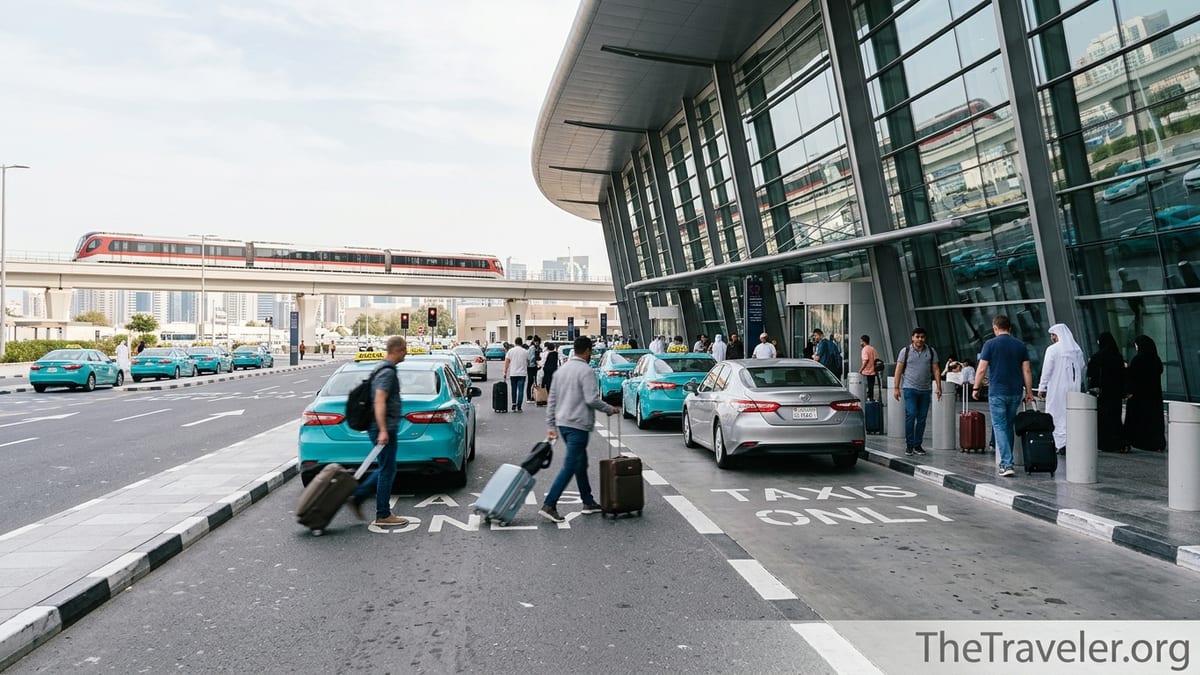
For many visitors and locals alike, the default way to leave Hamad International Airport, especially late at night or with heavy bags, is a Karwa taxi from the official rank. These turquoise-and-white metered taxis are operated by Mowasalat, the state-backed transport company. The taxi rank is clearly signposted as you exit customs; follow the “Taxi” signs, head outside, and you will find a well-organized queue overseen by staff who direct travelers to available cars.
Fares from the airport include a specific airport starting surcharge, which makes them slightly higher than equivalent trips from inside the city. Current guidance and real-world examples suggest that the starting fare at Hamad International Airport is in the mid-twenties in Qatari riyals, after which the meter increases per kilometer. Typical total fares to central areas such as West Bay, Souq Waqif or the Corniche fall roughly in the 35 to 70 riyal range, depending on traffic and exact destination. For instance, a straightforward off-peak ride from the airport to a hotel near City Centre Mall in West Bay can easily come out around 45 to 55 riyals.
Locals know that night-time and very late evening trips can cost slightly more because of higher per-kilometer rates and occasional congestion near major events, but even then, the amounts remain reasonable for a capital city. During Formula 1 weekends or large conferences, a journey that might usually cost 40 riyals may edge closer to 70, but importantly, Karwa taxis remain metered and regulated, so you avoid the aggressive price spikes that are common with surge-based ride-hailing.
At the airport, ignore anyone inside the terminal offering an unofficial “taxi” or private car. Doha residents avoid these offers and go straight to the Karwa rank or a pre-booked car from a reputable operator. Payment is usually by cash, but an increasing number of airport taxis accept card or contactless payments. To travel like a local, ask the driver politely at the start whether card is possible, and if you are paying cash, keep smaller notes available to simplify settling the fare at the end.
Ride-Hailing Apps: When Locals Use Uber and Karwa App Instead
Within city limits, ride-hailing apps are popular in Doha, especially among younger residents and visitors staying in apartments rather than large hotels. Uber is widely used, and the Karwa app offers similar functionality for booking official taxis through your phone. For pickups at the airport, rules have changed over time. There have been periods when only Karwa taxis were permitted to pick up passengers directly at the terminal, and other periods when Uber has been allowed to operate airport pickups with an added airport fee folded into the app price.
In practice, if ride-hailing pickups are currently permitted at Hamad International Airport, you will see clear pickup options and realistic fares in the app once you set your location to the terminal. A sample fare in recent months for an app-booked car from the airport to West Bay, including airport charges, has hovered around the mid-thirties to mid-forties in riyals when traffic is light. At peak times or during big events, surge pricing can push this higher. Locals sometimes check both Karwa and Uber to compare, then walk to the taxi rank only if surge levels on apps look unreasonable.
Where apps become particularly useful is for journeys from the city back to the airport. Because there is no special airport-only surcharge for pickups in most neighborhoods, an Uber or app-booked Karwa from areas such as Al Sadd, The Pearl or Lusail to Hamad International Airport can be noticeably cheaper than the same distance in reverse. Residents often schedule a pickup for early morning flights, especially when they live in areas not directly connected to the metro, or when they prefer a door-to-door transfer rather than navigating stations with luggage.
One newer development that circulates in local conversations is the gradual introduction of driverless robotaxis bookable through the Karwa app in certain zones such as West Bay and around the airport corridor. These services operate in limited areas and hours and are still considered experimental, so you should not plan your entire airport transfer around them. However, do not be surprised if you see locals mentioning them as a novelty option for short hops linked to the metro rather than a full replacement for a standard taxi or train ride.
Public Buses and Metrolink: Ultra-Budget Routes Locals Still Use
For travelers determined to keep costs to an absolute minimum, Hamad International Airport is connected to Doha’s public bus network. Mowasalat, which also operates Karwa taxis, runs city buses on numbered routes that call at or near the airport and head toward central hubs such as the old Doha Bus Station area, Souq Waqif surroundings and the Corniche. Historical and current route maps highlight services like 747 and 777, linking the airport with Al Ghanim and West Bay via key inner-city streets.
Bus fares are very low compared with taxis, and locals who use them typically purchase a rechargeable smart card that offers the best rate for multiple trips. You tap in when you board and, in most cases, tap out when you leave. In practice, residents who rely on buses for airport trips are usually solo travelers or long-term visitors with very little luggage, such as a backpack and one small suitcase, because the steps and tight aisles can be awkward with large checked bags.
Connecting services known as Metrolink buses act as free feeder routes between selected neighborhoods and metro stations. These are mainly intended to help people bridge the last mile to their nearest station and do not typically run long distances all the way to the airport. However, a local might take a Metrolink from a residential area to a Red Line station such as Oqba Ibn Nafie or Al Matar Al Qadeem, then continue by metro to Hamad International Airport T1. This two-step journey can be effectively free for the bus portion and just a few riyals for the train.
Information for public buses is less consolidated than for the metro, and timetables can evolve. Locals check the latest route numbers and timings on Mowasalat’s official channels before relying on a particular bus to the airport, especially early in the morning or late at night. If your flight departs before sunrise or arrives after midnight, most residents would avoid buses altogether and use a taxi or pre-booked car instead.
Timing, Traffic and Safety: Local Habits You Should Copy
Doha is not a city of endless traffic jams, but queues can form at predictable times. Office hours and evening shopping trips around major malls create heavier traffic near West Bay, the Corniche and Al Sadd, which can add 10 to 20 minutes to your airport journey. Local residents factor this in. If they are catching a morning long-haul flight to Europe at 8 or 9 am, they might leave West Bay by Karwa taxi or Uber 2.5 to 3 hours before departure, allowing 20 to 30 minutes to reach Hamad International Airport plus time for check-in and security.
Late at night, especially after 11 pm, locals take comfort in the fact that Doha feels notably safe. It is common to see solo travelers, including women, taking Karwa taxis from the airport to areas such as Al Sadd or Old Airport Road even after midnight. Many recount paying in the region of 50 riyals for these late-night rides, considering it a small premium for the convenience of walking directly from baggage claim to an official taxi without worrying about metro timetables or bus stops in the dark.
When an international event is in town, such as a major football tournament or Formula 1, residents assume traffic to and from the airport could be heavily impacted at specific times. They might then opt for the metro if it is operating normally, since the Red Line largely bypasses surface-level congestion. In contrast, if there is news of temporary closures affecting the airport branch of the metro, even metro-regular locals immediately switch their plan to taxis and build in extra time in case of heavy queues at the airport taxi rank.
Safety extends beyond personal security to avoiding scams or unnecessary stress. Locals do not negotiate flat fares in the taxi line, they insist that the meter is turned on, and they walk away from anyone trying to steer them toward an unmarked vehicle. Adopting these habits will keep your experience in line with what residents expect on a normal trip.
Real-World Itineraries: How Different Travelers Would Do It
Imagine you are arriving mid-afternoon from London and staying near Msheireb Downtown Doha. A local in the same situation would likely walk straight to the metro station under the terminal, buy or top up a travel card, ride the Red Line to Msheireb in under half an hour and walk to the hotel. The total cost would be just a few riyals and the journey would be mostly indoors and air-conditioned. They would only choose a Karwa taxi if they were exhausted after an overnight flight or carrying unusually heavy luggage.
Now consider a business traveler landing at Hamad International Airport after midnight with a meeting in West Bay the next morning. At that hour, the metro is no longer the default. Locals with similar schedules simply follow the signs to the taxi rank, join the organized queue and take a Karwa directly to their hotel in the towers around DECC or City Centre Mall. They expect to pay somewhere around 45 to 60 riyals depending on traffic and view the extra cost over the metro as justified by the time of night and comfort.
For someone staying in a neighborhood that is not directly on the metro, such as parts of Al Waab, a typical local pattern is to mix modes. To go from the city to the airport on a Friday afternoon, they might book an Uber or Karwa app taxi from their front door to the nearest Red Line station that is currently well connected, then continue by metro to Hamad International Airport T1. On the return leg with luggage, especially if the flight lands late, they might skip the two-step transfer and instead go straight from the airport taxi rank back home.
Budget-conscious long-stay visitors who become comfortable with Doha’s bus system sometimes stitch together complex but very cheap routes. For example, a university student living near the old Doha Bus Station area might take a local bus straight to the airport, paying only a handful of riyals with their smart card, while using the metro for other parts of their daily life. This is a minority behavior, but it shows how flexible the system can be when you understand all the pieces.
The Takeaway
Traveling between Hamad International Airport and Doha like a local is less about knowing one perfect route and more about reading your circumstances. If your timing aligns with metro operating hours and your hotel is near a Red Line or interchange station, the train is hard to beat for price and predictability. You will be doing exactly what many residents do on a normal workday trip.
When you are tired, loaded with luggage, arriving late or facing a tight connection, the official Karwa taxi rank at Hamad International Airport is your friend. Fares to central districts like West Bay, Msheireb or the Corniche sit in a sensible range for a Gulf capital, and you benefit from regulated meters and clear signage. Within the city, apps such as Uber and the Karwa app give you the same flexibility most locals enjoy for trips back to the airport.
Public buses and Metrolink feeders complete the picture for those stretching their budget or living near specific routes. By combining these options the way Doha residents do, you can keep your transfer costs reasonable, avoid stress at the terminal and step into the city with confidence that you are moving around on local terms rather than as an overcharged visitor.
FAQ
Q1. What is the cheapest way to get between Hamad International Airport and central Doha?
The Doha Metro Red Line is usually the cheapest option. A single journey from Hamad International Airport Terminal 1 to central stations such as Msheireb or West Bay typically costs only a few riyals, making it significantly less expensive than taxis or ride-hailing.
Q2. How much does a taxi from Hamad International Airport to West Bay usually cost?
A standard Karwa taxi from the airport to West Bay or City Centre Mall generally falls in the 40 to 60 Qatari riyal range in normal traffic, with slightly higher fares possible during busy periods or late at night.
Q3. Is it safe to take a taxi from Hamad International Airport late at night?
Yes. Doha has a reputation for being safe, and locals regularly use Karwa taxis between the airport and neighborhoods such as Al Sadd or Old Airport Road even after midnight. The official taxi rank is well lit and monitored by staff.
Q4. Can I use Uber or other ride-hailing apps to leave the airport?
Within the city, Uber and the Karwa app are widely used. At the airport, permissions for app pickups have changed over time, so availability may vary. If ride-hailing is allowed, you will see clear pickup options in the app; otherwise, head to the Karwa taxi rank.
Q5. How long does the metro take from Hamad International Airport to Msheireb?
Under normal conditions, the Red Line journey from Hamad International Airport Terminal 1 to Msheireb station typically takes under half an hour, not including walking time within the terminals and station.
Q6. Are there public buses from the airport into the city?
Yes. Mowasalat operates public bus routes that connect Hamad International Airport with central areas, including routes historically numbered 747 and 777. They are very cheap but best suited to travelers with light luggage and flexible schedules.
Q7. Can I pay for taxis and metro with a credit card?
The metro uses rechargeable travel cards that can be bought or topped up with card at station machines. Some Karwa taxis accept card and contactless payment, but not all, so locals often carry cash in small denominations as a backup.
Q8. How early should I leave Doha to reach the airport on time?
From central areas such as West Bay or Msheireb, many locals allow around 20 to 30 minutes for the drive plus the recommended check-in and security time. For morning peak or major events, leaving 2.5 to 3 hours before departure is common.
Q9. Is there a direct metro connection from the airport to Souq Waqif?
There is no single-seat train, but it is a simple transfer. You take the Red Line from Hamad International Airport Terminal 1 to Msheireb, then change to the Gold Line for one or two stops to reach the Souq Waqif area.
Q10. What should I do if the airport metro station is temporarily closed?
If the Hamad International Airport Terminal 1 metro station is closed due to maintenance or events, locals switch immediately to taxis or ride-hailing. In that case, follow signs to the official Karwa taxi rank or use a reputable app pickup point in the city for trips to the airport.