


Buying Bajaj Allianz travel insurance is only the first step. To actually benefit from your policy when something goes wrong on a trip, you need to set it up properly before you leave: choosing the right plan, entering correct details, saving documents and contacts, and understanding the basic dos and don’ts. This guide walks you through how to use Bajaj Allianz travel insurance step by step before your journey, with practical examples drawn from real travel situations.
Get the latest updates straight to your inbox!
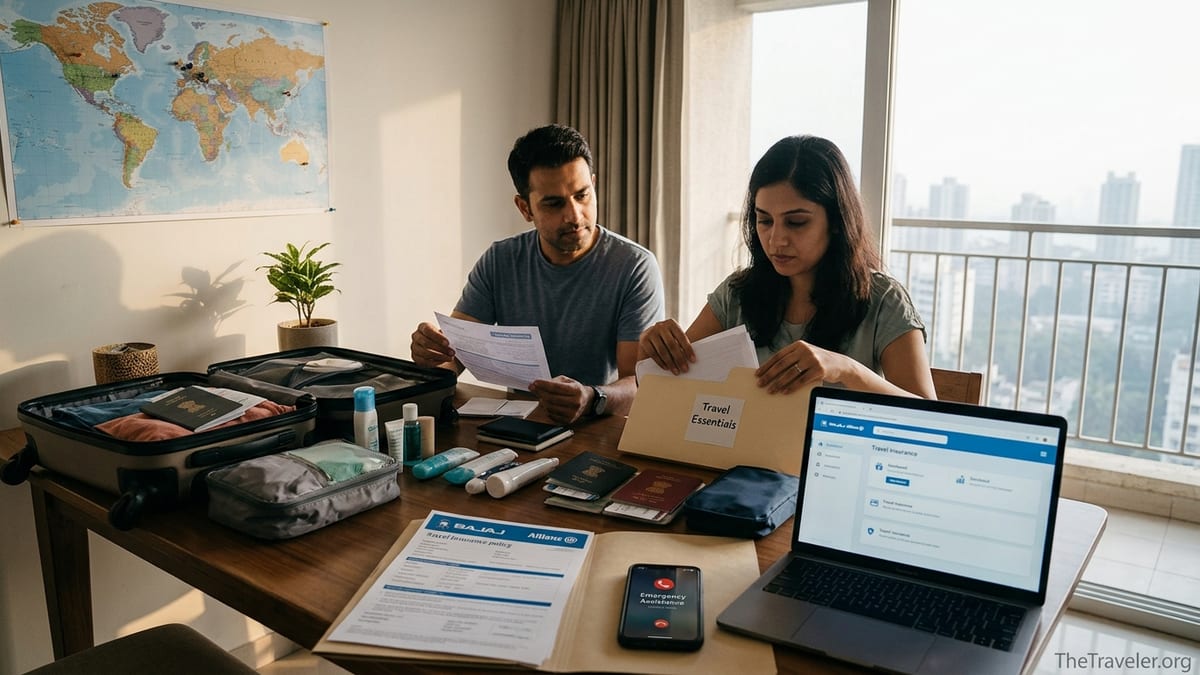
Understand What Your Bajaj Allianz Travel Policy Can Actually Do
Before you click “buy,” spend a few minutes understanding what Bajaj Allianz travel insurance is designed to cover. Their international products, such as Travel Prime or Travel Ace, typically focus on overseas medical emergencies, personal accident cover, baggage loss or delay, trip delay, and personal liability. For example, if you are a 32-year-old traveler from Mumbai flying to Paris for 10 days, a mid-level Travel Prime Individual plan is generally designed to help if you are hospitalized after a sudden appendicitis attack, your checked bag is lost at Dubai in transit, or your passport is stolen on the Paris Metro.
Equally important are the common exclusions that apply across most policies in India. Bajaj Allianz travel plans usually do not cover intentional self-injury, traveling against medical advice, non-urgent routine check-ups, or losses linked to illegal acts. Pre-existing medical conditions are often excluded except in very limited, explicitly mentioned scenarios in the policy schedule. If you have long-standing diabetes or heart disease, for instance, a heart attack related to these conditions abroad may not be covered unless the specific plan and schedule state otherwise.
Think of this step as setting realistic expectations rather than searching for a policy that covers everything. A traveler going on a two-week leisure trip to Thailand should not expect coverage for elective cosmetic surgery or planned dental procedures abroad. The policy is primarily there to protect you from unpredictable, sudden events that can cause serious financial strain, such as an emergency hospitalization in the United States, where even an overnight stay can run into thousands of dollars.
Once you understand these broad contours, it becomes easier to decide which events you are protecting yourself against and how much coverage you genuinely need. That clarity will guide every other step you take before departure, from sum insured selection to how you store your documents.
Choose the Right Bajaj Allianz Plan and Sum Insured for Your Trip
Your first concrete action before the trip is selecting an appropriate plan and sum insured. Bajaj Allianz offers different variants tailored to typical traveler profiles: individual leisure travelers, families, students, senior citizens and frequent corporate travelers. For example, a 24-year-old student heading to Germany for a two-year master’s program might look at a student-focused variant, while a 45-year-old IT professional visiting Singapore for a 5-day conference might pick a short-duration Travel Prime Asia or similar regional plan.
Destination and trip length should drive your sum insured choice. Medical costs in the United States, Canada and parts of Europe are significantly higher than in Southeast Asia. A family of four from Bengaluru traveling to Orlando for 10 days to visit theme parks might reasonably opt for a medical sum insured in the range that is typically recommended for the US market, while a solo traveler doing a 5-day shopping trip to Dubai may prefer a lower sum insured to keep the premium affordable. Study the available slabs on the Bajaj Allianz purchase page and check how the premium jumps with each higher band, then weigh that against your tolerance for risk.
Real-world example: Priya, a 29-year-old from Pune, is planning a honeymoon in Italy for 12 days with a total non-refundable trip cost of around ₹3 lakh (flights and hotels). She compares two Bajaj Allianz plans: one with a lower medical cover and minimal baggage benefits, and another that offers a higher medical limit and better baggage and trip delay cover for only a modest increase in premium, perhaps a few hundred rupees per person. Given that a single emergency MRI in Western Europe can cost more than that premium difference, she decides the higher cover is a rational choice.
Do not forget to match the “geographical scope” of the policy to the actual itinerary. If you are transiting through a country with very high medical costs, such as a long layover in New York en route to Mexico, ensure your chosen region includes that transit country. This is particularly important if you have separate tickets booked on low-cost carriers where a missed connection is more likely and medical help during transit might be required.
Buy and Activate the Policy at the Right Time
The timing of purchase can matter, especially for trip-related benefits. For international leisure travel, it is usually wise to buy Bajaj Allianz travel insurance as soon as your major trip arrangements are booked and you have dates and destinations confirmed. That way, if the plan you choose includes cancellation or curtailment benefits for reasons covered in the wording, you are protected during the lead-up to the trip as well, not just during your days abroad.
Consider a practical scenario: Arjun and Neha book return flights from Delhi to London in August for a New Year trip in late December. A couple of days later, they purchase a Bajaj Allianz travel policy covering the exact dates of travel, adding an extra day on either side to account for time zone differences and possible rescheduling. Two weeks before departure, Neha’s father is hospitalized with a serious, sudden illness. If their specific plan and wording recognize this as a valid trip cancellation reason, and the policy was already in force, they may be able to recover some or all of their non-refundable expenses, subject to limits and documentation, instead of bearing the full cost out of pocket.
When buying through an online aggregator or directly with Bajaj Allianz, double-check the policy start and end dates before paying. Many travelers accidentally start coverage from the date of purchase instead of the date of departure, or they forget to include the last day of the return journey. A traveler flying from Chennai to San Francisco, leaving on 5 July and landing back in India late night on 20 July, should generally set the coverage at least from 5 to 21 July to include the entire duration abroad and the return flight window.
Once payment goes through, Bajaj Allianz usually issues the policy document and schedule by email as a PDF. Treat this email as critical paperwork: save it to your primary email, forward it to a trusted family member and store a copy in a cloud drive you can access from any device. This single step, often overlooked, can make it far easier to show proof of insurance at immigration checkpoints or to a hospital overseas.
Fill in Details Carefully and Declare Existing Medical Conditions
Many travel insurance disputes start with small errors at the time of purchase. Before you travel, verify that the information on your Bajaj Allianz policy schedule exactly matches your passport, ticket and visa details. Names should be spelled as on the passport, with the same sequence of given name and surname. Your date of birth, passport number and trip dates should line up with your actual documents. Even seemingly minor typos can cause extra questions at claim time, particularly where identity verification is strict.
Be especially careful with medical history declarations where they are requested. Some Bajaj Allianz plans treat all pre-existing illnesses as excluded by default, while others may offer limited cover up to a specified amount if the condition has been declared and accepted by the insurer. For example, a 60-year-old traveler with well-controlled hypertension and type 2 diabetes planning a 10-day tour of Switzerland may be asked to answer medical questions during the proposal process. Skipping a mention of long-term blood pressure medication to keep the premium a bit lower can backfire badly if a stroke or heart-related issue occurs abroad and the insurer finds undeclared history in medical records.
Consider a concrete case: Suresh, 55, from Hyderabad, had a minor heart procedure three years ago but has been stable since. While buying travel insurance for a trip to Canada, he discloses the surgery and current medication in the online form. The system may either accept the risk with standard terms, offer a slightly higher premium, or, in some situations, limit or exclude related cardiac cover. Whatever the outcome, he now has written clarity in the policy documents. Had he hidden the condition and then required cardiac care in Toronto, there is a strong chance that part or all of the medical claim would be declined as a pre-existing, undisclosed risk.
If you are unsure whether a past condition counts as “pre-existing” or must be declared, it is safer to assume that any longstanding or recently treated illness, surgery or ongoing medication is relevant. Before your trip, you can contact Bajaj Allianz customer care or your insurance advisor to ask how to reflect this in the proposal. Get their clarification in writing where possible, such as an email summarizing what you disclosed and how the cover applies.
Save All Policy Documents, Assistance Numbers and Local Contacts
Once the policy is issued, your next pre-departure task is to organize key information so you can use the cover quickly in an emergency. Start with the policy document and schedule. Print at least one hard copy to keep in your cabin baggage, and if you are traveling as a family, give each adult traveler a copy. Many Bajaj Allianz documents include a short “emergency contact” section on the first or second page, which lists international assistance phone numbers and email addresses. Highlight this section physically or with a PDF annotation.
Store digital copies on your phone in at least two places: in your email app and in an offline folder within a file manager or note-taking app. Travelers often find themselves in a hospital waiting room with weak Wi‑Fi or no mobile data, trying to pull up their policy number. Having the PDF saved locally avoids that stress. Take a screenshot of the front page showing your name, policy number, validity dates and a key contact number, and set it as a favorite photo so you can access it in seconds.
Equally important is knowing how to reach Bajaj Allianz from abroad. The company publishes primary customer service and emergency assistance contact numbers on its website and documentation, including toll-free lines for India and specific lines for travel claim assistance and medical emergencies. Before leaving, program at least two of these numbers into your phone with clear labels such as “Bajaj Allianz Travel Medical Emergency” and “Bajaj Allianz Travel Claims India.” If you will be using a local SIM card at your destination, save the same numbers there as well.
To complete your preparation, compile a short physical card in your wallet listing your policy number, insurer name, and the main emergency assistance phone number, along with a line such as “In case of emergency, please contact this insurer.” If you are unconscious or unable to speak after an accident, hospital staff abroad often check wallets or phones for such information and may call on your behalf. This simple step can accelerate the process of getting a cashless guarantee from Bajaj Allianz’s assistance partner.
Coordinate Your Documents, Banks and Itinerary Before Departure
Using travel insurance smoothly often depends on more than just the policy itself. Before your trip, align your other documents and banking details with what Bajaj Allianz may need if you file a claim. At a minimum, ensure your passport details on the policy match the physical passport you are carrying. If you have recently renewed your passport after buying the policy, ask Bajaj Allianz or your broker to update the document before you travel so that there is no mismatch if a claim occurs.
Next, prepare basic financial and booking records. Keep digital copies of flight tickets, hotel confirmations, and major tour bookings in one folder, since insurers generally ask for proof of travel and proof of loss. For example, if your checked baggage is delayed by an airline on your way to Tokyo and you need to buy clothes and toiletries for two days, Bajaj Allianz will usually ask for the airline’s written confirmation of delay and receipts for the essentials you purchased. Setting up a simple system before departure, such as a dedicated email label and travel folder on your phone, means you are not searching through thousands of emails when you are already stressed.
Also review the banking method you will use for potential claim payouts. Bajaj Allianz in India typically settles approved claims via direct bank transfer to your Indian bank account. Confirm that the account details on file are correct, and if you plan to be away for an extended period, keep access to your Indian mobile number or arrange alternate verification methods with your bank. A traveler who spends six months on a student program in Spain but loses access to the Indian SIM linked to their bank may find it frustrating to complete two-factor authentication when a claim is finally settled.
Finally, cross-check your itinerary with any policy conditions. Some travel plans have maximum trip duration limits for a single policy. If you are combining multiple destinations and extended stays, make sure the total duration, including overnight transit, does not exceed the policy’s stated maximum. For instance, a young backpacker from Kolkata planning 60 days across Europe must choose a plan that expressly covers the full 60-day period; if the plan’s maximum is 45 days, he should either select a different variant or speak to Bajaj Allianz about extending coverage, rather than assuming extra days will be informally covered.
Know How to Use Assistance Services If Something Happens Abroad
The most important “usage” of Bajaj Allianz travel insurance before your trip is learning the basic steps to follow if something goes wrong once you are overseas. For medical emergencies, most travel policies expect you to contact the insurer or their appointed international assistance provider as soon as reasonably possible, especially for hospitalizations. Before you depart, read the claims and assistance section of your policy wording so you know what they will ask for: your location, nature of the emergency, treating hospital details, and your policy number.
Take a hospital scenario. Rhea, a 30-year-old traveler from Delhi, develops severe abdominal pain in Amsterdam and is taken to a nearby hospital by ambulance. Her partner, using the emergency assistance number saved earlier, calls Bajaj Allianz and provides the policy number and hospital details. The assistance team then coordinates with the hospital about payment arrangements. In many cases, they may arrange a cashless guarantee up to the covered amount, so Rhea does not have to swipe her own credit card for the entire bill, only for non-covered items such as some personal comfort charges if they arise.
For non-medical events such as baggage loss, trip delay or passport theft, the first step is usually to obtain documentation from local authorities or service providers. Before your trip, familiarize yourself with these requirements in your policy wording. If an airline misplaces your luggage on arrival in Rome, you typically need a Property Irregularity Report or written confirmation from the airline. If your passport is stolen in Bangkok, a police report and proof of passport re-issue from the Indian embassy or consulate will be key documents. Knowing this ahead of time helps you act methodically rather than panicking at the airport or police station.
It is also wise to understand what “deductibles” and limits apply. Some Bajaj Allianz travel plans include a deductible for certain covers, meaning you bear a small initial portion of the loss before the insurer pays the rest. For example, a policy might cover medical expenses abroad but require you to pay the first fixed amount yourself. Reading this section before traveling ensures that when a bill arrives, you are not surprised that the insurer does not reimburse a relatively small portion that falls under the deductible.
The Takeaway
Using Bajaj Allianz travel insurance effectively begins long before you board your flight. It starts with selecting the right plan and sum insured for your destination and trip length, and continues through accurate disclosure of your personal and medical details, careful checking of policy dates and documents, and well-organized storage of policy information and assistance contacts.
Practical preparation before departure makes a tangible difference when real-world problems occur abroad. A traveler who has saved the emergency number, kept receipts in one folder, and understood the basic claim requirements can move through a medical scare or a major baggage delay with far less financial and emotional strain. Someone who bought a policy at the last minute without reading it, misdeclared information, or cannot locate their policy number may find the safety net much harder to access.
If you are unsure about any detail, take the time before your trip to speak with Bajaj Allianz customer service or a licensed insurance advisor and to read at least the key sections of your policy wording. A single hour of preparation at home is often worth far more than the cost of the premium when you are facing a crisis in another country.
FAQ
Q1. When should I buy Bajaj Allianz travel insurance for my trip?
Ideally, buy your policy as soon as your major bookings are confirmed and at least a few days before departure, so your coverage period cleanly matches your travel dates and you may benefit from any pre-departure protections offered under your chosen plan.
Q2. Do I need to carry a printout of my Bajaj Allianz travel policy?
A printed copy is strongly recommended even though a digital copy is usually accepted. Hospitals, immigration officials or consular staff may find it faster to work with a paper document that clearly shows your policy number, validity dates and emergency contact details.
Q3. How do I contact Bajaj Allianz from abroad in a medical emergency?
Use the international emergency assistance number printed on your policy document, or the customer service contact listed in the travel insurance section of the Bajaj Allianz website. Save these numbers in your phone and on a physical card before you travel so you or hospital staff can reach them quickly.
Q4. Are pre-existing medical conditions covered under Bajaj Allianz travel insurance?
Many travel plans exclude pre-existing conditions, or cover them only on a limited basis if declared and specifically accepted in the policy schedule. Review your plan’s wording carefully, declare your medical history accurately at purchase, and confirm in writing what degree of cover, if any, applies to your particular condition.
Q5. What documents will I need if my baggage is delayed or lost?
Typically you will need the airline’s written confirmation of delay or loss, such as a Property Irregularity Report, along with boarding passes, baggage tags and receipts for essential items you purchased while your bags were missing. Organizing these documents from day one of your trip makes it easier to file a clear claim later.
Q6. Can I extend my Bajaj Allianz travel insurance if I decide to stay longer?
In many cases, extensions may be possible if requested before the original policy expires and if your overall trip duration stays within the plan’s maximum allowed period. You should contact Bajaj Allianz or your insurance intermediary as early as you know about the extension to check eligibility, revised premiums and any updated conditions.
Q7. What should I do if my passport is stolen abroad?
Report the theft to the local police as soon as possible, contact your country’s embassy or consulate to arrange a replacement travel document, and inform Bajaj Allianz using the emergency or claims contact. Keep copies of the police report and consular receipts, as these will typically be required when you submit a claim under passport or document cover.
Q8. Do I have to pay hospital bills myself and claim later?
For outpatient visits or minor treatments, you may pay upfront and seek reimbursement with bills and prescriptions. For serious emergencies and hospitalizations, Bajaj Allianz often works through an assistance provider to arrange cashless treatment up to covered limits, provided they are contacted promptly and the case meets policy conditions.
Q9. Can I buy Bajaj Allianz travel insurance after I have already started my trip?
Most standard policies are designed to be purchased before you leave your home country and may not be available once you are already abroad. Even where mid-trip purchase is technically possible, events that have already occurred or were foreseeable are unlikely to be covered, so it is far better to arrange the policy well in advance.
Q10. How long does it usually take for a Bajaj Allianz travel insurance claim to be settled?
Settlement times vary depending on the complexity of the claim, the completeness of documentation and any need for additional verification. Straightforward claims with clear paperwork can sometimes be resolved in a relatively short period, while complex medical or multi-country cases can take longer. Submitting all required documents promptly and responding quickly to queries helps speed up the process.