


More news on this day
Wildfire smoke is no longer just a local health concern. In recent summers, vast plumes have drifted across continents, turning skies hazy and forcing aviation officials to slow or stop traffic at major airports when visibility drops or airspace becomes congested by diversions and reroutes.
Get the latest news straight to your inbox!
Smoke, Visibility and Why Aircraft Slow Down
Wildfire smoke behaves like dense fog in the sky, scattering light and making it harder for pilots and controllers to maintain safe separation between aircraft. Publicly available guidance from aviation authorities highlights that poor visibility is one of the most common triggers for traffic flow restrictions, which can quickly cascade into delays across a region.
Modern jets rely on sophisticated instruments to land in low visibility, but the system around them still has limits. When smoke reduces what pilots and air traffic controllers can see out the window or via cameras around the airfield, airports often shift to what is known as low‑visibility operations. That typically means increasing the distance between takeoffs and landings and reducing the number of aircraft that can move on the ground at once.
The result is a slower, more cautious rhythm of arrivals and departures. Even if skies appear only slightly hazy to passengers in the terminal, the combination of degraded visibility and traffic management rules can cut the capacity of a busy hub by a significant margin, pushing flights into holding patterns or delaying departures at their origin.
Satellite and air quality data from agencies such as NOAA and NASA show that smoke from major fire seasons can travel hundreds or even thousands of kilometres from the source. That means airports far from any active blaze, including in the Midwest and Northeast of North America or across Europe, can experience visibility drops strong enough to affect flight operations.
How Air Traffic Managers Reroute Around Smoke
Beyond immediate visibility at a single airport, smoke also affects the wider network of routes that aircraft use. When thick plumes sit over busy corridors, traffic managers may shift aircraft to alternative paths or altitudes, much as they do around major storm systems. This kind of rerouting can add distance to a flight, increase fuel burn and push aircraft into already crowded sections of airspace.
In some cases, authorities introduce what are known as ground delay programs or en‑route flow restrictions. Published information from the Federal Aviation Administration shows that these tools are used when conditions, including smoke and other weather, reduce the number of flights that can safely enter or cross a particular region. Airlines are then assigned controlled departure times, holding aircraft at gates rather than sending them into airborne queues.
When smoke blankets large swaths of a country, rerouting options narrow. Flights that would normally take direct tracks across affected areas may need to fly longer arcs to stay in clearer air, which can create knock‑on congestion in neighbouring regions. Reports during recent summers in North America and southern Europe have highlighted days when smoke combined with storms or heat to push the air traffic system close to its limits.
International services can also be affected when smoke extends across borders. Canadian wildfires in recent years, for example, have sent smoke deep into the United States and across the Atlantic, with satellite imagery clearly showing impacts on transcontinental and transatlantic flight corridors on the worst days.
Temporary Flight Restrictions and Firefighting Airspace
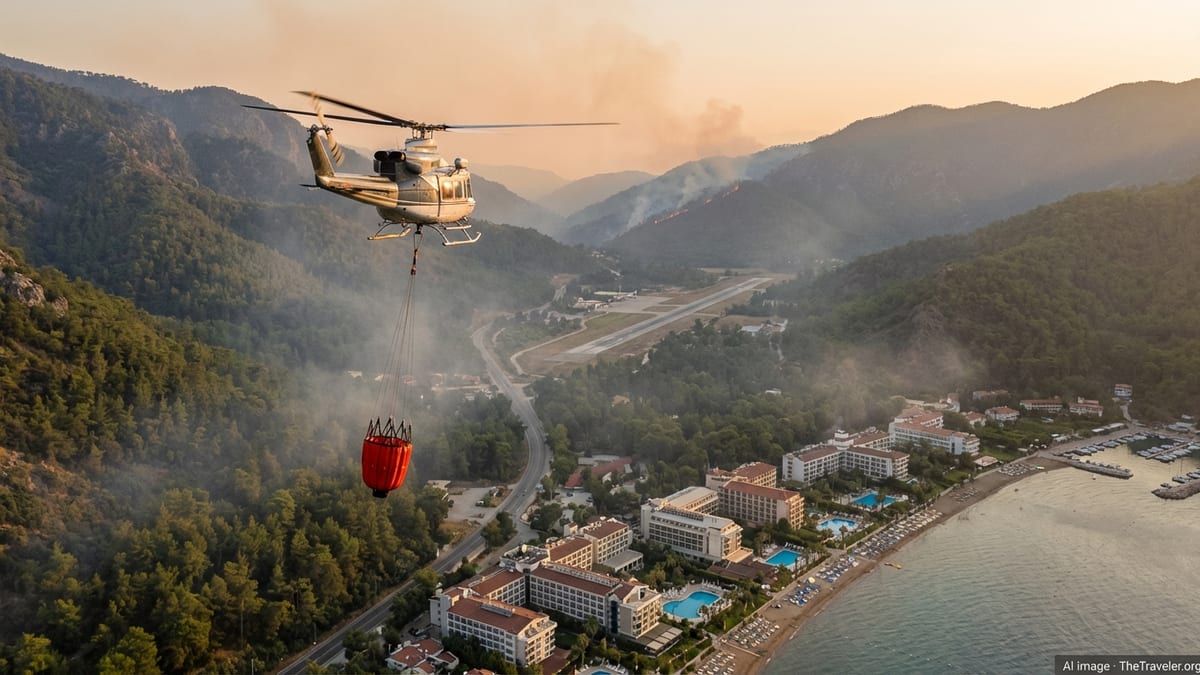
Wildfires themselves are surrounded by additional layers of airspace controls. Federal aviation documents describe how Temporary Flight Restrictions are established around active fires to give priority to firefighting aircraft and protect ground crews from rotor wash and other hazards. These restricted zones typically block most non‑emergency flights from entering.
While the restricted areas around a single fire may look small on a map, they are often placed in mountainous or remote regions that already have limited route options. Airliners that would normally overfly those regions at cruising altitude may be directed around them, adding minutes to flight times and creating new choke points in adjacent airways.
Firefighting activity itself can also influence nearby airports. When large air tankers, helicopters and support aircraft are operating at low altitudes, smaller regional fields sometimes dedicate part of their infrastructure to fire operations. Commercial flights may face departure holds or need to use different runway configurations, which can reduce capacity and cause localized delays.
Government and interagency bulletins published in early 2026 show that procedures for coordinating these restrictions are being refined as wildfire seasons lengthen and firefighting operations become more complex. For travellers, that translates into another layer of uncertainty during peak summer months in fire‑prone regions.
Health, Crew Safety and Ground Operations
Smoke affects more than what pilots can see. Fine particulate matter from wildfires, often referred to as PM2.5, can infiltrate aircraft cabins and airport buildings if filtration systems are not carefully managed. Scientific assessments over the last several years have underscored the health risks posed by repeated exposure to wildfire smoke, particularly for people with respiratory or cardiovascular conditions.
Airlines and airports are increasingly sensitive to crew health considerations on smoky days. If ground staff or flight crews report symptoms aggravated by poor air quality, operators may adjust shift patterns, reduce outdoor tasks or slow the pace of operations to limit exposure. That can mean fewer staff available to handle baggage, guide aircraft and perform maintenance, lengthening turnaround times between flights.
On the ramp, reduced visibility from smoke adds to safety concerns. Ground vehicles must move more slowly, and marshaling procedures for towing and parking aircraft can take longer. Even straightforward activities such as refuelling or catering can be delayed if visibility or air quality does not meet internal safety thresholds set by operators.
There is also growing interest in how well airport ventilation and filtration systems cope with repeated smoke episodes. Recent technical studies describe wildfire smoke as a particularly challenging test for HVAC filters, prompting some facilities to upgrade systems or adopt more frequent filter changes. During severe smoke events, terminals may limit access to outdoor observation decks or reduce ventilation from outside air, which can subtly change how passengers experience the airport environment.
What Travellers Can Expect in a Smokier Future
Climate research points to a clear trend toward hotter, drier conditions in many regions, with a corresponding rise in large, intense wildfires. Analyses of smoke exposure in western North America over recent decades indicate that wildfire smoke is now a recurring summer feature rather than a rare anomaly, and similar patterns are emerging in parts of southern Europe and other fire‑prone regions.
For air travellers, that means wildfire smoke is joining thunderstorms, snow and congestion as a routine source of disruption. On some days, the impact will be subtle, perhaps just a minor delay or a slightly longer flight path. On others, particularly when smoke coincides with storms or extreme heat, the combined effect can cause widespread cancellations and missed connections.
Publicly available air quality forecasts and smoke plume models are becoming more sophisticated, giving airlines and passengers better insight into when conditions might deteriorate. Meteorological services now frequently mention wildfire smoke in aviation and public forecasts, reflecting how central it has become to planning summer operations.
While individual flights remain overwhelmingly safe, travellers can expect that increasingly smoky summers will make schedules less predictable. Understanding how smoke influences visibility, routes, airspace restrictions and ground operations helps explain why a distant fire can delay a departure hundreds of kilometres away and why those disruptions are likely to become more common in the years ahead.