

More news on this day
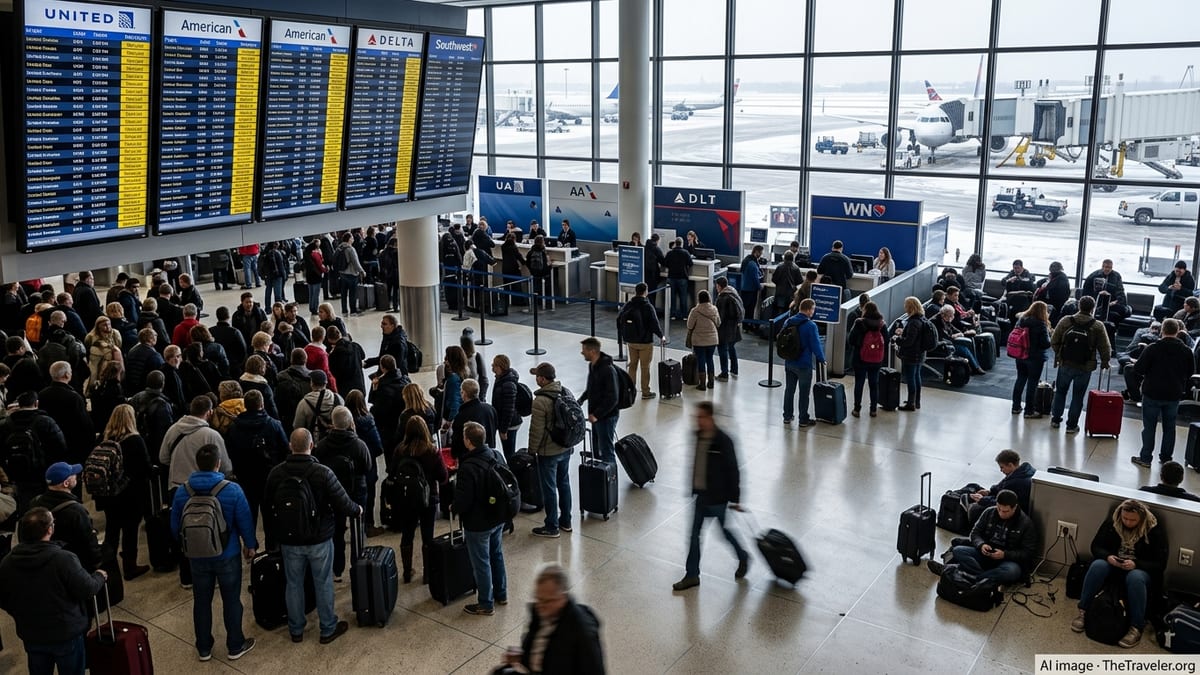
Passengers at Chicago O’Hare International Airport faced mounting frustration today as publicly available tracking data showed 314 flight delays and 5 cancellations, disrupting operations for major U.S. carriers and triggering knock-on effects across key hubs including New York, Los Angeles and Dallas.
Get the latest news straight to your inbox!
Ripple Effects Across Major U.S. Carriers
Data from widely used flight-monitoring platforms indicates that United Airlines, American Airlines, Delta Air Lines, Southwest Airlines and other operators all experienced schedule disruptions at O’Hare today. The delays spanned a mix of domestic and connecting routes, affecting morning departures as well as afternoon and evening banks that feed the national network.
United and American, the largest operators at O’Hare, appeared to shoulder the bulk of the impact, with regional affiliates also showing late departures and extended arrival taxi times. Delta, Southwest and several smaller carriers reported scattered delays that added to congestion on departure boards.
The pattern of staggered pushbacks, aircraft waiting for gates, and rolling crew and aircraft rotations contributed to longer-than-usual turnaround times. Publicly available information shows that while outright cancellations remained relatively limited compared with peak disruption events, the sheer number of delayed flights significantly affected passenger flows.
The situation at O’Hare fits a familiar pattern in which operational challenges at a key hub quickly radiate outward through airlines’ national networks, as late inbound aircraft and crews arrive behind schedule at their next destinations.
Nationwide Impact on New York, Los Angeles, Dallas and Beyond
Today’s disruption at O’Hare did not remain a purely local issue. Tracking data and published coverage show knock-on delays on routes linking Chicago to New York area airports, Los Angeles International Airport and Dallas Fort Worth, along with other major hubs such as Denver and Atlanta.
Flights scheduled to depart Chicago for New York and Los Angeles saw departure times pushed back, which in turn affected evening arrival banks and onward connections on the East and West Coasts. In Dallas, aircraft arriving late from Chicago compressed connection windows and in some cases required rebooking onto later services, especially on popular business routes.
Travelers on multi-leg itineraries connecting through Chicago reported extended layovers and missed connections as delay minutes accumulated over the course of the day. Even where flights eventually operated, the knock-on schedule changes meant that some passengers arrived several hours later than planned at final destinations thousands of miles from Chicago.
Because O’Hare serves as a central link in several domestic and international networks, disruptions on Chicago flights to and from coastal hubs can affect travelers as far afield as secondary cities that rely on those hubs for onward connectivity.
Weather, Congestion and Structural Strain
While a single cause for today’s delays was not immediately clear from publicly accessible information, recent weather patterns and operational constraints across the Midwest have increased pressure on airline and airport operations. Recent winter storms, thunderstorms and low-visibility conditions in the region have already led to several travel waivers this month, according to airline advisories and aviation-focused reports.
When weather-related restrictions limit the number of arrivals or departures that can safely use the runways in a given hour, flights begin to stack up both in the air and on the ground. This often triggers ground delay programs that hold departures at their origin airports until traffic eases in Chicago, which can quickly cascade into late arrivals, missed crews and aircraft out of position.
Chicago O’Hare is also in the midst of ongoing infrastructure and airfield modernization, and federal notices in recent weeks have highlighted upcoming schedule coordination efforts intended to manage peak congestion. When day-of-operations disruptions intersect with an already busy schedule, small delays can expand rapidly into an airport-wide slowdown.
Industry analyses published in recent years have repeatedly ranked Chicago, New York and Los Angeles among the country’s most delay-prone air travel markets, reflecting both their heavy traffic volumes and vulnerability to weather and airspace constraints.
Travelers Confront Long Lines and Changing Plans
Inside O’Hare’s terminals today, the combination of delayed departures and limited cancellations contributed to crowded gate areas and longer lines at customer service counters. Passengers seeking to adjust itineraries, secure meal vouchers or confirm seats on later flights often faced extended waits as airline staff worked through backlogs.
Many travelers turned to airline mobile apps and self-service kiosks to rebook missed connections or stand by for alternative flights. Publicly available guidance from carriers encourages travelers in disruption scenarios to use digital tools first, since seats on remaining departures can fill quickly once delays begin to accumulate.
Families with children, international travelers facing tight connection windows and business passengers with same-day commitments were among those most acutely affected by timing shifts. Even in cases where flights ultimately operated with modest delays, uncertainty about departure times and gate changes added stress to an already busy travel day.
Reports indicate that some travelers opted to abandon same-day air travel altogether on shorter routes, turning instead to trains or rental cars when schedule confidence fell and extended delays became apparent on departure boards.
What Today’s Disruptions Mean for Upcoming Travel
Operational experts often note that a heavy day of delays at a major hub like Chicago O’Hare can create residual challenges for airlines over the following 24 to 48 hours. Aircraft and crews that finish the day in unexpected locations may force further schedule adjustments, especially on early-morning departures.
Airline advisories and recent experience suggest that travelers with upcoming flights touching Chicago, New York, Los Angeles, Dallas or other large hubs should monitor flight status closely, check in early, and allow additional time for connections when possible. Even when weather improves, aircraft and crew realignments can take time to normalize.
Analysts point out that periods of heightened disruption also highlight broader structural issues in the U.S. air travel system, including tight staffing margins, congested airspace around major hubs and the challenge of maintaining on-time performance in the face of increasingly volatile weather patterns.
For now, publicly available tracking shows that most of today’s affected flights are operating, albeit late, and that cancellations remain relatively limited. Travelers, however, are likely to feel the impact of those delays well beyond Chicago as the ripple effects work their way through evening and next-day schedules across the country.